Gaming before bed disrupts sleep through three stacked mechanisms, and only one of them is the screen. First, competitive play is physiologically arousing — adrenaline, elevated heart rate, and a brain in fight-or-flight don’t switch off when the match ends. Second, bright light close to your face in the evening can delay melatonin, the hormone that signals it’s time to sleep. Third — and usually the real killer — the “one more match” loop has no natural stopping point, so a 30-minute session quietly becomes 2 a.m. The result researchers keep finding: later bedtimes, longer time to fall asleep, and shorter sleep overall. The good news is that you don’t have to quit gaming to fix it — you have to change when and how you stop.

Why does late-night gaming keep you awake?
Because your body treats a ranked match like a real confrontation. Competitive play triggers the stress-arousal system: heart rate climbs, adrenaline flows, attention narrows. That’s exactly what makes gaming fun — and exactly what sleep can’t coexist with. Sleep onset requires the opposite state: low heart rate, low vigilance, a brain willing to stop scanning for threats.
The problem is that arousal doesn’t end when the match does. Researchers studying evening gaming have found that markers of activation — heart rate, alertness, self-reported “wiredness” — stay elevated for a while after intense play. If you close the game at 00:30 and get into bed at 00:35, your body is still mid-fight. That’s why you lie there replaying the clutch you missed: the game is over, but your nervous system didn’t get the memo.
Intensity matters more than genre labels. A tense ranked shooter, a close fighting-game set, or a raid with your guild all spike arousal. A slow farming sim or a chill puzzle game barely moves the needle. The question isn’t “did I game tonight?” — it’s “how activated was I, and how close to lights-out?”
Is it the blue light, or the game itself?
Both — but for gamers, the game itself is the bigger half, and that’s what makes this different from ordinary screen time. The light story is real but often overstated: evening exposure to bright, blue-heavy light can suppress and delay melatonin, pushing your internal clock later. Studies suggest the effect depends on brightness, distance, and duration — a dim monitor across the room is not a phone six inches from your face. We’ve covered the general light-and-screens picture in screen time and sleep.
What that general picture misses is interactivity. Watching a show is passive; playing is participation. Your inputs matter, outcomes are uncertain, and there are stakes — rank, teammates, pride. That combination produces a level of cognitive and emotional engagement no night-mode filter can fix. You can turn your screen fully orange and still be furious about a lost round. Blue-light glasses solve the smallest of your three problems.
Why can’t you stop at “one more match”?
Because modern games are engineered with no natural stopping point — and your own psychology fills in the rest:
- Matches are short and queues are instant. A 20-minute match with a 30-second queue means the cost of “one more” always feels trivial. There’s no chapter end, no credits, no natural exit ramp.
- Outcomes are variable rewards. You might stomp, you might get stomped, you might have the game of your life. Unpredictable payoffs are the stickiest reward schedule known to behavioral science — the same one slot machines and social feeds run on.
- Nobody wants to end on a loss. A bad game triggers “one more to end on a win.” Lose that one and you’re tilted, which guarantees another. This single rule — the outcome of the last match decides whether you play another — is how midnight becomes 3 a.m.
- Night is when your time is finally yours. For a lot of working adults and students, late-night gaming is less about the game and more about reclaiming stolen hours — the same engine behind revenge bedtime procrastination. Recognizing that changes the fix: you don’t need more discipline at midnight, you need protected leisure time earlier.
What does the research actually say?
Honestly: suggestive, not damning. Studies on gaming and sleep consistently find that evening and nighttime gaming is associated with later bedtimes, longer sleep-onset time, and shorter total sleep, especially in teens and young adults. Some experimental work suggests intense evening play measurably raises pre-sleep arousal and can reduce sleep quality that night. Findings on deep-sleep and REM changes are more mixed, and effect sizes in many studies are modest.
Two honest caveats. First, much of the research is correlational — people with poor sleep may also be more drawn to late-night gaming, and the causation likely runs both ways. Second, individual variation is huge: some players genuinely wind down with a quiet game, and the research doesn’t support treating all gaming as a sleep toxin. The pattern to worry about is specific: competitive, engaging play, close to bedtime, with no stopping rule. That trio shows up again and again in the studies that find real harm.
| Game type | Arousal level | Last-match cutoff before bed |
|---|---|---|
| Ranked / competitive (shooters, MOBAs, fighting games) | High — adrenaline, tilt, stakes | 90+ minutes |
| Online co-op / MMO raids with friends | Medium-high — social pressure, no pause | 60–90 minutes |
| Single-player story or action | Medium — engaging but pauseable | 60 minutes |
| Cozy / puzzle / management sims | Low — calm, low stakes | 30 minutes |
A gamer’s wind-down protocol that actually works
The goal is not “stop gaming.” It’s ending on time and landing the plane — tapering arousal so sleep is possible when your head hits the pillow.
- Set the last match by the clock, not the outcome. Before you queue, decide: “queue closes at 23:00 — whatever game is running then is my last.” Wins and losses no longer get a vote. This one rule removes the “end on a win” trap entirely.
- Taper intensity in the final hour. If you want to keep playing late, switch from ranked to something low-stakes — casual modes, a cozy game, aim training with a podcast. Think of it as a cooldown lap, not a cold stop.
- Do a real cooldown, off-screen, for 30–60 minutes. Shower, stretch, tidy the desk, music, a few pages of a book. Your heart rate needs the runway. Going straight from a clutch round to a dark bedroom is asking your body to teleport between states.
- Kill the post-game scroll. The most common failure mode: you log off responsibly at 23:00, then lose 90 minutes to Discord, YouTube recaps, and TikTok in bed. Charge the phone outside arm’s reach — we’ve written a whole playbook on how to stop scrolling in bed.
- Move your sweatiest sessions to mornings or weekends. Competitive gaming when you’re fresh is genuinely better: reaction time and decision-making degrade when you’re sleep-deprived, so late-night ranked is often you playing your worst and sleeping badly to do it. A Saturday-morning session costs your sleep nothing.
“I kept telling myself I’d stop at midnight, but a loss at 23:50 meant one more, and one more. What fixed it was stupidly simple: queue closes at 23:00, last match plays out, then shower and 20 minutes of a novel. My rank actually went up — turns out I was donating MMR every night after 1 a.m.” — Marco, 27, software developer and ranked Valorant player
How does Unscrol help you log off at night?
Start with the free, built-in tools — they’re better than most people think. Consoles have them: the Switch has bedtime alarms, and PlayStation can show playtime and set limits. On PC, a simple alarm plus a “queue closes” rule goes a long way. And on your iPhone, Apple’s own Screen Time can schedule Downtime at your cutoff hour so mobile games and social apps go quiet.
The catch, as every gamer knows, is that self-imposed rules are exactly the kind you renegotiate at 23:58. That’s where Unscrol comes in — an iPhone app (iOS 16+) built on Apple’s Screen Time frameworks, so its blocks are real, system-enforced shields, not polite reminders. Everything is processed on-device: your block lists and usage never touch our servers.
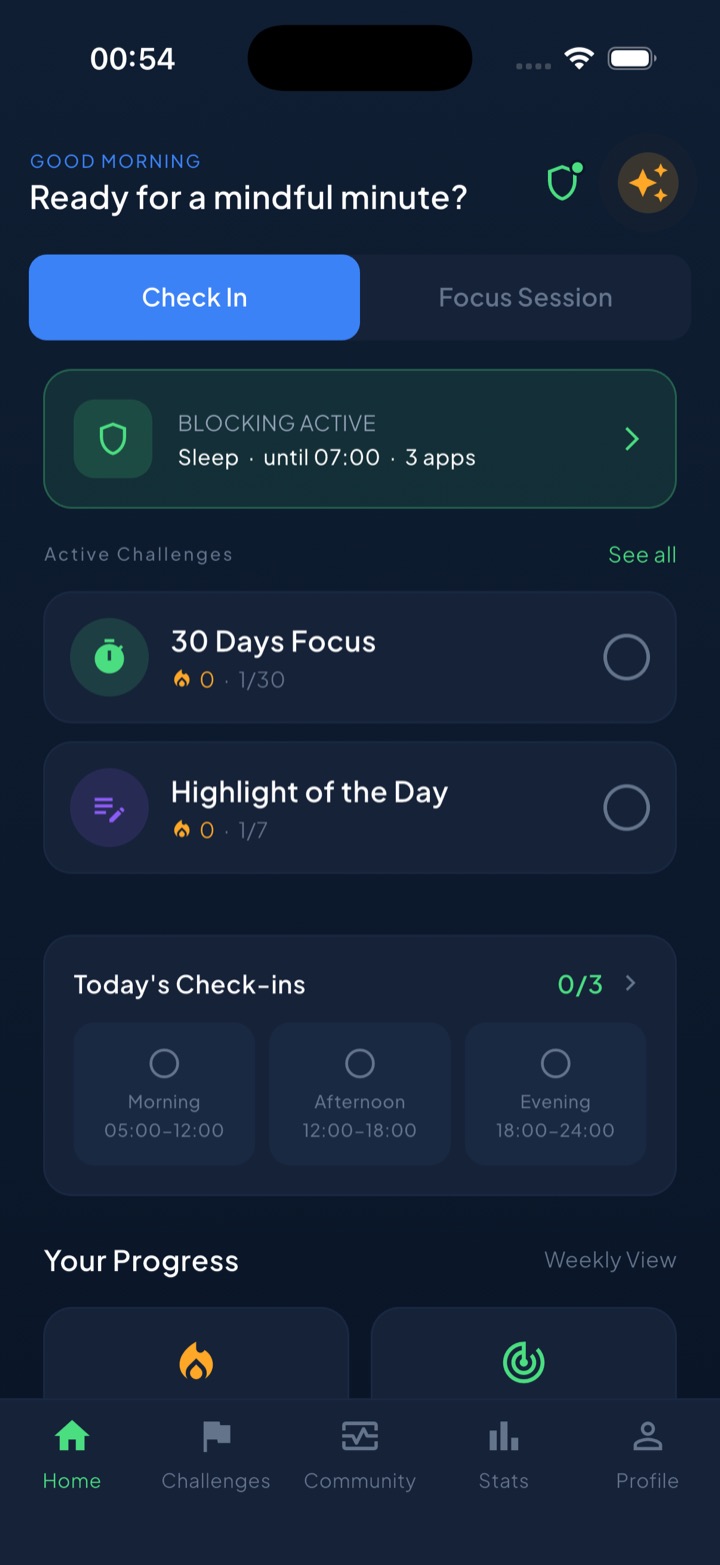
Here’s how it maps onto the protocol:
- A scheduled Sleep routine ends the night for you. Set a block window from, say, 23:00 to 07:00 and your mobile games, Discord, YouTube, and TikTok are shielded — which also kills step 4’s post-game scroll before it starts. If something genuinely urgent comes up, a short “take a break” bypass exists; it’s a deliberate speed bump, not a wall.
- Honest limitation: Unscrol runs on your iPhone, so it can’t force-quit your PC or console. But in practice the phone is what turns a 23:00 logoff into a 1 a.m. bedtime — block that half of the night and the clock rule for the other half gets much easier to keep.
- Streaks make the new bedtime stick. Daily check-ins and a unified streak turn “I went to bed on time again” into a visible run you won’t want to break — the same score-chasing instinct, pointed at sleep.
The honest version: a clock rule, a cooldown ritual, and Apple’s free tools can absolutely fix late-night gaming. Unscrol is the enforcement layer for the nights when “one more match” is winning the argument.
Frequently asked questions
Is gaming before bed bad for your sleep?
Often, yes — but not because games are uniquely evil. Late-night gaming combines three things that each work against sleep: physiological arousal from competitive play (elevated heart rate and adrenaline that take time to fade), bright screen light close to your face, and a reward loop with no natural stopping point. Studies suggest evening gamers fall asleep later and take longer to drift off. Calm, single-player games at moderate volume an hour or more before bed are far less disruptive than ranked matches at 1 a.m.
How long before bed should you stop gaming?
A practical rule of thumb: end competitive or intense games 60–90 minutes before your target bedtime, and calmer games about 30–60 minutes before. The point of the gap is physiological — your heart rate, adrenaline, and mental engagement need time to come down before your body will accept sleep. If you regularly lie in bed replaying a lost round in your head, your buffer is too short. Fill the gap with a genuine cooldown: shower, stretching, music, or reading.
Why is it so hard to stop at one more match?
Because matches are short, queues are instant, and outcomes are unpredictable — the same variable-reward structure that makes slot machines and social feeds sticky. On top of that, most players hate ending on a loss, so a bad game triggers 'one more to end on a win,' which can chain for hours. The fix is to decide your last match by the clock before you start playing, not by the outcome after you finish one.
Is gaming before bed worse for sleep than watching TV?
Research on this is still limited, but the mechanics point that way: TV is passive, while gaming is interactive, goal-driven, and often competitive — your body is participating, not just watching. Studies comparing active versus passive screen use before bed suggest interactive play produces more arousal and longer time to fall asleep. That said, both keep you up past your bedtime if there's no stopping rule; autoplay episodes and ranked queues exploit the same weakness.