Apps that pay you to stay off your phone do work in the short term — but the payout is almost never the reason. Most of them hand out tiny amounts (typically a few cents of gift-card credit per focused hour, often funded by ads), and decades of motivation research show small external rewards fade fast once the novelty wears off. What actually keeps people off their phones is a mix the cash apps mostly miss: something you don’t want to lose (a streak, or your own money on the line), visible progress, and real blocking so the reward isn’t competing with a wide-open feed. The strongest apps in this category aren’t the ones that pay you — they’re the ones where you stand to lose something.
How do apps that pay you to stay off your phone actually work?
There are really four models hiding under one headline. Cash and gift-card apps credit you a small amount for logged focus time — usually a few cents per hour, funded by ads or brand offers, and cashed out as a gift card once you clear a threshold. Charity apps turn your focus time into a donation instead of personal cash, so the “reward” is knowing you did some good. Virtual-stakes apps like Forest give you a tree that grows while you stay off your phone and withers if you leave early; some pair those in-app coins with a real tree-planting partnership. Deposit or stakes apps flip the whole thing around: you put your own money on the line and lose it if you break your own rule.
Notice the split. The first three give you something. The last one threatens to take something away. That distinction turns out to matter more than the dollar amount — which is exactly where the psychology comes in.

Do the payouts actually change your behavior?
Short answer: a little, and then less and less. Two well-documented effects explain why.
The first is the overjustification effect. When you start paying someone to do something they might have done for their own reasons, the external reward can quietly crowd out the internal motivation. Once the payments stop — or shrink to pennies — the behavior often drops below where it started. A reward meant to build a habit ends up renting it instead.
The second is loss aversion. Research on how we weigh gains against losses suggests that losing something feels roughly twice as powerful as gaining the same thing. That’s why “earn eight cents for an hour off Instagram” barely registers, while “you’ll lose the $15 you put down” genuinely changes what you do at 11 p.m. The apps with the strongest track record aren’t generous — they’re the ones where you have skin in the game. This is the core idea behind commitment devices: you bind your future self in advance, while you’re thinking clearly, so the tempted version of you can’t easily wriggle out.
The catch with pure cash apps is that the payouts are tiny by design. No ad-funded app can pay you enough per hour to outweigh what an algorithmic feed is worth to its advertisers. So the money is real, but it’s rarely the thing keeping you off your phone.
Which reward model is actually worth it?
Here’s an honest comparison of the main categories:
| Model | How you’re rewarded | Real-world effect | Watch out for |
|---|---|---|---|
| Cash / gift-card | Cents per focused hour, ad-funded | Weak and short-lived; novelty fades | Ads, data collection, tiny payouts |
| Charity / donation | Your focus time becomes a donation | Nice framing, but easy to ignore | No real cost to quitting |
| Virtual stakes (e.g. Forest) | A tree grows or dies; some plant real trees | Surprisingly sticky for a gentle model | Purely symbolic once you stop caring |
| Deposit / stakes | You lose your own money if you fail | Strongest effect per the research | Real financial risk if life gets in the way |
| Gamified blockers | Streaks, points, leaderboards + blocking | Durable when paired with real shields | A streak alone won’t stop a determined tap |
The pattern is clear once it’s laid out. The models that lean on your loss — your money, your streak, your tree — outperform the ones handing you a few cents. And the strongest of all combine a reward you care about with actual blocking, so willpower isn’t left doing all the work.
What actually keeps you off your phone?
If cash isn’t the answer, what is? In practice, three ingredients do the heavy lifting — and you can assemble them for free.
- Attach a cost to failure. A streak works because breaking it hurts a little — which is exactly the loss-aversion lever the cash apps waste. If you slip, the goal is to restart fast, not to spiral; here’s what to do when you lose your streak without quitting for good.
- Make progress visible. A number that goes up — days clean, sessions finished, a chart trending down — gives your brain the small hit of feedback that a feed hijacks. This is a big part of why streaks build habits more reliably than a distant payout ever could.
- Close the door. Rewards fail when the temptation is one tap away. Real blocking removes the decision entirely, so you’re not relying on willpower at the exact moment it’s weakest.
“I chased three of those ‘get paid’ apps for a month and cashed out about the price of a coffee. What finally worked wasn’t the money — it was not wanting to break a 40-day streak. The streak felt like mine. The eight cents never did.” — Marcus, product designer, 29
The takeaway isn’t that reward apps are scams — plenty are legit. It’s that the reward doing the real work is almost never the cash. It’s the version of you that doesn’t want to lose something they’ve built.
How does Unscrol help you stay off your phone?
If you just want the free route first: any iPhone can already build a reward loop. Set up Screen Time, add app limits or Downtime, and track your own streak in a habit app or even a paper calendar. That combination costs nothing and works — it’s the honest baseline, and for many people it’s enough.
Unscrol exists for the part that’s hard to keep up on your own: consistency. It doesn’t pay you money. Instead it makes the reward the thing that actually sticks — a unified daily streak you earn with a single mood or urge check-in or by finishing one of 45+ challenges, a leaderboard if competition motivates you, and honest guess-vs-real screen time reports so the progress is undeniable.
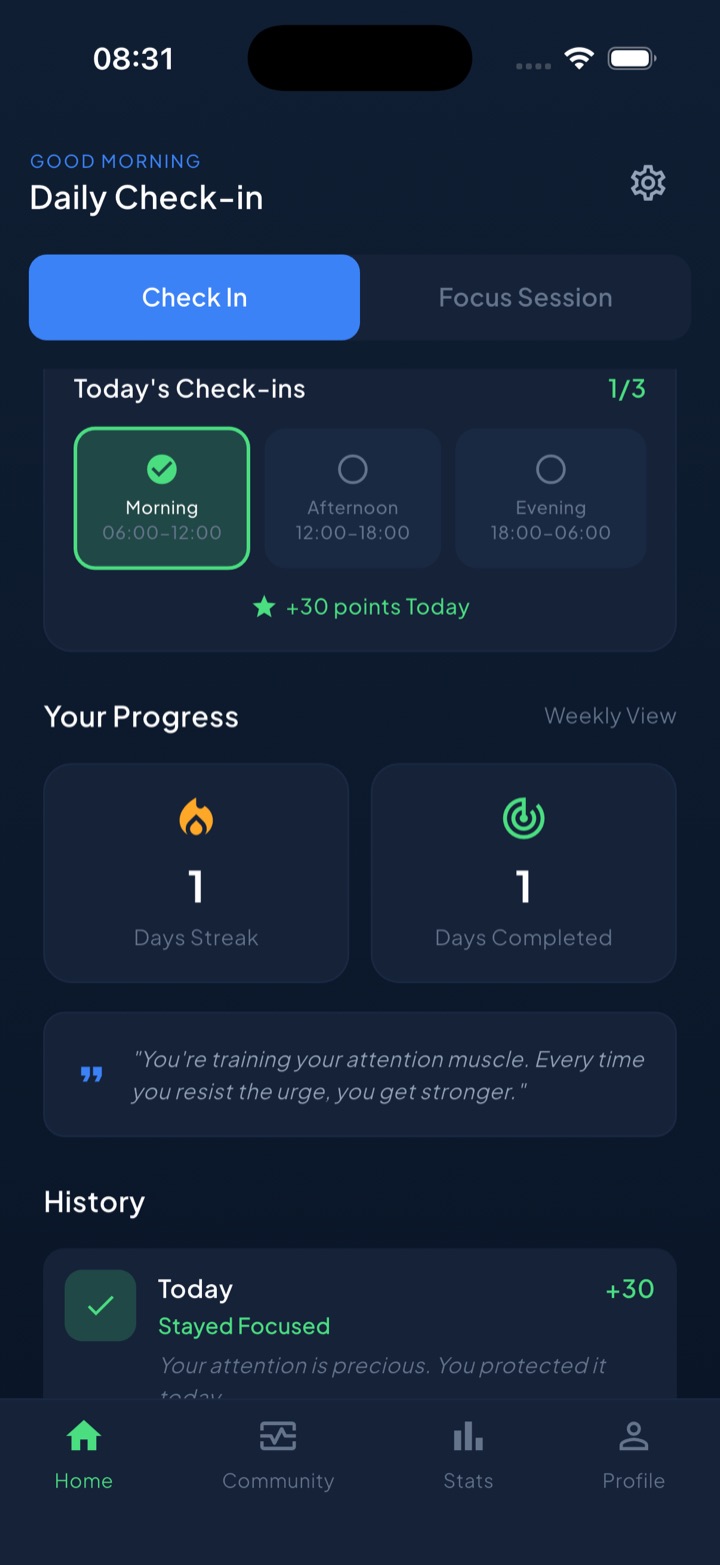
Crucially, the reward isn’t fighting an open door. Unscrol uses Apple’s official Screen Time frameworks to put real, system-enforced shields on the apps and categories you choose — on schedules like Sleep 22:00–07:00 or Work 09:00–17:00, plus focus sessions with a countdown in the Dynamic Island. A short “take a break” bypass exists for the moments you genuinely need one, so it’s a firm middle ground rather than a wall you’ll resent and delete. Your block lists and usage stats are processed on-device by iOS and never reach Unscrol’s servers. It’s free to download; Pro adds only a Streak Saver (2 per week) that rescues a single fully-missed day. No cents per hour — just a streak worth protecting and the shields to protect it.
Frequently asked questions
Do apps really pay you to stay off your phone?
Yes, a few genuinely do — but the amounts are small. Most cash and gift-card apps credit you a fraction of a cent to a few cents per focused hour, funded by ads or brand offers, and you cash out only after clearing a threshold. Others convert your focus time into charity donations or virtual rewards instead of personal money. The payment is real, but no ad-funded app can pay enough per hour to outweigh what an algorithmic feed earns from your attention. Treat the cash as a nudge, not an income.
What app pays you the most to not use your phone?
There's no honest single answer, because payouts shift constantly with ad rates and change by country, and any app promising large sums is usually the one to distrust. As a rule, cash and gift-card apps pay only cents per hour, so the difference between the 'highest' and 'lowest' payer is tiny in practice. If your real goal is spending less time on your phone, a deposit or stakes app — where you lose your own money if you fail — tends to change behavior far more than any app trying to pay you.
Are apps that reward you for not using your phone worth it?
They can be worth trying, but not for the reward itself. External payouts work briefly and then fade, and can even weaken the habit once they stop — an effect psychologists call overjustification. What lasts is a streak you don't want to break, visible progress, and real blocking so the reward isn't fighting a wide-open app. If a reward app gives you those, keep it. If it's only paying you pennies while your feed stays one tap away, it probably won't hold.