Take your daily screen time average and multiply it by 365. That is the whole exercise, and it is more persuasive than any argument about attention or dopamine, because it converts an abstract habit into something you already know how to value: days. Your number is in Settings > Screen Time on iPhone. Look at the weekly average, not today’s, and resist the urge to subtract the hours you consider legitimate — we will get to those.

The arithmetic
| Daily average | Hours per year | Full 24h days per year | Over 50 adult years | Share of waking hours |
|---|---|---|---|---|
| 2 hours | 730 | 30 days | 4.2 years | 13% |
| 3 hours | 1,095 | 46 days | 6.2 years | 19% |
| 4 hours | 1,460 | 61 days | 8.3 years | 25% |
| 5 hours | 1,825 | 76 days | 10.4 years | 31% |
| 6 hours | 2,190 | 91 days | 12.5 years | 38% |
| 7 hours | 2,555 | 106 days | 14.6 years | 44% |
Waking share assumes sixteen waking hours a day. The fifty-year column assumes your current average holds, which it probably will not — but it has held for most people for the last decade, and the direction of travel has not been downward.
Find your row. Sit with it for a second before reading on, because the next paragraph is the one that usually lands.
At four hours a day, you are spending two months of every year on your phone. Not two months of spare time — two full calendar months, sleeping hours included. That is longer than most people’s total annual leave, doubled.
The comparison that actually lands
Big numbers go numb quickly. Small ones do not. So convert it into things you already measure:
- Four hours a day is 61 days a year. Roughly the length of a school summer holiday.
- One hour a day is 365 hours a year — about 46 eight-hour working days, or nine working weeks. If someone offered you nine extra weeks a year, you would take it without asking what for.
- Thirty minutes a day is 182 hours a year. That is a language to conversational level, or a marathon trained for from nothing, or roughly 45 books at four hours each.
- Two hours a day is 30 full days a year — a month, gone, annually, with no memory attached to it.
None of these are arguments for zero. They are units of exchange. The question is not “is your screen time too high”, it is what you would rather have bought with those nine weeks.
“I did the maths on a train and got 6.2 years. I am 34. That is not a statistic about society, that is six years of my actual life that I will not be able to describe to anyone.” — Kasia, veterinary nurse, 34
The honest correction
The table above is deliberately blunt, and blunt is misleading in three specific ways. Correct for them before you spiral.
Not all of it is scrolling. Maps while driving, a video call with your parents, an audiobook on a walk, a two-hour train journey spent reading. All of that counts in your Screen Time figure and none of it is what you are worried about. Look at the category breakdown, not the total.
Background audio inflates the number. A podcast playing with the screen off logs hours against an app. Many people’s “entertainment” figure is largely a commute.
Screen time is not automatically loss. Time you chose, spent on something you would defend, is not the same as time that happened to you. The distinction that matters is not screen versus no screen — it is the session you started and ended deliberately versus the one that started when you were bored and ended when you were exhausted.
So do the exercise twice. Total first, for the shock. Then again with only the categories you genuinely regret — usually social and entertainment. That second number is the real one, and for most people it is between one and three hours a day. Which is still, at two hours, a month a year.
What one hour a day is actually worth
The most useful reframe is not to aim at your total. It is to aim at one hour, and to know exactly what you are buying with it.
One hour a day back, sustained for a year:
- A book every fortnight, comfortably — 26 books
- Enough movement to change how your body feels, not just how it looks
- An hour of sleep, which changes everything downstream of it
- A side project that actually ships rather than one that stays a plan
- Or nothing structured at all: 365 hours of not being reached, which is its own thing
One hour is achievable in a way “cut my screen time in half” is not. And it usually comes from a very small number of specific places — the hour after waking, the hour before sleep, and the drift between 21:00 and midnight. See how to reduce screen time for where it typically hides.
Why the number alone does not change anything
Here is the part most articles like this leave out. Being shocked by your screen time does not reduce your screen time. Almost everyone reading this has already seen their weekly report, already felt bad about it, and already carried on exactly as before. Information is not friction.
The arithmetic is useful for one thing only: deciding that it is worth doing something structural. What actually moves the number is changing where the phone is, when it is available, and what fills the gaps it leaves — environment design, not resolve. If a report was going to fix this, it would have fixed it by now.
There is one exception, and it is worth knowing: the guess. Write down what you think your daily average is before you look. Then look. The gap between the two is far more affecting than the number on its own, because it is not a fact about screens — it is a fact about how badly you can misjudge your own days.
How does Unscrol help?
The whole calculation above is free, and your number is already on your phone in Settings > Screen Time. If reading it is enough to change something, you do not need anything else.
Unscrol exists for the gap between knowing and changing. It is an iPhone and Apple Watch app built on Apple’s Screen Time frameworks, so blocks are enforced by iOS rather than by a cosmetic overlay.
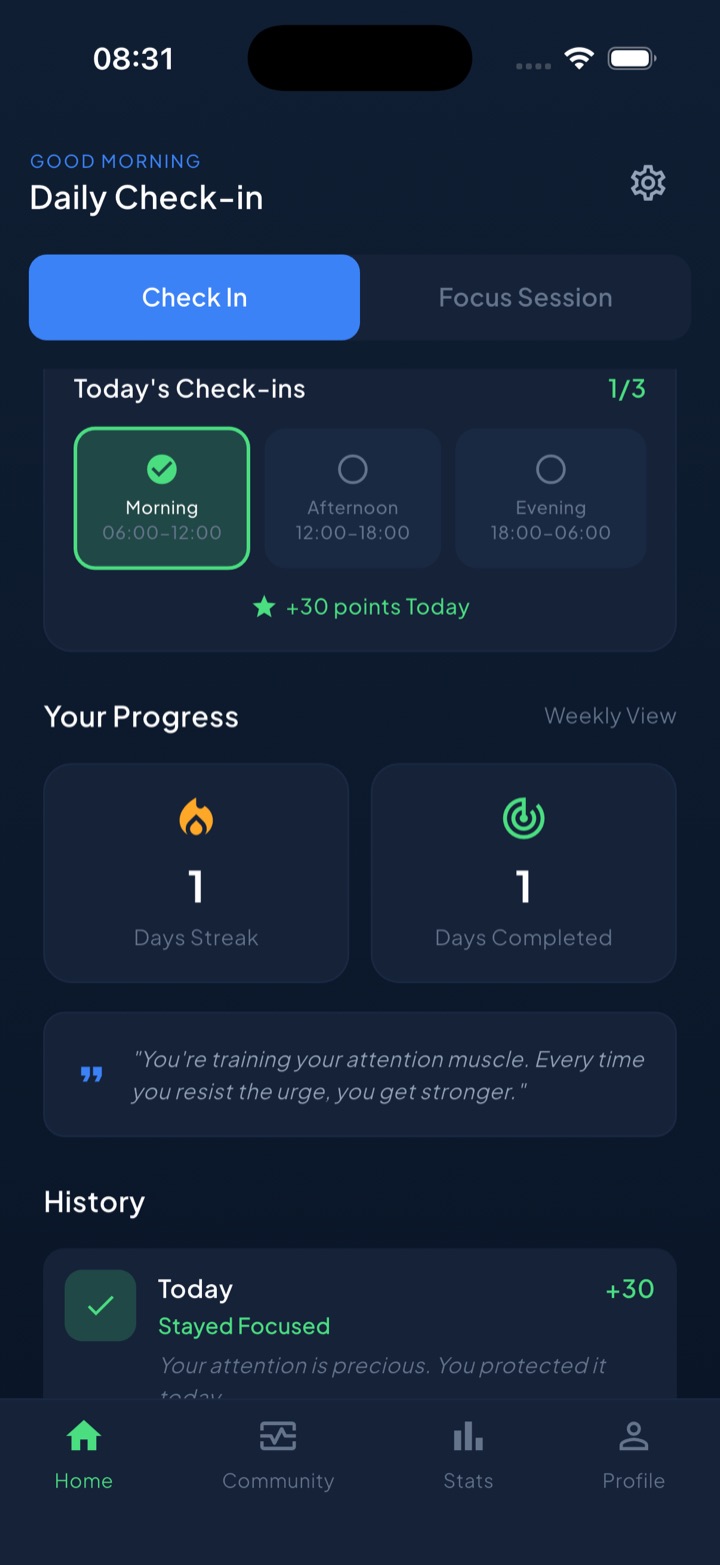
It is built around the guess described above: a guess-versus-real check asks for your estimate first, then shows the actual figure, because the gap moves people in a way a raw chart does not. Scheduled blocks target the specific windows where the hour actually goes — the hour before sleep, the drift after nine — so the decision belongs to the version of you who set it this morning rather than the one on the sofa. A unified daily streak grows on any day you complete a quick check-in or one of 45+ challenges, which turns an abstract annual figure into something with a daily unit. Block lists and usage data are processed on-device by iOS and never reach Unscrol’s servers. Free to download; the optional Pro tier adds a Streak Saver that rescues a single missed day, twice a week. One hour a day is nine working weeks a year. It is worth some structure.
Frequently asked questions
How many years of your life do you spend on your phone?
It depends entirely on your daily average, and the arithmetic is easy to do yourself. Four hours a day is 1,460 hours a year, which is just under 61 full 24-hour days. Sustained across fifty adult years that is roughly 3,040 days, or about eight years and four months of waking and sleeping time combined. Measured against waking hours rather than the full day, four hours a day is a quarter of every hour you are conscious. Your own number is in Settings under Screen Time, and it is usually higher than people guess.
What is a normal amount of screen time per day?
Reported averages vary a lot by country, age, and how the measurement is taken, and most widely quoted figures for adults land somewhere between three and five hours a day of mobile use. That range is wide enough that comparing yourself to an average is not very useful. The more informative comparison is against your own number from six months ago, and the more useful question is what the time displaced — sleep, exercise, reading, people — rather than whether it beat a national figure.
Is all screen time bad?
No, and treating it as one quantity is why most reduction attempts fail. Two hours spent video-calling family, reading, navigating, or learning something is not the same as two hours of feed you cannot remember afterwards. The distinction worth drawing is between time you chose and time that was chosen for you. If you opened the app with a purpose and left when it was met, the hours are not the problem. The hours that matter are the ones that happened to you rather than the ones you spent.