Bed rotting is the Gen-Z name for spending long, unstructured hours lying in bed — scrolling, streaming, napping, and doing nothing in particular — and framing it as rest or self-care. Whether it’s good for you comes down to one thing: what you’re actually doing under the covers. A slow Sunday morning where you genuinely switch off can be real recovery. But when bed rotting is really doomscrolling with a cozy name — hours of TikTok and Instagram that leave you more drained, anxious, and behind than before — it’s avoidance dressed up as wellness, and it quietly wrecks your sleep.
The term blew up on TikTok as a self-care flex, and there’s a kernel of truth to it: rest is real. The trouble is that “rest” and “scroll” got blurred into the same word. This guide separates the two — when bed rotting is legitimate, when it isn’t, and how to protect your sleep either way.
What does “bed rotting” actually mean?
At its most literal, bed rotting is choosing to stay horizontal in bed well past the point of sleeping or waking — sometimes for a whole morning, sometimes for most of a day off. In the original, kindest version, it’s a deliberate low-stimulation reset: no plans, no productivity, just lying there.
But that’s rarely how it plays out. In practice, most bed rotting is phone-first. The bed is the setting; the phone is the activity. You’re not resting your mind — you’re feeding it a firehose of short-form video, which is closer to the opposite of rest. That’s why bed rotting sits so close to what researchers call brain rot: the passive, low-value content churn that leaves your attention feeling worse, not better.

The word “rotting” is doing quiet honesty. People chose it half-jokingly — but the joke lands because part of you knows the difference between recharging and decaying.
Is bed rotting bad for you — or is it just rest?
Both can be true, on different days. The useful question isn’t “is bed rotting bad?” — it’s “which kind am I doing?” Here’s the split:
| Genuine rest | Avoidance in disguise | |
|---|---|---|
| What you’re doing | Napping, daydreaming, reading, listening to music | Endless scrolling, refreshing feeds, autoplay episodes |
| How you feel after | Calmer, recharged, ready to move | Flat, foggy, anxious, behind on everything |
| Why you’re there | You chose to slow down | You’re dodging a task, a feeling, or a decision |
| How long it lasts | Time-boxed, then you get up | It expands until the day is gone |
| Effect on sleep | Neutral or positive | Erodes it — bed becomes a scrolling cue |
The pattern to watch for is avoidance. Genuine rest is something you move toward; disguised bed rotting is something you retreat into — usually away from a hard task, a low mood, or a decision you don’t want to face. If you consistently get up feeling worse than you lay down, you weren’t resting. You were hiding, and the phone made it comfortable.
There’s also a real overlap with its night-time cousin, revenge bedtime procrastination — staying up scrolling to claw back “me time” you didn’t get during the day. Bed rotting is often the morning-after version of the same trap. If it’s the scrolling itself you can’t stop, that habit has its own fixes.
“I called it self-care for months. The reality was I’d wake up at 8, tell myself I ‘deserved’ a lazy morning, and still be in bed at noon with a knot in my stomach and 90 minutes of TikTok I couldn’t remember watching. Nothing about it was restful. Naming it honestly was the first thing that actually helped.”
— Priya, 26, grad student
Why does your bed become a scrolling trap?
This is the part most “rest is good, actually” takes skip. There’s a sleep-science reason bed rotting backfires, and it’s called stimulus control.
Your brain learns by association. When your bed is only used for sleep, your body starts treating it as a sleep cue — you lie down and your system begins to wind down. But when you spend hours in bed awake and scrolling, you teach your brain the opposite: bed means alert, engaged, dopamine-on. Over time, that association makes it genuinely harder to fall asleep at night, because your bed no longer signals “sleep” — it signals “content.”
Layer on the blue light, the emotional charge of the feed, and the way screen time in bed pushes back your sleep, and a habit that markets itself as rest becomes a slow-burn sleep disruptor. The cruel irony: the more you bed-rot, the more tired you feel, and the more you want to bed-rot. That’s a loop, not a lifestyle.
How do you rest without rotting?
You don’t have to give up lazy mornings — you have to keep the rest and drop the rot. A few concrete moves:
- Time-box the lie-in. Set an alarm before you settle in. Thirty minutes of doing nothing is a reset; three unplanned hours is a hole. The alarm is the difference.
- Get the phone out of the bed. Charge it across the room or in another room entirely, and use a cheap alarm clock. If the phone can’t reach the bed, the bed can’t become a scrolling cue.
- Build a screen-free rest menu. Decide in advance what “rest” is allowed to mean, so it doesn’t default to your phone. Keep 3–4 options within reach:
- A physical book or magazine
- Music or a podcast with the screen face-down
- A short walk, a stretch, or sitting outside
- A bath, tea, or a proper breakfast
- Use the bed for sleep, rest elsewhere. If you want a slow, horizontal morning, do it on the couch or a chair. Protect the bed–sleep association.
- Separate the feeling from the phone. If you’re bed-rotting to avoid something, name the something. Ten minutes of writing down what you’re dodging beats three hours of numbing it.
If you find these rules easy to say and impossible to keep at 9 a.m. on a Saturday, you’re not weak — you’re up against apps engineered to be frictionless. That’s where a little enforced structure helps, which is the honest case for the last section.
How Unscrol helps you rest without rotting
First, the honest part: you don’t need any app to fix bed rotting. Apple’s built-in Screen Time can set app limits and a Downtime schedule for free, and the single most effective move — charging your phone in another room — costs nothing. Start there. If that’s enough, you’re done.
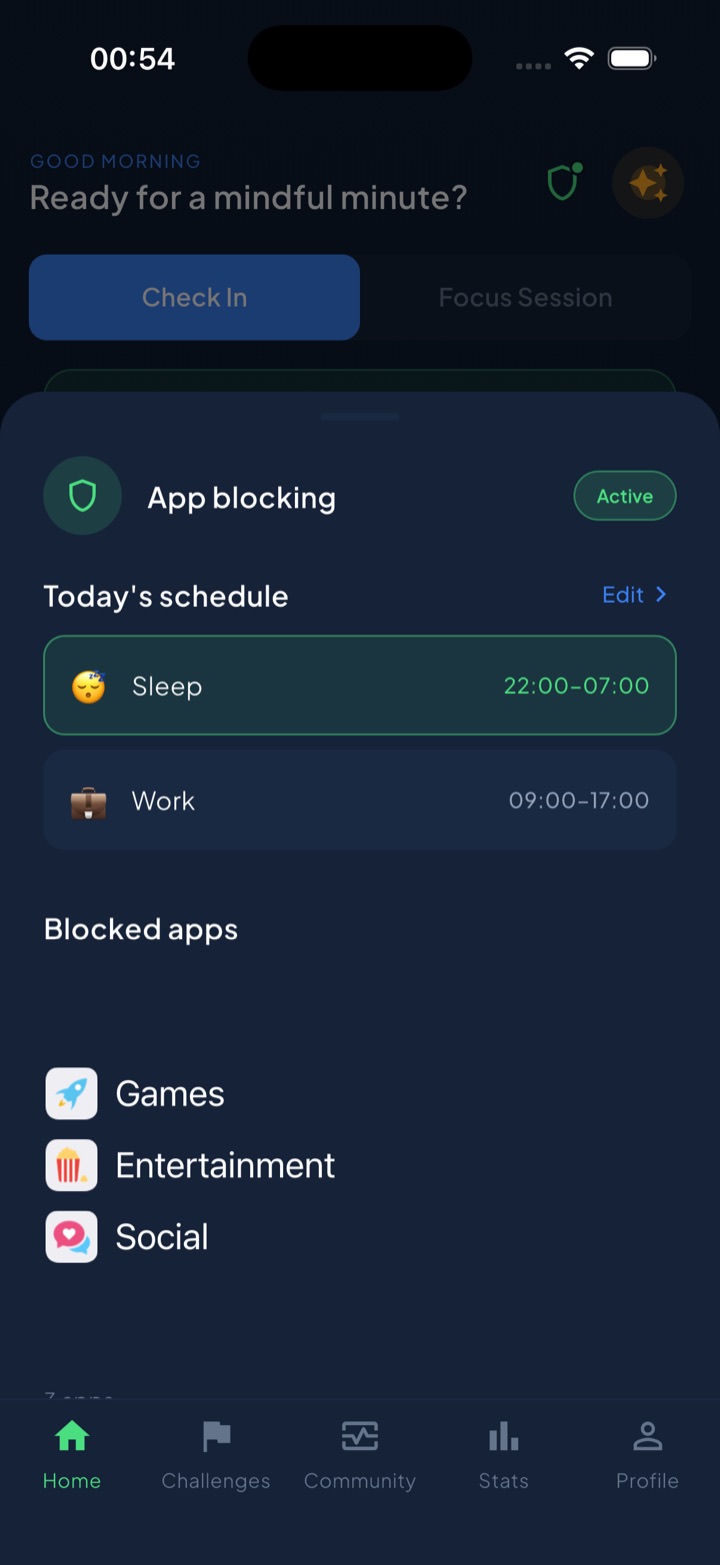
Where Unscrol earns its place is consistency. Built on Apple’s official Screen Time frameworks, it puts a real, system-enforced shield on the apps most likely to turn a lie-in into a rot — so when you reach for TikTok at 8 a.m., you hit a wall, not an endless feed. You can set a scheduled routine (say, block Social and Entertainment from 10 p.m. to 9 a.m.) so your wind-down and wake-up hours are protected automatically, without a daily decision. There’s a short “take a break” bypass for the genuine exception — a deliberate middle ground, not a prison. And because a day counts toward your streak whenever you check in or complete a challenge, you’re nudged to get up and start, instead of rotting. What apps you block and your usage stats stay on your device — iOS processes them locally and they never reach Unscrol’s servers.
Bed rotting isn’t the enemy. Mistaking a numbing scroll for rest is. Protect the difference, and a lazy morning goes back to being what it was supposed to be.
Frequently asked questions
What is bed rotting?
Bed rotting is a Gen-Z social media term for spending long, unstructured stretches of time lying in bed — scrolling your phone, streaming shows, napping, and doing nothing in particular — while framing it as rest or self-care. It went viral on TikTok as a wellness trend. The label itself is neutral: an occasional slow morning under the covers can be genuinely restorative. It becomes a problem when 'bed rotting' is really hours of doomscrolling that leave you more tired, anxious, and behind than when you started.
Is bed rotting bad for you?
It depends on what you're actually doing. A rare, intentional lazy morning where you truly switch off can be real recovery. But regular, phone-heavy bed rotting is usually harmful: it trains your brain to associate your bed with scrolling instead of sleep, which erodes sleep quality over time. Doomscrolling in bed also tends to spike anxiety rather than calm it. If you routinely leave a bed-rotting session feeling worse — flat, foggy, guilty — that's a sign it's avoidance dressed up as self-care, not genuine rest.
How do I stop bed rotting?
Start by separating true rest from scrolling. Time-box lazy mornings with an alarm so a 30-minute lie-in doesn't quietly become three hours. Keep your phone out of the bedroom — charge it in another room and use a cheap alarm clock — so your bed stops being a scrolling cue. Build a short 'screen-free rest menu' (a book, music, a walk, a bath) so resting doesn't automatically mean reaching for your phone. If willpower alone isn't enough, schedule an app block over your wind-down and wake-up hours.