Nomophobia — short for “no-mobile-phone phobia” — is the anxiety and restlessness you feel when you can’t reach your phone. It shows up as a racing mind, a compulsive urge to check, and low-grade dread when the battery is dying or the phone is in another room. It isn’t an official diagnosis; the word came from a 2008 UK survey, and for most people it’s a learned attachment, not a disorder. The reason it feels so stressful is that your phone has quietly become a safety signal — it holds your connections, your escape from boredom, and your sense of control — so its absence registers as a small threat. The good news is that graded exposure reliably shrinks it.
Where does the word “nomophobia” come from?
The term appeared in 2008, from a UK study commissioned by the country’s Post Office and carried out by the polling firm YouGov. Researchers found that a majority of mobile users felt anxious when they lost their phone, ran out of battery, or had no coverage, and a journalist coined “nomophobia” to label it. It spread fast because it named something people already felt.
It’s worth being precise about what that origin means. This was a survey about feelings, not a clinical trial, and “nomophobia” is not a recognized diagnosis in the DSM or ICD. Psychologists generally treat it as a useful descriptive term for problematic phone attachment, sitting on a spectrum from mild habit to, in rare cases, something that overlaps with genuine anxiety disorders. Naming it isn’t the same as medicalizing it — and that distinction protects you from both dismissing the discomfort and catastrophizing it.
Why does phone separation feel like a threat?
Three mechanisms stack up, and understanding them tells you exactly what to unlearn.
Your phone is a bundle of safety signals. A safety signal is anything the brain associates with being okay — able to reach people, find your way, fill dead time, and exit any uncomfortable moment. Your phone is all of those at once. Remove it and you don’t lose one comfort, you lose several simultaneously, so the brain flags the absence as mildly unsafe.
Checking is a conditioned habit. If you check dozens or hundreds of times a day, that loop is deeply grooved. Blocking a well-worn habit produces the same restless itch as any interrupted routine — the urge isn’t really about needing information, it’s about completing a pattern. This is the same loop behind why you check your phone 100 times a day, just felt from the anxiety side.
Anticipated FOMO. Part of the stress is the story that something important is happening without you. Notifications have trained you to expect that the next check might contain something urgent, and uncertainty is what keeps the tension alive.
There’s a subtler cost too. Psychologist Adrian Ward and colleagues found that the mere presence of your phone can occupy attention even when you’re not using it — a “brain drain” on working memory. The flip side is that its absence can feel like losing a limb precisely because so much of your mental life has been outsourced to the device.
What does nomophobia actually feel like?
It ranges from a flicker to a genuine spike. Common signs, from mild to more intense:
- Reaching for a phone that isn’t there (phantom pocket buzz counts).
- Feeling twitchy or unable to settle when the phone is off, dead, or in another room.
- Battery anxiety — planning your day around charging, dreading the red icon.
- Difficulty being alone with your thoughts, so you fill every gap by checking.
- Real distress, a racing heart, or intrusive worry when genuinely cut off.
Most people live in the first three. That’s a habit worth loosening, not a pathology. It’s the last two, when they’re severe, persistent, and interfering with work or relationships, that deserve a conversation with a clinician rather than a blog post — anxiety that intense may not be “about the phone” at all.
How is nomophobia different from ordinary phone habit?
It helps to separate the everyday pull from the anxious edge, because they need slightly different responses.
| Ordinary phone habit | Nomophobia (anxious end) | |
|---|---|---|
| Core feeling | Pull, boredom, autopilot | Dread, restlessness, threat |
| Trigger | A free moment | The phone being unreachable |
| What helps | Friction and better defaults | Graded exposure + friction |
| When to worry | Rarely | If it’s severe and persistent |
| Underlying driver | Conditioned checking loop | Loss of a safety signal |
Most readers are somewhere on the left, drifting occasionally toward the right. The plan below works across the whole range, because reducing compulsive checking and gently proving the phone’s absence is safe are complementary, not competing, goals.
How do you ease phone anxiety with graded exposure?
The evidence-based approach to any low-level, learned anxiety is graded exposure: face the trigger in small, tolerable doses so your brain updates its prediction from “danger” to “fine.” Crucially, you pair each rep with an absorbing activity, so you’re moving toward something rather than just enduring an absence.
A two-week ramp most people can do:
- Days 1–3 — Ten minutes, another room. Put the phone in a different room and do something engaging (cook, shower, read). Ten minutes. Notice the urge rise and pass without acting on it.
- Days 4–6 — Thirty minutes, out of sight. Extend it. A meal, a walk to the shop, a chapter of a book — phone deliberately absent.
- Days 7–9 — A phone-free walk. Leave the phone at home for a 20–30 minute walk. No music, no podcast. Let the discomfort be the exercise.
- Days 10–12 — Airplane mode for a work block. Keep the phone with you but genuinely unreachable during 60–90 minutes of focused work.
- Days 13–14 — A phone-lite half-day. One weekend morning where the phone stays on the charger and you check it only twice, on purpose.
Two principles make it work. First, the urge always peaks and falls — the anxiety is a wave, not a rising line, and every rep where you don’t check teaches your brain that. Second, reduce the compulsive checking in parallel, because the fewer times a day you check, the weaker the safety-signal attachment becomes. How to stop phone addiction covers that side in depth, and the digital detox guide is a good next step once the short reps feel easy.
You do not need any app for this. A phone left in another room and a timer on the oven will run the entire protocol. The value of a tool is only that it holds the boundary during the reps when your resolve wobbles.
When is the anxiety actually a useful signal?
Here’s the reframe worth keeping: a jolt of discomfort when you’re separated from your phone isn’t only a problem to eliminate — it’s information. It tells you how much of your regulation you’ve outsourced to the device. If ten phone-free minutes feels genuinely hard, that’s not a verdict on your character; it’s a measurement, and a reason to run a few reps. The goal isn’t to hate your phone or live without one. It’s to reach a place where the phone is a tool you pick up on purpose, and being without it for an hour is unremarkable.
How Unscrol helps you practice being unreachable
The hard part of graded exposure is that the phone is still in your hand during a focus block, quietly inviting one check. Unscrol, the screen-time app we build, lets you run those reps without relying on willpower alone. A focus session blocks your most tempting apps with Apple’s official Screen Time frameworks for a set stretch — real system-level shields — so “airplane mode for 90 minutes” becomes a button, and the phone stays useful for calls while the feeds stay closed. A Lock Screen countdown shows the time remaining, turning a raw urge to check into a small, visible commitment you’re keeping.
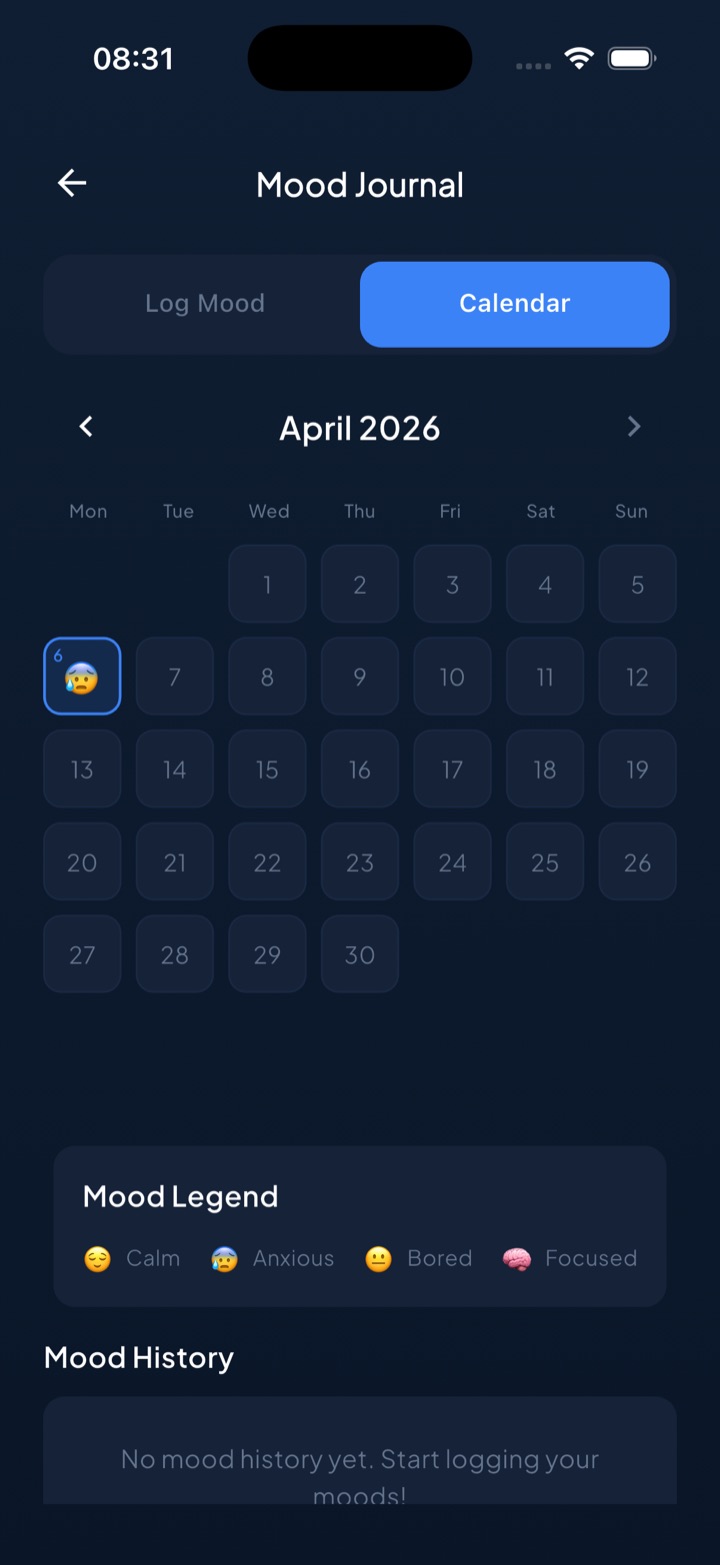
The mood and urge journal is the other half. Logging Calm, Anxious, Bored, or Focused during your reps lets you watch the anxiety spikes actually shrink over two weeks — concrete evidence that the exposure is working. And to be clear, none of this is a treatment for an anxiety disorder; it’s structure for a learned habit. If the distress is severe or persistent, talk to a clinician.
The takeaway: your phone feels essential because you’ve quietly handed it your safety, your boredom, and your escape hatch. Take a few of those back, ten minutes at a time, and the panic fades into a habit you can steer.
Frequently asked questions
What is nomophobia?
Nomophobia is short for 'no-mobile-phone phobia' — the anxiety or distress people feel when they can't use or be near their phone. Symptoms include restlessness, a racing mind, and a compulsive urge to check when the phone is out of reach, off, or low on battery. It isn't an official clinical diagnosis, but the discomfort is real and measurable, and for most people it's a learned habit rather than a disorder.
Why does being without my phone make me anxious?
Your phone has become a safety signal. It holds your social connections, your navigation, your entertainment, and your escape from awkward or boring moments, so its absence removes several comforts at once. The brain reads that loss as a small threat. On top of that, frequent checking is a conditioned habit, so a blocked check creates the same restless itch as any interrupted routine.
Is nomophobia a real diagnosis?
Not officially. It isn't in the DSM, and most researchers treat it as a descriptive term for problematic phone attachment rather than a formal phobia. The word came from a 2008 UK survey, not a clinical study. That said, extreme phone anxiety can overlap with genuine anxiety conditions, so if the distress is severe, persistent, and interfering with your life, it's worth talking to a clinician rather than self-diagnosing.
How do I get over phone separation anxiety?
Use graded exposure. Start with brief, low-stakes separations — phone in another room for ten minutes while you do something absorbing — and slowly extend the time and stakes. Pair each rep with an activity so you're moving toward something, not just white-knuckling the absence. Over a couple of weeks the spike of anxiety shrinks as your brain learns nothing bad happens when the phone is out of reach.