Monk mode is a self-imposed stretch of stripped-down living where you cut low-value distractions — social media, most entertainment, aimless socializing — to pour your energy into one or two goals that matter. The name borrows the image of a monk’s minimal, disciplined routine, but the aim isn’t suffering; it’s removing noise so real work and habits have room to grow. Done well, it frees up hours and mental bandwidth and puts a useful clock on your goal. Done badly, it’s an all-or-nothing sprint that collapses after the first missed day. The difference is specific rules, kept essentials, and a recovery plan — not raw willpower.
What is monk mode, really?
Strip away the internet mystique and monk mode is just aggressive subtraction in service of one goal. You decide what’s stealing your attention, you cut it hard for a defined period, and you redirect the reclaimed time and focus at something specific — writing a book, building a business, getting fit, passing an exam, rebuilding a broken sleep schedule.
The idea overlaps heavily with Cal Newport’s work. His concept of deep work — long, undistracted stretches on cognitively demanding tasks — is monk mode at the level of a work session, and his “digital minimalism” is monk mode at the level of your whole device. Monk mode simply packages that philosophy into a committed, time-boxed lifestyle challenge.
What monk mode is not: it’s not a personality, not a permanent vow of isolation, and not a competition to suffer the most. The versions that go viral — no talking, no fun, punishing 4am routines — are usually the ones that fail, because they’re built to be extreme rather than sustainable.
Why does monk mode work when it works?
Three real mechanisms are underneath it.
Subtraction beats addition. Most productivity advice piles on new habits. Monk mode does the opposite: it removes the biggest attention drains, and the focus you wanted appears in the gap. You don’t have to summon two extra hours of deep work; you have to stop losing them to the feed.
A container creates urgency. An open-ended goal generates no pressure. “Get in shape eventually” is inert; “30 days, no exceptions, starting Monday” is alive. A fixed window turns intention into a countdown, and countdowns get acted on.
Momentum compounds identity. After a couple of weeks of consistent focused days, you stop forcing the behavior and start being the person who does it. Habit research from Phillippa Lally’s UCL group found behaviors take an average of roughly two months to feel automatic — a wide range, but the direction is clear: a 30-day block is enough to build real momentum, even if the habit isn’t fully cemented by day 30. The point of the sprint is to get the flywheel spinning.
How intense should your monk mode be? The tiers
The biggest mistake is picking a tier you can’t sustain. Match the intensity to your life, not to a YouTube thumbnail.
| Tier | Duration | What you cut | Best for |
|---|---|---|---|
| Monk morning | Ongoing, daily | Phone/feeds before a set time | Building a durable daily focus habit |
| Monk sprint | 30 days | Social media, most streaming, doomscrolling | A concrete goal with a deadline |
| Monk month (deep) | 30–60 days | The above + most casual socializing, news | An all-in push where the goal justifies it |
| Monk isolation | Short, rare | Nearly all inputs | Retreat-style resets; not for normal weeks |
Most people should start at monk morning or a monk sprint. The deeper tiers have real costs — relationships, spontaneity, mental variety — and are only worth it when a specific, time-limited goal justifies the trade. There’s no virtue in cutting more than your goal requires.
What do you cut, and what do you keep?
The skill of monk mode is precision. Cut ruthlessly, but keep what actually sustains you.
Cut (typical):
- Social media and short-form video — the biggest attention thieves for most people.
- Passive streaming and background YouTube.
- News and doomscrolling.
- Low-value socializing: obligation plans, small talk that drains you.
- Notifications, broadly. Kill the interruptions.
Keep (non-negotiable):
- Sleep. Cutting sleep to “gain hours” sabotages the focus you’re chasing.
- Exercise and time outside — they fuel deep work, not compete with it.
- Real relationships. Isolation is a bug, not a feature; tell the people close to you what you’re doing and keep them in.
- Your actual work and responsibilities. Monk mode redirects discretionary time; it doesn’t excuse you from life.
If you’re cutting apps hard, the process in the digital minimalism guide gives you a cleaner way to decide what comes off the phone, and to prepare for the withdrawal-heavy first week.
How do you avoid the all-or-nothing collapse?
This is where most monk modes die, and the cause is not weakness — it’s perfectionism. Addiction researchers describe the abstinence violation effect: after breaking a perfect record once, people don’t slip a little, they abandon completely. Miss one day of your monk-mode routine and the all-or-nothing story (“I’ve ruined it”) makes quitting feel logical.
The fix is to design for the slip before it happens:
- Write the rules down, with allowed exceptions. A rule with a defined exception (“no social media, except 15 minutes Sunday to message family”) is one you can keep. An absolute rule with no give tends to shatter on contact with real life.
- Adopt “never miss twice.” One missed day is noise. Two in a row is a new pattern forming. Make the recovery — not the perfect streak — the thing you protect. This single rule is the most durable idea in habit-building, explored more in why streaks work for building habits.
- Track the streak, forgive the slip. A visible chain of completed days is motivating, as long as one blank square doesn’t end the game.
“My first attempt at monk mode was 30 days of total austerity and I quit on day 4, feeling like a failure. The version that stuck was way looser — a scheduled block that kills my feeds from 9 to 5, one goal, and a rule that one bad day doesn’t count as blowing it. I finished the month and actually shipped the thing.” — Daniel, indie developer, 27
What’s a realistic 30-day monk mode plan?
A template you can start Monday:
- Before Day 1: Write your one goal, your cut list, your keep list, your daily non-negotiables (e.g. “3 hours deep work + gym”), and your recovery rule. Tell someone.
- Week 1 — Detox. Expect restlessness and phantom urges; this is withdrawal from constant stimulation, not proof it’s not working. Just hold the rules and do the minimum daily action.
- Week 2 — Rhythm. The routine starts feeling normal. Protect one or two deep work blocks a day as the core.
- Week 3 — Push. Focus is easier now. This is when the real output happens. Guard against overconfidence-driven relapse.
- Week 4 — Land it. Finish the goal, and pre-plan your exit so you don’t binge everything you cut on day 31.
- Exit criteria: Decide in advance what “done” looks like and which cuts you’ll keep for good. A good monk mode ends with a couple of habits that quietly stay.
Putting monk mode on autopilot with Unscrol
Monk mode lives or dies on one boring detail: whether the apps you swore off are actually unavailable when the urge hits. Relying on willpower to not open Instagram forty times a day is the fast road to the all-or-nothing collapse. Unscrol, the screen-time app we build, is designed to hold the boundary for you. Set a scheduled blocking routine — say Work 09:00–17:00, plus a Sleep block — that automatically shields your feeds, video, and games with Apple’s official Screen Time frameworks. These are real system-level shields, not reminders, so the cut apps simply aren’t there during your monk hours.
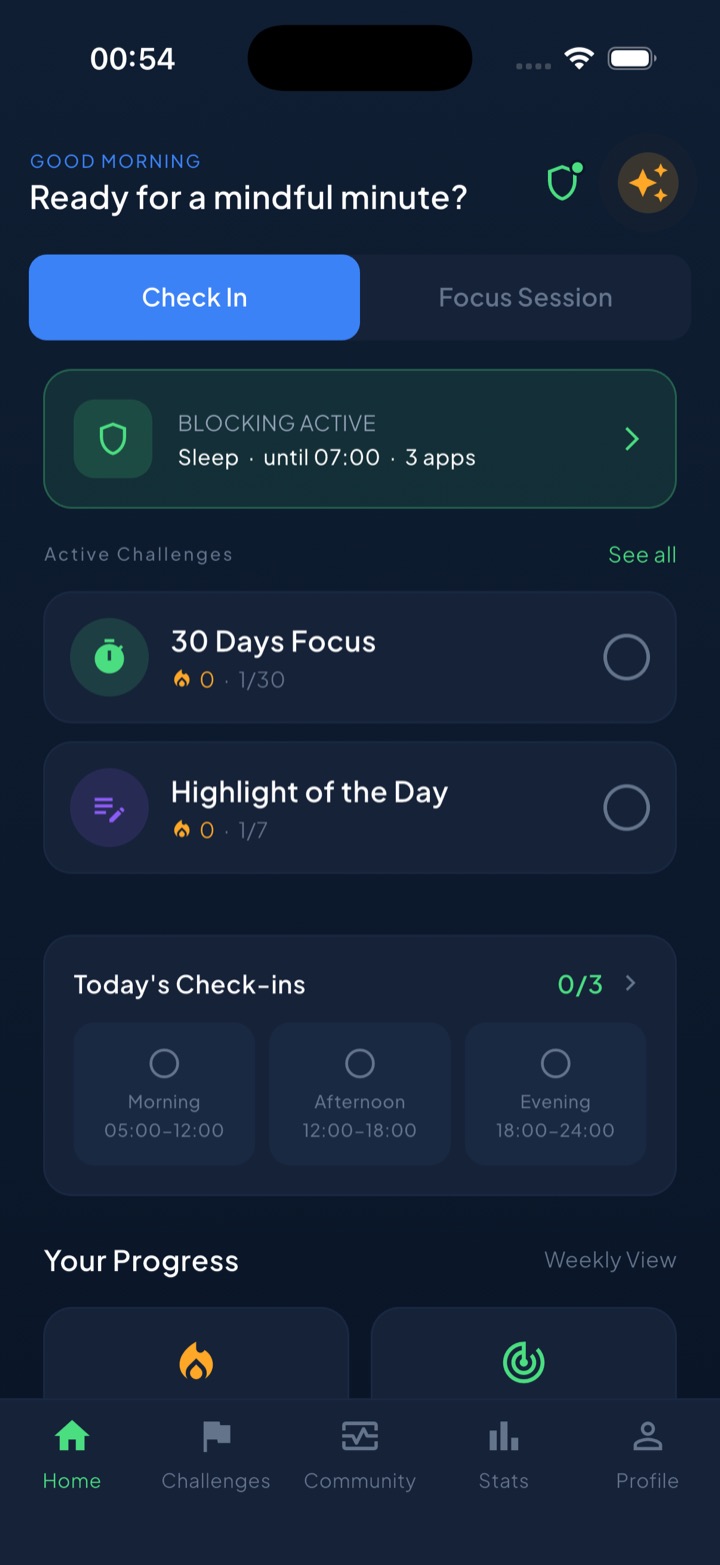
The daily check-ins and unified streak give your monk days a visible chain, and the Streak Saver encodes “never miss twice” directly — it can rescue a single missed day but never two in a row, which is exactly the failure mode you’re guarding against. None of this is required; a written contract taped to your wall and a phone in a drawer run the same play. Unscrol just makes the rules enforce themselves.
The takeaway: monk mode isn’t about how much you can suffer. It’s about cutting precisely, keeping what sustains you, and surviving the inevitable slip — one goal, clear rules, never miss twice.
Frequently asked questions
What is monk mode?
Monk mode is a self-imposed period of stripped-down living where you cut low-value distractions — usually social media, most entertainment, and unnecessary socializing — to pour your energy into one or two important goals. It borrows the image of a monk's disciplined, minimal routine. It can last a morning, a month, or longer, and the point isn't deprivation for its own sake; it's removing the noise so your best work and habits have room to grow.
How long should monk mode last?
Match the length to the goal and to what you can realistically sustain. A daily 'monk morning' of a few distraction-free hours can run indefinitely. A focused sprint toward a specific goal — a launch, exams, a fitness reset — usually works best as 30 days, long enough to build momentum and see results, short enough to commit to fully. Avoid open-ended 'forever' versions; they blur into vague restriction and tend to collapse.
Does monk mode actually work?
It works when it's specific and survivable, and fails when it's all-or-nothing. Cutting distractions genuinely frees up hours and mental bandwidth for a real goal, and a fixed timeframe creates useful urgency. The common failure isn't weakness — it's perfectionism: one missed day triggers total abandonment. A monk mode with clear rules, allowed exceptions, and a 'never miss twice' recovery rule is far more likely to finish than a rigid one.
What are the rules of monk mode?
You set them, but good rules are specific and few. Typically: pick one primary goal, list exactly which apps and activities you're cutting, define your daily non-negotiable actions, keep the essentials (work, real relationships, exercise, sleep), and set an end date. Write them down before you start and decide your recovery rule in advance, so one slip doesn't end the whole thing.