A dumbphone is a basic button phone that calls and texts but runs no apps, feeds, or browser, and switching to one works by removing the option to be distracted rather than strengthening your willpower. A year without a smartphone tends to give people back long stretches of unbroken attention, easier sleep, far less reflexive checking, and more ordinary boredom, which is where rest and ideas actually live. It does not make you smarter or more disciplined; it just deletes the slot machine from your pocket. The good news is that most people do not need to go that far: a smartphone that hard-blocks its own distracting apps on a schedule reproduces most of the effect.
What can a year without a smartphone really do?
Consider a concrete case. In interviews after the 2026 LGS, Turkey’s national high-school entrance exam, one 14-year-old who reportedly finished among the country’s top scorers described the same move: “At the start of 8th grade I put away my smartphone and switched to a button phone. I didn’t use a phone for a year.” He also cut out television toward the end. His own explanation was not that the button phone made him gifted; it was that it removed the thing that pulled him away from studying.
That is the honest version of what a dumbphone does. It does not add focus. It subtracts the interruptions that were shredding your focus into fragments. When the phone in your pocket cannot open a feed, the reflex to check it decays, because the reflex was only ever being rewarded by what you found there. Strip out the reward and the loop quietly starves.
What does a dumbphone actually remove?
It helps to be specific about what you are giving up, because it is not “the internet” in the abstract. A dumbphone removes three things engineered to be hard to resist:
- Variable-reward feeds. Social apps and short-video are built on the same unpredictable-payoff schedule that makes slot machines compelling. You keep pulling because the next swipe might be great. A button phone has nothing to pull.
- Always-on triggers. A smartphone is a single object cueing dozens of habits, so picking it up to check the time can end in twenty minutes of scrolling. A dumbphone that only calls and texts breaks that one-object-many-habits trap.
- The frictionless escape hatch. The moment a task gets boring or hard, the smartphone offers instant relief one tap away. Remove the tap and you have to sit in the difficulty long enough to actually get through it.
What you keep is the genuinely useful part: calls, texts, an alarm, often a camera and maps. Most people discover that the apps they “needed” were a handful, and the rest was pure pull.
Who does a dumbphone help, and why does it beat willpower?
A full dumbphone switch is not for everyone, and pretending otherwise is dishonest. It helps most when your attention is fragmented and the stakes are high for a defined period, exactly the exam-prep situation, or a writer on deadline, or someone whose checking has tipped into compulsion. If that is you, the research on reducing screen time points the same direction: change the environment, not just the intention.
It is a poor fit when your work genuinely runs through smartphone apps (two-factor logins, ride-hailing, work chat, banking), when navigation and messaging isolation would create real risk, or when you would spend the saved attention worrying about what you are missing. For most of these people the answer is not a worse phone; it is a better-behaved one.
The deeper reason a dumbphone works is that willpower is a poor tool for a fight that happens hundreds of times a day. Every decision to not check drains a little self-control, and you lose eventually not because you are weak but because the phone is designed to win. The durable fix is to change what is available, so the decision does not come up. This is the core of environment design beating willpower: make the good path easy and the bad path effortful, then let the environment carry you.
A dumbphone is the maximum-friction version of that idea. It makes the distracting behavior not merely harder but impossible, which is why it works so reliably. But friction is a dial, not a switch. You can add a lot of it without throwing away the smartphone entirely, and that is where most people should actually land.
Dumbphone vs. a smartphone that blocks its own apps
If the benefit comes from the missing apps, you can engineer the same absence on a schedule and keep the useful tools. Here is the honest comparison:
| Full dumbphone | Smartphone with scheduled hard-blocks | |
|---|---|---|
| Distracting feeds during focus | Impossible | Blocked in chosen windows |
| Maps, banking, 2FA, work chat | Lost or awkward | Kept |
| Effort to set up | Buy a second phone, migrate | Pick apps and windows once |
| Reversibility | High friction to switch back | Adjust in seconds |
| Best for | Heavy dependence, long sprints | Most people, most of the time |
| Risk | Missing something genuinely needed | Turning blocks off too easily |
The middle path is “a dumbphone on demand”: your phone becomes a button phone from 8am to 12pm and after 9pm, and a full smartphone otherwise. You get the deep-focus mornings and the calm nights without losing maps on the drive home.
How to run a realistic dumbphone experiment
You do not have to buy anything to test the core idea:
- Pick a window, not your whole life. Start with one daily block where the phone goes fully dumb, mornings or study hours.
- Decide the rules the night before. Which apps vanish, which stay. Deciding in the moment is how you talk yourself out of it.
- Expect three bad days. The restlessness in days one to three is withdrawal from quick rewards, not a sign it isn’t working. It fades.
- Give the boredom somewhere to go. Keep a book, a notebook, or a walk ready, so the freed time has a landing spot.
- Judge it after two weeks. Then decide whether to widen the windows, or go all the way to a button phone.
“I couldn’t face carrying a real button phone, so I set my mornings to go dumb instead — feeds and games just gone until noon. The first few days were fidgety, then I noticed I was reading actual pages again. The scheduled block makes the decision for me, which is the only reason it stuck.” — Daniel, freelance designer, 27
How Unscrol gives you a dumbphone on demand
The whole point of the dumbphone experiment is friction you cannot casually undo, and Unscrol is built to give you exactly that without a second phone. Using Apple’s official Screen Time frameworks, it puts real system-level shields on the apps you choose. Scheduled blocking routines mean your feeds, games, and short-video simply are not there from, say, 8am to noon and after 10pm, so the phone behaves like a button phone in the windows that matter and a normal smartphone the rest of the day. Focus sessions add a shorter, on-demand version with a Live Activity countdown on your Lock Screen.
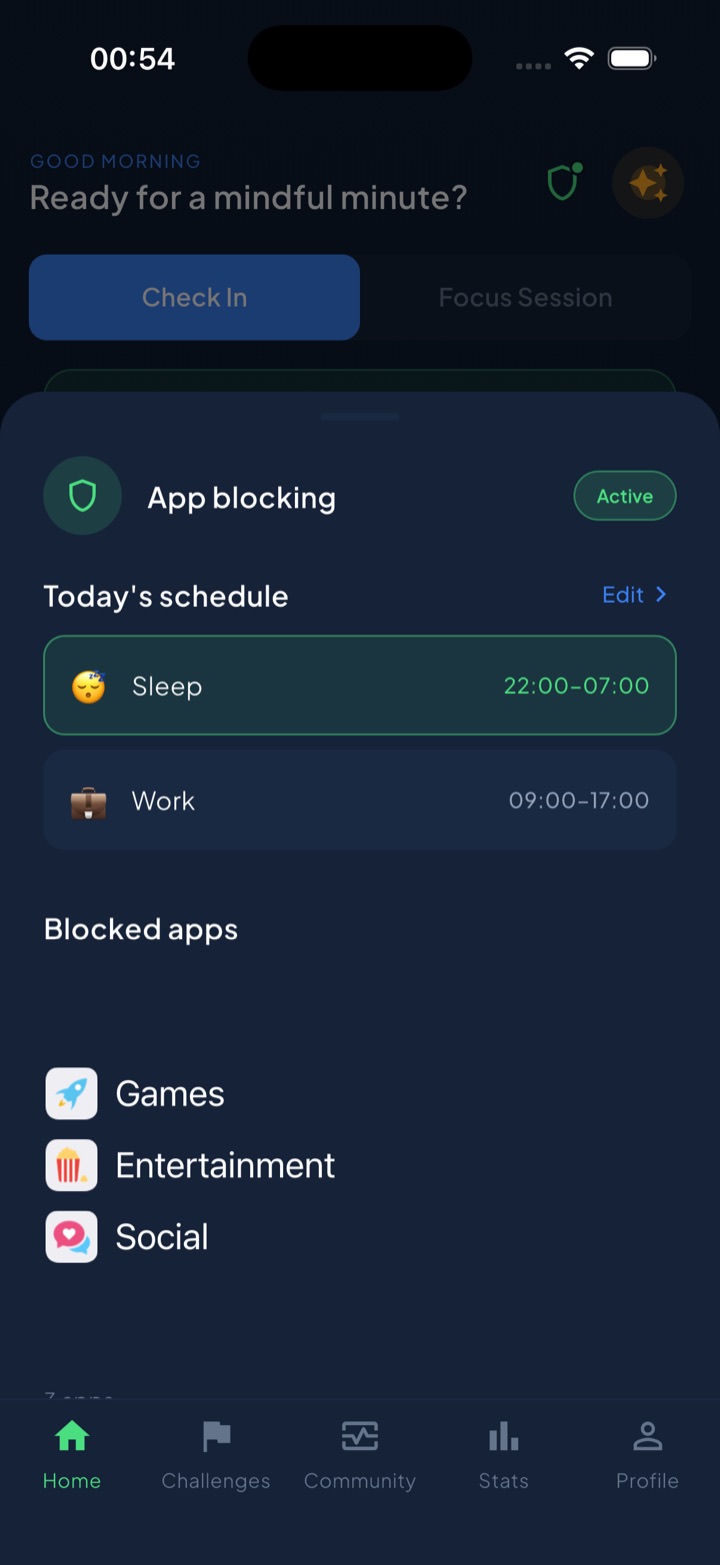
You can build a version of this for free, of course: hand your phone to someone else during study hours, or use Apple’s Screen Time downtime, and you have crude friction at no cost. The app’s job is to make that friction consistent, harder to bypass on a weak day, and tied to a streak so the good windows compound. The principle is the same either way: you do not have to become a different person, just make the phone a worse slot machine.
Frequently asked questions
Does switching to a dumbphone actually improve focus?
For most people, yes, but not because it makes you more disciplined. A dumbphone removes the option to be distracted, so there is no feed to open when a task gets hard. People who try it usually report longer stretches of unbroken attention, less reflexive checking, and easier sleep. The gains come from the missing apps, not from willpower, which is why a smartphone that hard-blocks those same apps captures most of the benefit.
Do I have to give up my smartphone completely to get the benefits?
No. The active ingredient in the dumbphone experiment is friction: the distracting apps simply are not reachable. You can recreate that on a smartphone by blocking your feeds and games during chosen windows so the phone behaves like a button phone when you need it to and a full smartphone the rest of the time. Full switches help people with heavy dependence, but most get the focus gains without going that far.
How long should a dumbphone experiment last?
Long enough to pass the withdrawal phase. The first three to five days feel restless because your brain expects the usual quick rewards. Try two weeks as a minimum honest test, and a month if you can. By then the constant urge to check has usually faded and you can judge the real trade-offs, like harder navigation and messaging, against the calmer attention and better sleep.