In the last month, stop learning new material and start consolidating, testing, and executing. Run a full, timed mock exam each week under real conditions, keep an error log, and spend most of your hours on targeted review of your weakest topics rather than re-reading everything. Ramp effort gradually across the four weeks instead of front-loading a panic, protect seven to nine hours of sleep because that’s when memory consolidates, and lock distractions out of every study block so the hours are real. The final month is where scores often move most — not by cramming new topics, but by turning half-known material into reliable answers and fixing careless-mistake patterns.
Should the final month be a cram or a build?
Neither, exactly. A cram tries to shove in everything at the last second; a passive “build” keeps gently reviewing without pressure. The final month is a controlled ramp — rising intensity layered on top of work you’ve already done. One Turkish 8th-grader who reportedly topped the 2026 LGS (Turkey’s national high-school entrance exam) described exactly this shape: he started prep well in advance, increased the pace through the year, and pushed hardest in the last three months and the final month. The crucial detail is that the hard final push sat on a year of accumulated work. The sprint amplifies a base; it cannot replace one.
This is where the testing effect earns its keep. Cognitive scientists Henry Roediger and Jeffrey Karpicke showed repeatedly that retrieving information from memory — testing yourself — builds far more durable recall than re-reading the same notes. In the final month, that means your hours should tilt heavily toward active recall and full mock exams, not highlighting. Re-reading feels productive and teaches little; retrieval feels harder and teaches a lot. If you’re still building the underlying schedule, it’s worth grounding this month in a proper study schedule for exams so the ramp has a structure to climb.
The four-week plan, week by week
Work backward from exam day and give each week a distinct job. Adjust the block counts to your own stamina, but keep the shape: broad review narrowing to sharp execution, effort rising then tapering right at the end.
| Week (to go) | Primary focus | Mock exams | Mistake to avoid |
|---|---|---|---|
| Week 4 | Map every topic; heavy targeted review of weak areas; first full mock to set a baseline | 1 full, timed | Reviewing what you already know because it feels good |
| Week 3 | Deep work on the 2–3 weakest topics; daily active recall; build the error log | 1 full, timed | Ignoring the mock review — the log is the point |
| Week 2 | Mixed review across all topics; convert error-log items into fixes; simulate conditions | 1–2 full, timed | Adding brand-new topics from scratch |
| Week 1 | Light, confident review; sleep-first; short recall sessions; nothing new | 0–1, early in the week | All-nighters, new material, and last-minute panic |
The engine of the plan is the loop inside each week: full mock → error log → targeted review → repeat. The mock reveals what’s actually weak; the log records it precisely; the review fixes it; the next mock checks the fix. Most students take mocks but skip the review, which is like weighing yourself repeatedly and never changing what you eat.
How often should you take mock exams in the final month?
About one full, timed mock per week through weeks 4 and 3, tightening to one or two in the last ten days, then easing off in the final couple of days so you arrive fresh rather than fried. But frequency is the smaller half of the answer. The review is where the score actually moves. For every mock, budget as much time to analyze it as you spent taking it: go through every wrong answer and every lucky guess, and sort each into “didn’t know it,” “knew it but misread,” or “ran out of time.” Each category has a different fix, and naming it is how you stop repeating it — the whole discipline of a proper mock-exam strategy.
Simulate the real thing while you’re at it: same time of day, same time limit, same no-phone conditions. A mock taken in exam-like silence trains the sustained attention the actual exam demands; a mock taken with a phone buzzing nearby trains the opposite.
Why is sleep a study strategy in the last month?
Because sleep is not time off from studying — it’s the part of studying where the learning gets filed. Sleep researcher Matthew Walker and others have shown that memory consolidation, the process that turns fragile new information into stable knowledge, happens largely during sleep, especially the deep and REM stages. Trade a night of sleep for an extra cramming session and you typically lose more in next-day recall than the extra hours added. You also arrive at the exam with a slower, foggier brain.
So through the whole final month, hold a regular seven-to-nine-hour schedule rather than a heroic catch-up on weekends. Protect the two nights before the exam, not just the last one — the second-to-last night matters more than most students think. And get screens out of the wind-down: late-night scrolling delays sleep and fragments it, which is why the link between screen time and sleep belongs in any serious exam plan. A phone charging outside the bedroom is one of the cheapest score protections available.
What should you NOT do in the final month?
The final month has a short list of reliable ways to sabotage yourself, and avoiding them is half the battle:
- Don’t start large new topics in the last week. New material is fragile and unconsolidated; leaning on it under exam pressure is where panic comes from. If a topic is genuinely untouched by week 1, triage it and protect your strong areas.
- Don’t pull all-nighters, ever, and especially not the night before. See above — it’s a net loss.
- Don’t confuse activity with progress. Ten hours of re-reading can teach less than three hours of testing. Track retrieval, not time on the chair.
- Don’t doom-compare. Someone in your class is always “already finished.” Their timeline is not your exam. Run your plan.
- Don’t let a bad mock end the week. A low score in week 3 is information, not a verdict. Log it, fix it, move on.
Locking down distractions for the sprint
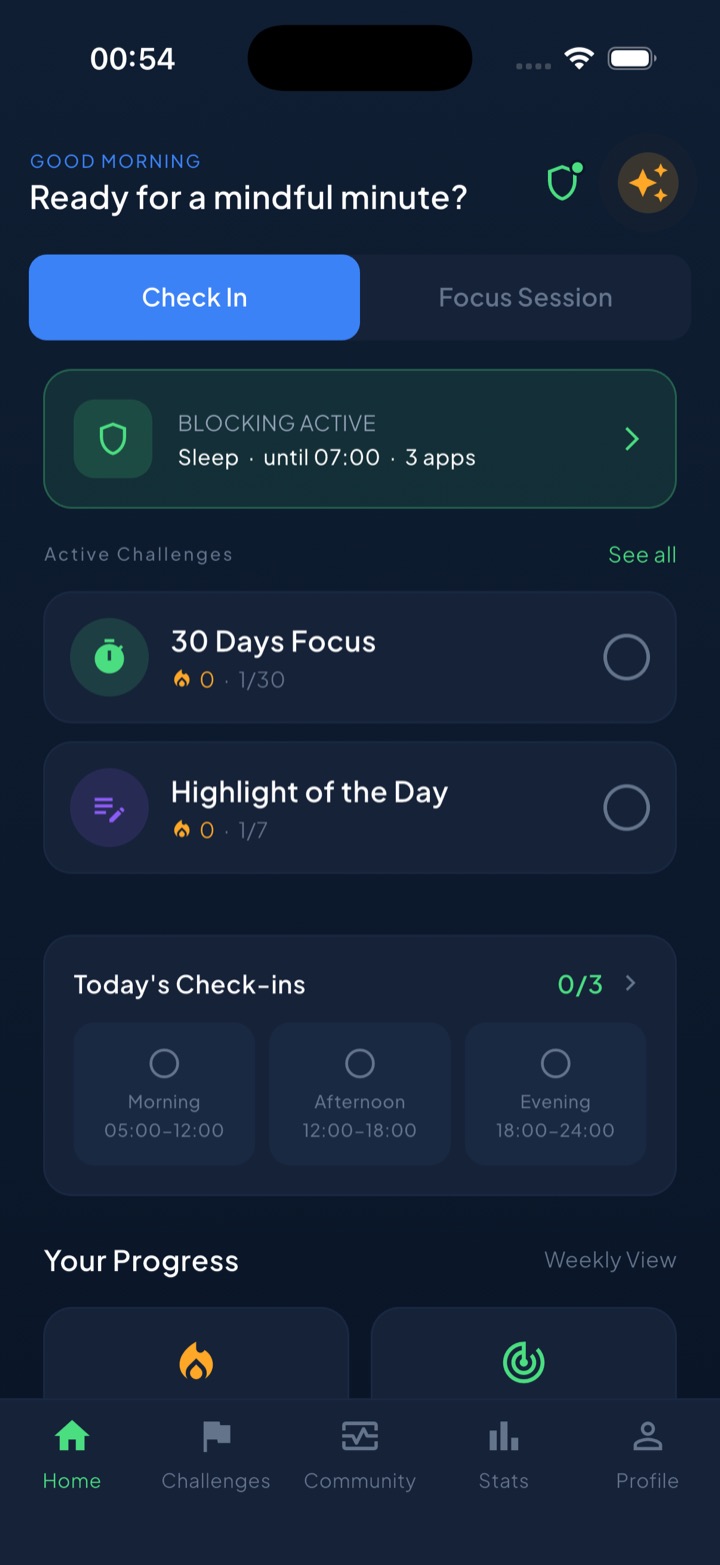
A month-long plan lives or dies on whether the study blocks are real, and the biggest threat to that is the phone in your pocket. Unscrol, the screen-time app we build, is designed to make the sprint’s blocks hold without relying on willpower you won’t always have at 9pm in week 2. A scheduled blocking routine can auto-block your distracting apps during fixed study windows (say 17:00–20:00 on weekdays) using Apple’s Screen Time frameworks, and a focus session with a Lock Screen countdown wraps each mock or deep-work block so the scroll option simply isn’t there.
You can run this whole month with no app at all: a paper calendar counting down the four weeks, a physical error log, and a phone left in another room during blocks is the same system for free. Apple’s built-in Screen Time can even automate a study-hours downtime. What a dedicated setup adds during a high-stakes sprint is enforcement that doesn’t waver with your motivation and a sleep-window block that protects the nights the plan depends on. The month is won by protecting the blocks and the sleep, whatever tool you use to do it.
Frequently asked questions
How should I study in the last month before a big exam?
Shift from learning new material to consolidating and testing what you know. Run a weekly full mock exam under real conditions, keep an error log, and spend most of your hours on targeted review of your weakest topics. Ramp effort gradually across the four weeks, protect seven to nine hours of sleep, and lock away distractions so each block is real. Don't cram new topics in the final week.
Is it too late to improve my score in the last month?
No. The final month is often where scores move most, because it's when active recall and mock-exam practice convert half-known material into reliable answers, and where you fix careless-mistake patterns. What rarely works is trying to learn large new topics from scratch in the last week. Consolidate strengths, target weak spots, and sharpen exam execution instead.
Should I pull all-nighters before an exam?
No. Sleep is when the brain consolidates what you studied, so trading it for extra cramming usually costs you more in recall than the cramming adds. All-nighters raise stress and slow thinking on exam day. Protect a regular seven-to-nine-hour schedule through the whole final month, and especially the two nights before, not just the last one.
How many mock exams should I take in the final month?
Roughly one full, timed mock per week early on, tightening to one or two in the final ten days, each followed by a thorough review of every mistake. The review matters more than the score: a mock you don't analyze is just tiring practice. Simulate real conditions, including no phone, so the test itself holds no surprises.