Active recall is studying by retrieving information from memory, closing the book and forcing yourself to produce the answer, rather than rereading it. Decades of research, most famously Henry Roediger and Jeffrey Karpicke’s work on the “testing effect,” show it produces dramatically stronger long-term retention than passive review, even though it feels harder and less pleasant. The reason rereading fails is the fluency illusion: seeing familiar words tricks you into thinking you know the material, when recognition isn’t the same as recall. Every time you struggle to retrieve something and succeed, you strengthen that memory. The effort is the mechanism, not a side effect, which is why the method that feels worse is the one that works.
What is active recall, exactly?
Active recall means generating an answer from a blank page instead of reviewing an answer that’s already in front of you. The distinction is simple but decisive:
- Passive review: re-reading notes, re-watching lectures, highlighting, copying out text. Information flows into your eyes.
- Active recall: shutting the material and asking “what do I know about this?”, then producing it, out loud, on paper, or as a flashcard answer. Information is pulled out of your memory.
That act of pulling is the whole point. Memory works like a muscle in at least one respect: retrieving a fact makes it easier to retrieve next time, while merely re-exposing yourself to it does far less. An exam only ever tests retrieval, you sit with a blank page and have to produce answers, so it makes sense to practice the exact skill you’ll be graded on. Most students do the opposite, and it’s the single biggest fixable mistake in how to study effectively.
Why does rereading feel productive but fail?
Because rereading is comfortable, and comfort is exactly the wrong signal. When you reread highlighted notes, the words feel smooth and familiar, and your brain interprets that fluency as knowledge. Cognitive scientists call this the fluency illusion: you mistake recognizing the material for being able to recall it. Then the exam asks you to recall it cold, and the gap appears.
Here’s the counterintuitive part the research keeps confirming: the more effortful and awkward a study method feels, the more it’s usually teaching you. Retrieval that makes you sweat is building durable memory; rereading that feels effortless is mostly building false confidence.
| Rereading / highlighting | Active recall | |
|---|---|---|
| How it feels | Smooth, easy, reassuring | Hard, slow, sometimes frustrating |
| What it trains | Recognition (“that looks familiar”) | Recall (“I can produce this cold”) |
| Confidence it creates | High, often false | Accurate, sometimes humbling |
| Long-term retention | Weak, fades fast | Strong, durable |
| Matches the exam? | No, you never reread on the test | Yes, exams are pure retrieval |
The practical takeaway: distrust the study session that felt easy. If review felt frictionless, you probably reinforced the illusion rather than the memory.
What does the research actually show?
The testing effect is one of the most robust findings in learning science. In Roediger and Karpicke’s well-known experiments, students who studied material and then were tested on it remembered far more a week later than students who spent the same time restudying it, even though the restudy group felt more confident right afterward. The group that struggled to retrieve learned more and knew it less; the group that reread learned less and felt sure.
Related work adds nuance worth keeping honest about:
- Retrieval helps most when it’s successful with effort, hard enough to be a real pull, easy enough that you don’t just blank. Quizzing on material you’ve never seen doesn’t help.
- Feedback matters. Check your answers after retrieving. Retrieving a wrong answer and never correcting it can cement the error.
- The benefit is strongest for meaningful material and grows over time, the retrieval advantage widens the longer the delay before the real test.
The numbers vary by study and I won’t pin a precise multiplier on it, but the direction is settled across dozens of experiments: test yourself, don’t just review.
What are the best active recall formats?
Active recall isn’t one technique; it’s any method that forces retrieval. Six that work:
- Closed-book brain dump. Read a topic, close everything, and write down everything you can remember on a blank sheet. Then reopen and fill the gaps in a different color. The gaps are your study list.
- Flashcards, answered before flipping. The rule that makes them work: say or write your answer out loud before you turn the card. Flipping without answering is just rereading.
- Past papers, timed. The closest thing to the real exam. Do them under conditions, then mark honestly. This trains retrieval and exam pacing at once, key for any exam study schedule.
- The Feynman technique. Explain a concept aloud, in plain language, as if teaching a beginner. The moment you stumble or hand-wave is the moment you’ve found a hole in your understanding.
- Question-generation. As you first read, turn each heading and key fact into a question (“Why does X cause Y?”). Later, answer your own questions from memory. You’ve built a personal quiz bank.
- Blurting / free recall in speech. Walk and talk through a topic from memory, no notes. Portable, phone-free, and surprisingly punishing in a good way.
Rotate formats so retrieval stays effortful and you don’t just memorize the shape of one deck.
How do you combine active recall with spaced repetition?
Active recall answers how to study; spaced repetition answers when. Together they’re the highest-yield combination in learning science.
Spacing exploits the forgetting curve first described by Hermann Ebbinghaus: memories decay over time, but each well-timed review flattens the curve, and reviews spaced across days beat the same number crammed into one sitting. So instead of one three-hour retrieval marathon, do shorter retrieval sessions spread over a week, revisiting each topic just as you’re starting to forget it.
A simple protocol:
- Day 1: Learn, then immediately do a brain dump (first retrieval).
- Day 2: Quick flashcard/brain-dump pass. Anything you miss goes to a “weak pile.”
- Day 4, Day 7, Day 14: Retrieve again, spending most time on the weak pile. Correct answers get spaced further out; wrong answers come back sooner.
Do these retrieval blocks phone-free. Retrieval requires holding effortful attention, and a single notification interrupts the exact process that builds the memory, one reason protecting your study focus isn’t separate from the method; it’s part of it. A 25-minute retrieval block with the phone in another room beats a distracted hour with it on the desk.
You don’t need any special software for this. A stack of index cards, a blank notebook, and a calendar run the entire system for free. Free spaced-repetition apps automate the scheduling if you want it, but the paper version has been producing top exam results for a century.
Building phone-free retrieval blocks with Unscrol
Active recall only works when you can hold effortful attention long enough to actually retrieve, and that’s exactly what a buzzing phone destroys. Unscrol is built to protect those blocks. Start a focus session for a retrieval round and it runs a distraction-blocking countdown, Pomodoro-length is ideal for brain-dump and flashcard sprints, that shields your distracting apps with Apple’s official Screen Time frameworks, with a Live Activity countdown on your Lock Screen so a glance at the phone reminds you you’re mid-recall.
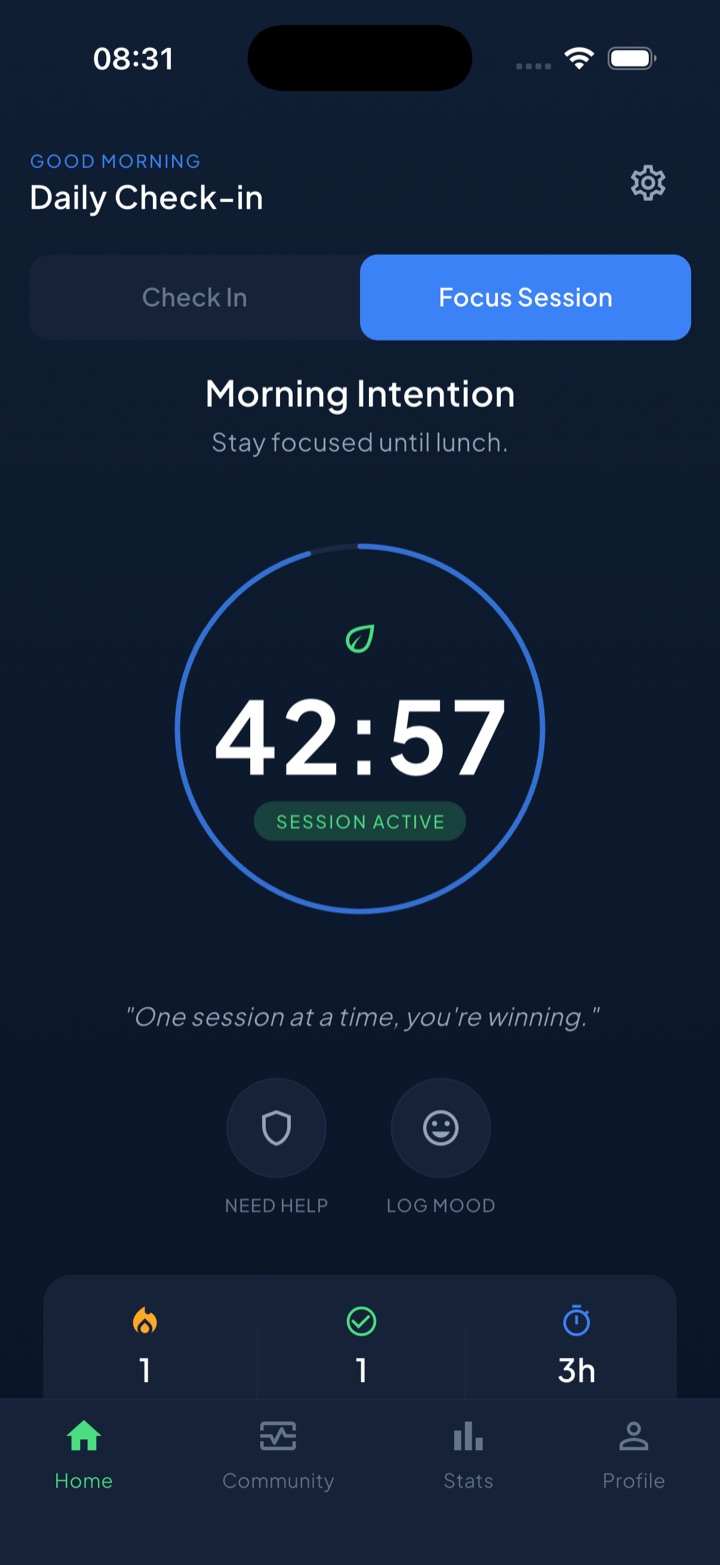
The built-in break timer fits neatly between spaced retrieval rounds, and scheduled blocking can protect a recurring study window every day so the phone isn’t even a temptation during your best hours. Your blocked apps and usage stay on-device with iOS. And to be honest about it: a drawer, a kitchen timer, and index cards give you the same phone-free retrieval block for nothing. Unscrol just makes the wall automatic, so the hard part is the recall, not resisting the notification. Test yourself, space it out, and keep the phone off the desk, that’s the whole method.
Frequently asked questions
What is active recall and why does it work?
Active recall is studying by retrieving information from memory, closing the book and forcing yourself to produce the answer, rather than rereading it. It works because the effort of retrieval strengthens the memory each time you pull something out and get it right. Cognitive scientists call this the testing effect: being tested on material teaches you more than restudying it for the same amount of time, even though it feels harder.
Why is rereading a bad way to study?
Because it creates the fluency illusion. Seeing familiar words and highlighted notes feels smooth and makes you believe you know the material, but recognition is not the same as recall. On the exam you have to produce the answer from a blank page, a skill rereading never trains. Rereading feels productive precisely because it's easy, and that ease is the trap: the harder it feels, the more you're actually learning.
How do I use active recall to study for exams?
Close your notes and try to write down everything you remember about a topic (a brain dump), then check what you missed. Use flashcards where you answer before flipping, do past papers under timed conditions, and explain concepts aloud as if teaching someone. Space these retrieval sessions across days rather than cramming, and quiz the things you got wrong more often. Do it phone-free so retrieval isn't interrupted.