The scroll time warp is a real, studied effect, not a character flaw. You opened the app at eleven with every intention of sleeping. You look up and it is one in the morning. Nothing dramatic happened in between, and you were not enjoying yourself for two solid hours either. What happened is that your brain temporarily lost the equipment it uses to feel time passing, and short-form video is extremely good at removing that equipment on purpose.
Why does an hour of scrolling feel like fifteen minutes?
Because you have no organ for duration. Your sense of how long something took is reconstructed after the fact from two ingredients: attention checkpoints, the moments your focus surfaced and noticed the outside world, and memory markers, the distinct events your brain filed while the time was passing.
Both are cheap to destroy. A feed holds attention continuously, so there are no checkpoints. And it serves clips that are near-identical in shape — vertical, loud, twenty seconds, another one — so almost nothing gets filed separately. When you finally look up, you estimate the elapsed time the way you always do, by counting the markers. There are three. Three markers means fifteen minutes.
The clock says two hours. That gap is the flinch.
Notice that the estimate was not lazy. You did the arithmetic correctly; the input was corrupted before it reached you.
What does a feed remove that a TV episode does not?
Edges.
An episode is forty-two minutes and then it stops. A chapter ends. An album has a last track. Each of those is a unit, and units quietly do two jobs: they tell you how much you have consumed, and they hand you a decision point where continuing requires an action.
A feed has neither. No episode number, no page count, no credits, no bottom of the page. “One more and then bed” is a sentence that needs a countable one — and the feed has made one twenty seconds long, so the sentence never terminates. Long before the two hours are up, you have stopped counting altogether.
Why do a thousand small changes feel like no time at all?
Here is the genuinely counterintuitive part. Your brain timestamps memory by change of context: a new room, a new person, a new task. Walk through a doorway and it files a boundary, which is why you forget what you came into the kitchen for.
A feed is nothing but change of context. Cat, war, dance, recipe, stranger crying, advert. You would expect that to generate an enormous sense of elapsed time. It generates the opposite, because a boundary only works as a marker if it is distinguishable. A thousand context switches with the same length, the same format, the same posture and the same room merge into a single undifferentiated now. One vivid, well-separated hour is remembered as an hour. A hundred interchangeable minutes are remembered as a blur, and blur has no length.
Is this just flow state?
It feels like it, and that resemblance is the trap.
Flow — the absorbed, self-forgetting state people describe while playing music, writing or climbing — famously distorts time in the same direction. Researchers looking at short-form video have pointed to exactly this time distortion as one of the core ingredients of its pull, precisely because from the inside the two states feel so similar.
The difference is on the outside. Flow is absorption around a task with an output: at the end there is a paragraph, a repaired engine, a distance covered. The feed gives you the absorption and deletes the output. You spent the same two hours of attention and there is nothing at the end to show what they were for, which is why looking up feels less like surfacing from work and more like being robbed. What short-form video does to attention is the wider version of the same story.
What does dopamine have to do with the clock in your head?
More than you would guess. The brain’s interval timing — the mechanism that lets you judge seconds and minutes without counting them — is tied to dopaminergic activity. Shift dopamine and time judgements shift measurably with it.
Which means the circuitry a feed spends two hours stimulating with unpredictable rewards is the same circuitry your internal clock runs on. It is not a coincidence that the most engaging thing on your phone is also the thing that makes you worst at knowing how long you have been holding it.
Why does five minutes of waiting feel longer than an hour of scrolling?
This is the part that gives the whole mechanism away.
The distortion is asymmetric. Filled, novel, effortless attention compresses time. Empty, unstimulated attention expands it. Ninety minutes of video feels like twenty. Four minutes in a queue with nothing to look at feels like fifteen.
The uncomfortable implication is that the habit is not only eating your evenings, it is recalibrating your tolerance, so that every unstimulated moment of ordinary life now feels longer than it is. The lift, the bus stop, the ninety seconds while the kettle boils. Nothing about those intervals changed. Your baseline did. It is also part of why the totals in your Screen Time report never match what you think you did.
| What your brain uses to judge duration | What a short-form feed supplies |
|---|---|
| Attention surfacing to check the outside world | Continuous capture, no surfacing |
| Distinct, separable events in memory | A thousand near-identical 20-second clips |
| Unit boundaries: episode, chapter, track | No end, no count, no credits |
| A steady internal clock | Dopamine stimulation that skews that clock |
| Effort, which makes time feel long | Zero effort, which makes it vanish |
“I used to think I was exaggerating when I said the evening disappeared. Then I actually wrote my guess down for a week before checking. Monday I guessed forty minutes and it was two hours ten. Every single day I was out by more than half. I was not lying to anyone, I genuinely could not feel it. That week bothered me more than any total ever had.” — Owen, veterinary nurse, 29
How do I get my sense of time back?
Five things, roughly in the order they tend to work.
Use a clock that interrupts, not one that informs. A widget showing your usage is a passive clock, and passive clocks lose to feeds every time, because you have to look and looking is the one thing you will not do mid-scroll. A lock is an active clock: it arrives at you. This is the whole argument for a per-session cap over a daily total — a session cap is an attention checkpoint reinstalled at a point you chose while calm.
Give your media units again. Watch an episode rather than a feed. Play an album rather than a shuffle. Read a chapter. Anything that ends by itself hands back both a countable marker and a decision point, and it costs you nothing in enjoyment.
Wear a watch. Small, faintly old-fashioned, and it works. Phones fail as clocks because checking the time on one puts you back inside the machine that eats it. A wrist glance is the only time check that does not cost a re-entry.
Give scrolling a window with an edge. Twenty minutes after dinner is a scroll with a shape. “Whenever” is a scroll with no shape, which is functionally the same as no end.
Run the one-week calibration log. For seven days, before you open your Screen Time, write down your guess for yesterday’s total. Then check. The number that matters is not the actual figure, it is the gap. Most people are out by forty to sixty per cent, and seeing your own gap in your own handwriting does more work than any statistic about the average user ever will. If you want the long-range version of that arithmetic, the years this adds up to runs the same sum across a lifetime.
Is this the same thing as ADHD time blindness?
No, and the distinction is worth keeping clean.
ADHD time blindness is a persistent difficulty estimating and feeling time that shows up everywhere: cooking, leaving the house, starting a task, sitting in a waiting room, with or without a phone. It existed long before smartphones did. Scroll time distortion is situational. It appears inside a specific designed environment and largely goes when you step out of it, and it happens to people with no attention condition at all.
They do compound, badly. A feed strips out exactly the external markers that someone with ADHD relies on most, which is why the two-hour hole is often a four-hour hole. But if your time estimates collapse only inside apps, that is design rather than diagnosis. If they collapse everywhere, that is a conversation for a clinician rather than an app. The restless, half-attentive state in between has a name too: popcorn brain.
How does Unscrol help?
The honest starting point: a lot of this is free. Apple’s Screen Time gives you daily App Limits per app or category, Downtime for scheduled windows, and a real weekly average to calibrate that guess against. If seeing the number is enough to change the behaviour, you do not need anything else and should not buy anything. Where the built-in tools run out is that Screen Time is fundamentally a report: it tells you afterwards, and afterwards is exactly when time distortion has already finished its work. iOS also has no native per-session cap, and App Limits ship with a one-tap dismissal.
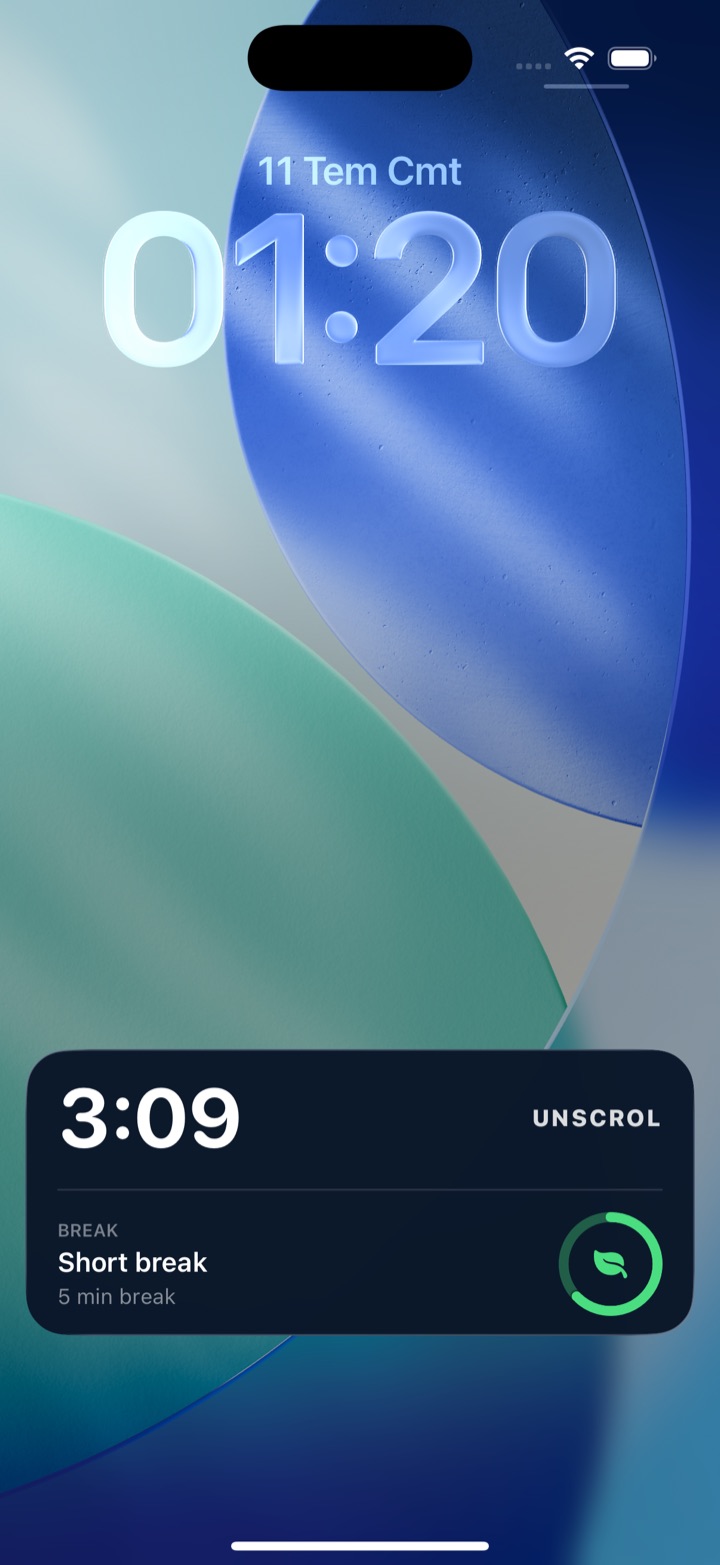
Unscrol is an iPhone and Apple Watch app built around putting edges back on time. You set a daily total (45 minutes by default) and a per-session maximum (5 minutes by default), and iOS enforces both through the Screen Time and FamilyControls frameworks rather than a cosmetic overlay. The session cap is the attention checkpoint the feed deleted: use a session-sized block of your budget and the chosen apps lock for 15 minutes, which is a clock you cannot scroll past. Spend the whole daily budget and they lock until tomorrow. Shield is blocking you schedule by time of day, so scrolling gets a window with an edge, and switching it off mid-block is deliberately slow: a breathing exercise and a wait, not a one-tap dismissal. A streak counts every day you finish under budget, and home-screen and lock-screen widgets keep the remaining time visible without you opening anything.
Two caveats, plainly. The numbers are estimates, because iOS reports usage through crossed thresholds across an interval rather than exact minutes, so treat the budget as approximately right rather than precise to the second. And iOS hands the app opaque tokens, never app identities: Unscrol cannot see which apps you picked, their names, their icons or your per-app usage. The system draws the app picker; the app only draws the frame around it, and block lists and usage data are processed on-device by iOS and never reach Unscrol’s servers. Free to download, with an optional premium tier adding Streak Saver for a missed day and five concurrent challenge slots instead of one.
Frequently asked questions
Why does time go so fast when I scroll?
Because you do not perceive duration directly, you reconstruct it afterwards from two sources: how often your attention checked in on the world outside the screen, and how many distinct events your memory stored while it was happening. A short-form feed removes both. It holds attention continuously so there are no check-ins, and it delivers clips that are near-identical in length and shape so almost none of them get filed separately. When you look up, you count the markers you have, find three of them, and estimate fifteen minutes. The estimate is not careless, it is a correct calculation run on a corrupted input.
Is losing three hours to TikTok a sign of ADHD?
Not on its own. Scroll time distortion is situational, meaning it appears inside a specific designed environment and largely disappears when you step out of it, and it happens to people with no attention condition at all. ADHD time blindness is persistent and context-free: it shows up while cooking, leaving the house, starting a task or sitting in a waiting room, with or without a phone, and it existed long before smartphones. The two do compound, because a feed strips away exactly the external time markers that someone with ADHD leans on hardest. If your time sense is only wrecked inside apps, that is design. If it is wrecked everywhere, that is worth raising with a clinician rather than an app.
Why does five minutes of waiting feel longer than an hour of scrolling?
Because feed-induced time distortion is asymmetric. Attention that is filled, novel and effortless compresses time, while attention that is empty and unstimulated expands it. So ninety minutes of video can feel like twenty, and four minutes in a queue with nothing to look at can feel like fifteen. The uncomfortable implication is that the habit is not only eating your evenings, it is also recalibrating your tolerance so that every unstimulated moment of ordinary life feels longer than it actually is. Nothing about the queue changed. Your baseline did.
How do I stop losing track of time on my phone?
Passive clocks lose to feeds, so use one that interrupts rather than one that informs. A usage widget requires you to look, and looking is precisely the thing you will not do mid-scroll, whereas a lock arrives at you whether you want it or not. Alongside that, put units back into your media by choosing things that end on their own, such as an episode, an album or a chapter, because a unit gives you both a countable marker and a natural decision point. Wearing a watch helps for the same reason a phone does not: checking the time on a phone puts you back inside the machine that eats it.