Popcorn brain is not about what you watch, it is about how fast it moves. Your attention has a clock speed, and years of eight-second cuts have set it high. Nothing is broken. Your brain quietly recalibrated its expectation for how often something new should arrive, and now anything running slower than the feed reads as a stall. That is why the novel on your nightstand has had the same bookmark in it since spring, why you reach for your phone during the establishing shot, and why the strangest symptom is that even the good slow things, films and conversations and your own children, feel underclocked.

What does popcorn brain actually mean?
The term comes from David Levy, an information science researcher at the University of Washington, who used it for a mind conditioned by the fast, parallel rhythm of screens until slower offline life becomes hard to sit inside. It has resurfaced now because it names something millions of people were already feeling and had no word for.
The image is doing real work. Popcorn does not move steadily. It pops, and between pops there is nothing to hold you. That explains a symptom pattern that otherwise looks contradictory: you are not incapable of focus. You just spent forty minutes on a feed, which is forty minutes of unbroken attention. What you have lost is the ability to stay with something that does not supply a new stimulus every few seconds. It is not a deficit of concentration. It is a narrowed range of acceptable pace.
How is popcorn brain different from brain rot?
These two terms get used interchangeably online and they describe different things. Brain rot is a verdict on content. Popcorn brain is a description of pacing. The practical difference is what happens when you try to fix it.
| Brain rot | Popcorn brain | |
|---|---|---|
| What it is about | What you consume | How fast it arrives |
| Core complaint | This content is junk | Everything else is too slow |
| Obvious fix | Consume better things | Retrain tolerance for slowness |
| Does upgrading content solve it | Yes, by definition | No, this is the trap |
| Where you notice it | Afterwards, as regret | Immediately, as restlessness |
| Who it hits hardest | Anyone in a feed | People who used to read and watch films |
The trap in that fourth row is worth spelling out. Someone with popcorn brain usually tries the content upgrade first: delete the short-form apps, subscribe to long podcasts and serious documentaries. It feels like progress and the numbers even improve. Then they open a novel and it is still unbearable, because the podcast played at 1.75x while they did the dishes and the documentary had a cut every six seconds. The pace never changed. Only the subject matter did.
What are the symptoms of popcorn brain?
Read these as a pattern rather than a checklist. Three or four is common. Most of them, and you have your explanation.
- You read the same paragraph three times, take in nothing, then check your phone as a reward for the effort.
- You cannot watch a film without a second screen, and you now genuinely believe the film is boring rather than that you are unavailable.
- You skip the slow parts of songs and add 1.5x to podcasts by reflex.
- Someone is telling you a story and you notice yourself waiting for the end rather than listening to the middle.
- Waiting for a lift, a kettle or a traffic light produces an immediate reach for your pocket.
- Your favourite writer’s new book is on the shelf, unopened, and you feel a flicker of dread looking at it.
- You lose the thread of your own thoughts, which is closer to why you can’t focus anymore than to any diagnosis.
The one that lands hardest is the story one, because it is where this stops being about media. You can feel yourself waiting for a person to get to the end. That is your pace expectation applied to a human being.
Why does a book feel slower than it used to?
Two mechanisms, and both are ordinary learning rather than damage.
The first is prediction. Your brain forecasts what is coming next, calibrated to the environment it has been living in. A feed delivers something new every few seconds and varies unpredictably in quality, which is the exact schedule that trains the tightest expectations. After enough hours your forecast interval is a handful of seconds long, and the first page of a novel delivers almost nothing on that timescale. The prediction comes back empty, empty registers as discomfort, and the discomfort resolves the instant you pick up the phone. You are not bored of the book. You are in a very short withdrawal from a rate.
The second is stimulus density tolerance, and it works like caffeine. Two coffees felt like a lot once and are now a baseline that does nothing; your receptors are fine, the dose that counts as normal simply moved. Feed content is extremely dense: cuts, sound, faces, text overlay, novelty, all compressed. A slow scene delivers a fraction of that per second, so once your normal has moved up it registers not as calm but as almost nothing. Same mechanism as what short-form video does to attention, seen from the pacing side rather than the platform side.
Damage would be permanent. A tolerance comes back down when you stop topping it up.
Is popcorn brain permanent?
No. It reverses in weeks, and the shape of the recovery is worth knowing in advance, because the first stretch is where people give up. Days one to four are genuinely unpleasant: sitting with a book produces real restlessness, easily misread as proof of permanent damage. It is the opposite, the withdrawal you would expect from a tolerance being allowed to fall. The second week is duller rather than agonising. Somewhere in weeks three and four most people get the moment they were waiting for, which is usually looking up from a book to find twenty minutes gone without any effort.
That it does not happen by itself is arithmetic. A tolerance falls only if the dose falls, and five minutes of scrolling six times a day keeps your baseline pinned at the top. That is why people who have halved their screen time often feel no change in their reading. The number that matters is not total hours. It is how often you top up.
How do you rebuild tolerance for slowness?
Progressively, the way you would rebuild any tolerance. Four things do most of the work.
One screen at a time. The highest-yield rule and the hardest to keep. No phone during a film, no second tab during a video, no scrolling during a conversation. Split your attention and the slow thing never gets a fair test: you conclude it is boring, when what happened is that it lost an auction it was never told it had entered.
Long-form on purpose, at normal speed. Pick one thing a day that is longer than your comfort: thirty pages, a full album with no skipping, one film start to finish. Turn playback back to 1x. Speed listening feels like efficiency and is really tolerance maintenance, because it teaches your brain that the normal rate of the world is too slow.
Boredom reps. Treat every queue, lift and kettle as a set, and do not fill it. Ten to twenty seconds of unfilled waiting is the actual exercise, uncomfortable the way a set is supposed to be. Same reason boredom is good for your brain: the empty interval is where attention learns it can survive not being fed.
Distance, not willpower, during films. Put the phone in another room before you press play. Face-down on the sofa does not work, because the reach costs nothing and the decision has to be won again every slow minute. Move it eight feet and you win it once.
One warning in the other direction: none of this is permission to accept more interruption, and switching between a book and a phone every few minutes adds the real cost of context switching on top. Longer stretches of one thing is the whole treatment, and how to increase your attention span sets it out as a graded progression.
“I used to read forty books a year. Last year I read two, and I blamed work, then my age, then my kids. What actually fixed it was putting my phone in the hallway during films. Three weeks later I finished a novel in a weekend for the first time since university. Nothing about my life changed except how far away the phone was.” — Marcus, product manager, 38
How does Unscrol help?
The honest starting point: Apple gives you a lot of this for free. Screen Time has daily App Limits per app or category, Downtime for scheduled windows, and a real weekly average to work from. If a daily number and a sleep schedule are enough to stop you topping up your tolerance all day, you do not need anything else and should not buy anything. Where the built-in tools run out is the part that matters most for pacing: iOS has no per-sitting cap, and its limits ship with a one-tap dismissal, so nothing stops the six five-minute top-ups that keep your baseline high.
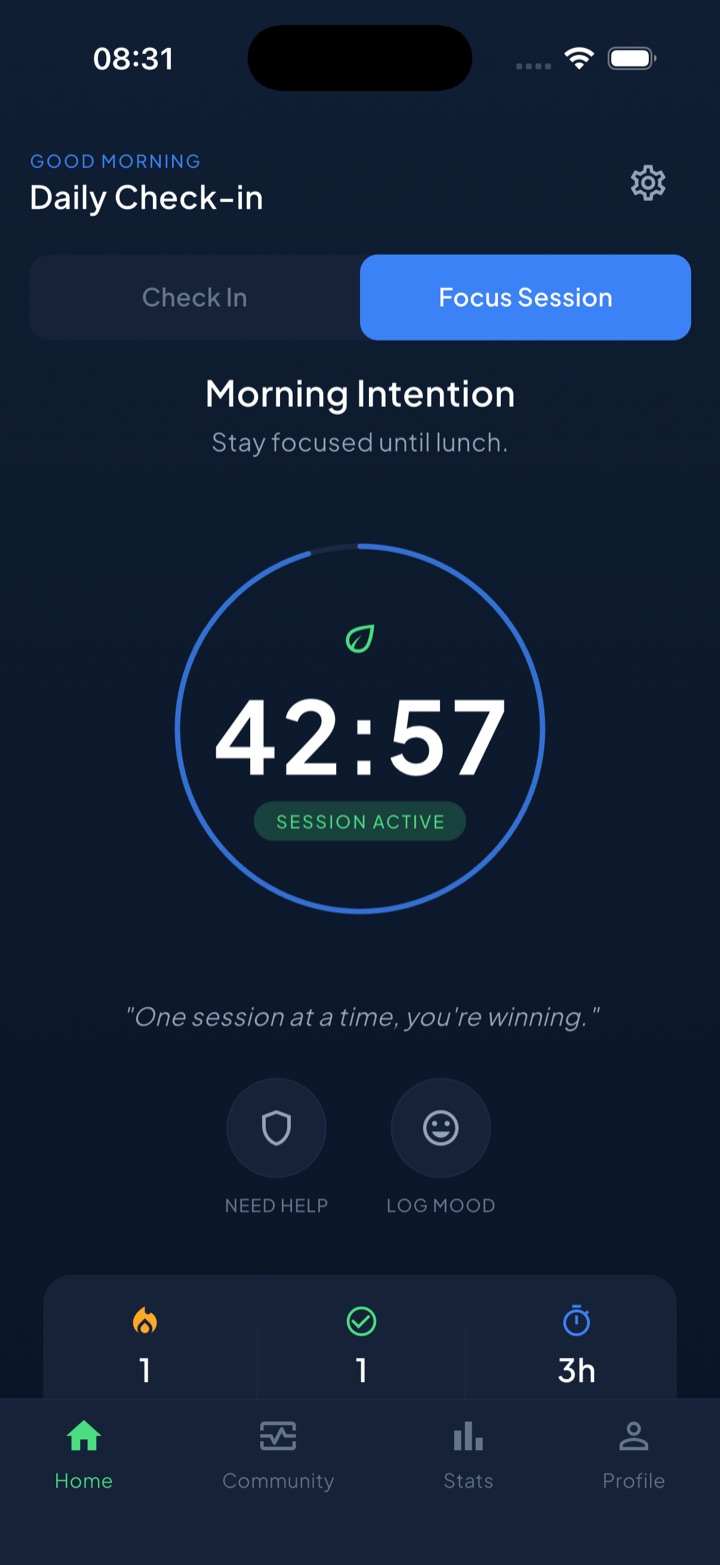
Unscrol is an iPhone and Apple Watch app built around two numbers, and the second one is the pacing tool. You set a daily total (45 minutes by default) and a per-session maximum (5 minutes by default), enforced by iOS through the Screen Time and FamilyControls frameworks rather than a cosmetic overlay. Spend a session-sized chunk of the budget and the chosen apps lock for 15 minutes; spend the whole daily budget and they lock until tomorrow. That 15-minute lock is the part that does the work here, because it targets precisely the top-up interval that keeps stimulus tolerance pinned high, and it is the one thing a daily cap never touches. Shield handles placement, blocking you schedule by time of day, and switching it off mid-block is deliberately slow: a breathing exercise and a wait, not a one-tap escape. A streak counts every day you stay under budget, and home-screen and lock-screen widgets show what is left without you opening anything.
Two caveats, plainly. The numbers are estimates, because iOS reports usage through crossed thresholds across an interval rather than exact minutes, so treat the budget as approximately right rather than precise to the second. And iOS hands the app opaque tokens, never app identities: Unscrol cannot see which apps you picked, their names, their icons or your per-app usage. The system draws the picker; the app only draws the frame around it, and block lists and usage data are processed on-device by iOS and never reach Unscrol’s servers. Free to download, with an optional premium tier adding Streak Saver for a missed day and five concurrent challenge slots instead of one.
Frequently asked questions
What does popcorn brain mean?
Popcorn brain is the name for a mind that has been trained to pop from one stimulus to the next and now finds anything slower than that pace almost physically uncomfortable. The term comes from David Levy, a researcher at the University of Washington, who used it to describe what happens to attention after long exposure to the fast, parallel rhythm of screens. The defining symptom is not that you cannot concentrate at all, it is that you cannot tolerate a slow rate of new information. A page of a novel, a film that takes four minutes to establish a scene, or a friend telling a story with a long wind-up all start to feel like a stall, and your hand reaches for the phone to fill the gap.
Is popcorn brain the same thing as brain rot?
No, and the difference is the useful part. Brain rot is a judgement about content: low-value, disposable, algorithmically shaped material, and the implied fix is to consume better things. Popcorn brain is about pacing, so it survives the upgrade. You can swap TikTok for documentaries and long podcasts and still find that a novel is unbearable, because what got recalibrated was your tolerance for how fast new information arrives, not your taste. That is why people who have cleaned up what they consume are often surprised to find the restlessness still there.
Can popcorn brain be reversed?
Yes, and faster than most people expect, because pacing tolerance behaves like a tolerance rather than damage. The same way caffeine tolerance falls after a couple of weeks of smaller doses, your baseline for stimulus density drops when you stop topping it up all day. Most people report that the first three or four days of deliberately slow input feel genuinely awful, that the second week is merely dull, and that somewhere in weeks three and four a book starts holding them again without effort. The reason it does not happen on its own is that a few minutes of feed scrolling, several times a day, is enough to keep resetting the baseline back up.
Why can I watch a two-hour film in the cinema but not at home?
Because the cinema removes the alternative and your living room does not. Attention does not usually collapse on its own, it gets outbid, and a slow scene only loses when there is something faster within arm's reach offering a better return in the next two seconds. In a cinema the phone is off and in a pocket, so a slow scene has no competition and you sink into it exactly as you always could. This is also why putting the phone in another room works so much better than putting it face-down on the sofa, because the fix is distance rather than willpower.