JOMO is the joy of missing out: the practiced opposite of FOMO, where an evening you are not at becomes an evening you chose rather than an evening you lost. Tech writer Anil Dash popularized the term in a 2012 essay, and it is having a moment now for an unglamorous reason — a decade of fear of missing out left a lot of people checking constantly and enjoying none of it. JOMO is not a personality type, a retreat, or a hatred of parties. It is a small repeatable skill: deciding in advance what you are going to miss, so that missing it costs you nothing. And the observation at its centre is the uncomfortable one — while you were making sure you missed nothing online, you were missing your own Tuesday night.

What does JOMO actually mean?
JOMO stands for the joy of missing out. It is the deliberate inversion of FOMO, the fear of missing out: instead of treating an unattended event or an unopened app as a debt you owe, you treat it as a choice you made.
The two words point at the same gap in your evening and ask completely different questions. FOMO asks what is happening without me. JOMO asks what I want this evening to be. Both are about absence, but only one has an answer you can reach. There is no quantity of checking that proves you missed nothing, because the feed always has one more story. There is a very specific quantity of deciding that makes an evening yours, and it is one decision.
It is worth being precise about what JOMO is not. It is not anti-social, not a permanent no, and not the claim that staying home beats going out. It is the claim that a night you picked is not a night you lost — and that the difference between the two is rarely the night itself. It is whether you audited it afterwards.
Why is JOMO trending right now?
Because FOMO won, and the prize turned out to be bad.
For most of the past decade the ambient instruction was to stay reachable, stay current, keep the streak. People did. And the payoff FOMO promised — the relief of being caught up — never arrived, because being caught up requires the feed to end, and it does not. What arrived instead was an evening spent supervising other people’s evenings.
JOMO spreads now as the counter-trend precisely because it asks you to quit nothing. It is not deleting your accounts and it is not a thirty-day cleanse. It is a change of question, and it is available tonight — which is also why it surfaces everywhere at once: no plans as a flex, phone-free dinners, the quiet reappearance of people who simply do not answer after nine.
How do feeds manufacture the fear of missing out?
This is the part worth being annoyed about. Almost none of the urgency you feel is real urgency. It is a product decision, and four mechanisms do most of the work:
- Stories that expire. A post that vanishes in twenty-four hours is not scarce, it is fenced. The content would be identical tomorrow; the deadline is bolted on to convert mild curiosity into a now-or-never check.
- Streaks. A streak converts something you enjoy into something you maintain. Once it is long enough you are not opening the app for the person on the other end, you are opening it to avoid a loss.
- Active-now dots and read receipts. These take other people’s presence and hand it to you as an obligation. A green dot is a notification that someone else is available, which your brain files as a small deadline with your name on it.
- The everyone-was-there post. The group photo you were not in was posted by the one person who posts. The nine friends who also stayed home posted nothing, and there is no feed of them. That sampling bias is not a distortion in your head, it is built into what the product is able to show you.
Together they run an engine that manufactures scarcity in a medium that has none. If the feeds are affecting more than your evenings, the wider picture is in social media and anxiety — but this specific gear, the one that turns other people’s ordinary nights into your restlessness, is the one JOMO unbolts.
What are you actually missing while you make sure you miss nothing?
Here is the inversion, and it is worth sitting with for a moment.
Every check is a small trade: you leave the room you are in to inspect a room you are not in. Do that fifty times a day and you have attended neither. The things you reliably miss out on are not the parties. They are sleep, the person across the table, and the hour you were in before you started auditing it.
The sleep one is the most expensive and the least discussed. The midnight sweep — stories, group chat, the two accounts you compare yourself to — costs forty minutes at the point in the day when forty minutes are worth the most. Nobody has ever finished that sweep and felt caught up. It is doomscrolling wearing a social justification.
There is a retroactive version that anxious scrollers know well: a genuinely good Saturday, ruined at eleven at night by sixty seconds of evidence that somewhere else was louder. Nothing about the Saturday changed. Only the audit was added. The real fear of missing out should point at the hour you are standing in, because that is the only one actually at risk.
FOMO vs JOMO: what changes in practice?
| FOMO | JOMO | |
|---|---|---|
| The question you are asking | What is happening without me? | What do I want tonight to be? |
| Who sets the deadline | The app: twenty-four hours, then it is gone | You: it ends when you go to sleep |
| What a free evening is | Evidence you are being left behind | Space you get to spend |
| What checking gives you | Seconds of relief, then a longer list | Nothing, which is why you stop |
| How you decline | An apology plus a reason | Not this one, have a good time |
| How the night ends | One in the morning, still unsatisfied | Whenever you decide it does |
The row doing the most work is the deadline row. FOMO is not really about other people, it is about who owns the clock. Every expiring story hands a small piece of your evening’s schedule to a company that will never give it back. JOMO is the practice of taking the clock back, and most of the rest follows from that single move.
“For two years I could not go to bed without one last sweep: stories, the group chat, the two people I compare myself to. I was not enjoying it. I was auditing. What broke it was not willpower, it was noticing that the only thing I reliably missed out on was sleep. Now the feeds close at ten. The first week I felt genuinely out of the loop. Nothing happened, and nothing happening turned out to be the entire point.” — Nadia, primary school teacher, 31
How do you practice JOMO deliberately?
Three moves, in order of how much they give back.
Decline without building a case. FOMO turns every no into a negotiation you have to win with evidence: you are tired, you are busy, you have a thing. “Not this one, have a great time” is a complete sentence, and using it changes the internal accounting. A no with a reason is a loss you justified; a no without one is a choice you made. Guilt is the machinery that converts missing into losing.
Expiry-proof your social life. Feeds run on deadlines, friendships do not. Move the relationships you actually care about onto formats that cannot vanish — a standing Thursday, a phone call on the walk home, a proper catch-up that works better without your phone anyway. Then test everything else with one question: if the only reason to check tonight is that it will be gone tomorrow, it was never a reason.
Let the gap stay empty for the first ten minutes. This is where most attempts die. You clear the evening, you feel restless rather than serene, and you conclude JOMO is not for you. That restlessness is withdrawal, not evidence, and it fades within a few nights. What sits on the other side of it is the thinking you have had no room for, which is why boredom is good for your brain. If you would rather begin with a list than a blank evening, things to do instead of scrolling is a running start.
One practical note outperforms all three. Pick the shutdown time while you are calm. Nine in the evening decided at lunchtime is a plan. Nine in the evening decided at nine in the evening is a negotiation with the version of you who has just been scrolling, and that version does not lose.
How does Unscrol help?
Start free, because a good deal of this is a settings problem. On iPhone, Screen Time will turn off notifications for social apps, put daily App Limits on your worst feeds, and schedule Downtime across the evening so the midnight sweep is not on the menu. If that plus one honest unfollow session is enough for you, you are done and you should not buy anything.
Where the built-in tools run out is the moment itself: App Limits are a cumulative daily budget that arrives with a one-tap dismissal, and iOS has no native cap on a single sitting.
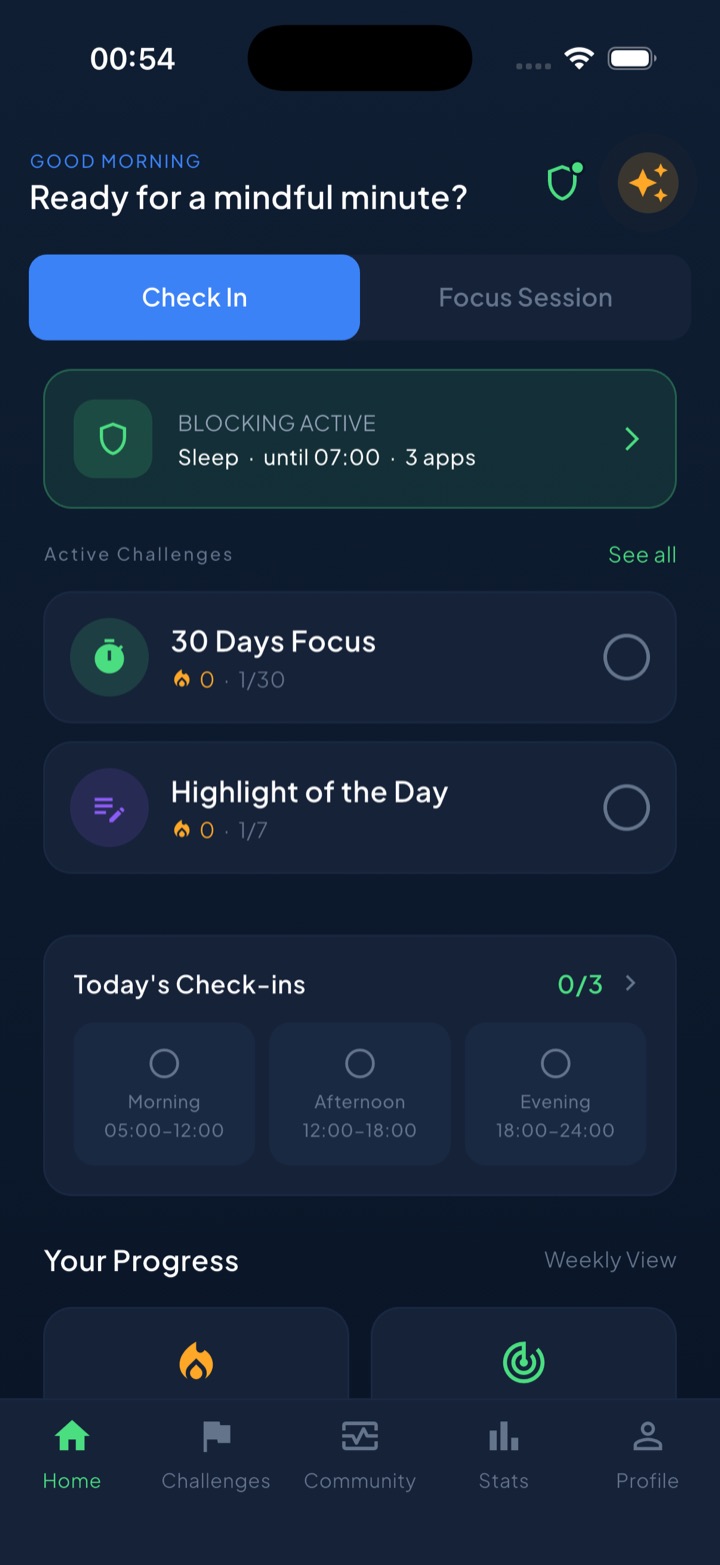
Unscrol is an iPhone and Apple Watch app built on Apple’s Screen Time and FamilyControls frameworks, so its blocks are enforced by the system rather than drawn on top of it. You set a daily total (45 minutes by default) and a per-session maximum (5 minutes by default): spend a session-sized chunk of the budget and the chosen apps lock for 15 minutes, spend the whole daily budget and they lock until tomorrow. Shield is the scheduled half — blocking by time of day, so the ten o’clock decision you made at lunchtime is the one that actually runs at ten o’clock — and switching it off mid-block is deliberately slow: a breathing exercise and a wait, not a dismissal. A streak counts every day you finish under budget, and home-screen and lock-screen widgets show where you stand without you opening anything.
Two caveats, plainly. The usage numbers are threshold-based estimates, because iOS reports crossed thresholds across an interval rather than exact minutes, so read the budget as approximately right rather than precise to the second. And iOS hands the app opaque tokens rather than app identities: Unscrol cannot see which apps you picked, their names or their icons, and your block lists and usage data stay on-device. Free to download, with an optional premium tier adding Streak Saver for a missed day and five concurrent challenge slots instead of one.
Frequently asked questions
What does JOMO mean?
JOMO stands for the joy of missing out, the deliberate opposite of FOMO. Instead of treating a party you skipped or an app you did not open as something taken from you, you treat it as something you chose, which makes the exact same evening feel completely different. The term was popularized by tech writer Anil Dash in a 2012 essay and has spread widely since, largely because a decade of fear of missing out left people checking constantly and enjoying none of it. JOMO is not anti-social and it is not a permanent no; it is the small, repeatable skill of deciding in advance what you are going to miss, so that missing it costs you nothing.
What is the difference between FOMO and JOMO?
FOMO asks what is happening without you. JOMO asks what you want the evening to be. Both questions are about the same gap in your night, but only one of them has an answer you can actually reach, because no amount of checking ever proves you missed nothing. The deeper difference is who owns the clock: an expiring story or a streak sets a deadline you did not choose, while JOMO takes the clock back by making one decision in advance, while you are calm. It even shows up in how you decline, since FOMO says no with an apology and a reason, and JOMO just says not this one.
How do I practice JOMO without feeling guilty?
Start by declining without building a case, because a no that needs evidence is a loss you justified rather than a choice you made. Then move the friendships you actually care about onto formats that cannot expire, such as a standing weekly plan or a phone call on the way home, so your social life stops depending on catching things before they vanish. Expect the first ten minutes of a cleared evening to feel restless rather than peaceful; that is withdrawal, not proof that JOMO is not for you, and it passes within a few nights. It also helps enormously to pick your shutdown time at lunchtime rather than at ten at night, when you would be negotiating with the version of you who has just been scrolling.
Is JOMO just a nicer word for being left out?
Not if it is genuinely chosen, because JOMO has a cost built into it: you could have gone, and you decided not to. If you were never invited in the first place, what you are feeling is loneliness rather than the joy of missing out, and that deserves plans rather than a reframe. A useful test is how the evening lands afterwards, since a real JOMO night leaves you rested while the counterfeit version leaves you relieved and slightly hollow. The other honest limit is that if your checking is compulsive rather than social, and the thought arrives after the tap, a reframe alone will not hold.