You are experiencing phantom vibration syndrome, it is not a sign that anything is wrong with your phone or with you, and depending on the survey, somewhere between two thirds and nine out of ten phone users report exactly the same thing. You felt the buzz against your thigh. You reached in. Blank screen, no badge, nothing waiting. This is not a hallucination in any dramatic sense, it is a misfiled signal: your brain has spent years learning that one particular flutter against your leg means something is waiting for you, and it now applies that label a little too eagerly, to a muscle twitch, to your trousers shifting as you stand, to almost nothing at all. The interesting part is not that your brain made an error. It is which error it chose to make.

What exactly is phantom vibration syndrome?
It is the sensation of your phone vibrating when it did not. The sound version, hearing your ringtone inside running water or a car engine, is called phantom ringing, and some researchers have grouped both under the friendlier name ringxiety.
One thing about the word syndrome: it is not a disorder, it is not in any diagnostic manual, and nobody is going to treat you for it. Researchers borrowed the word because the sensation is consistent, repeatable and shared by almost everyone. It makes the thing sound like a malfunction, when it is closer to the opposite, a system doing what it was trained to do slightly too well.
The phenomenon got its reputation in a hospital. A 2010 survey of medical residents found that roughly two thirds regularly felt their pager go off when it had not, and residents were the perfect test case because their pagers carried real consequences, so the stakes attached to each buzz were unusually high. Later surveys of undergraduates put the figure closer to nine in ten, with the typical experience landing around once every couple of weeks. Almost nobody described it as distressing. They described it as strange.
Why does my brain invent a buzz that never happened?
Because it is not inventing anything. It is classifying.
Below the level you have access to, your brain runs a constant sorting operation on physical sensation. Fabric moves. A muscle in your thigh fires a small involuntary twitch, which happens to nearly everyone many times a day and is normally beneath notice. Your leg presses against the chair. A lorry passes outside and the floor carries it up. Each of these is a smear of low-frequency, low-amplitude input arriving at roughly the place your phone lives, and each has to be labelled as something or discarded.
The label your brain reaches for first is the one it has used most, and you have trained it thoroughly. Every real buzz for the last decade arrived paired with something worth having: a message from someone you like, a reply you were waiting on, news, resolution. That is exactly the pairing that builds a strong perceptual template. Your brain is not neutrally observing your thigh, it is actively looking for the phone there, and looking for something changes what you find.
Which is why the sensation feels so specific. You do not get a vague tickle you then reason into calling a notification. You get a notification. The classification happens before it reaches you, which is also why knowing all this does not stop it.
Is this a glitch, or is my brain doing it on purpose?
On purpose, in the only sense that matters, and this is the part worth knowing about yourself.
Any detector facing an ambiguous signal has to set a threshold, and that threshold forces a trade-off between two errors. Set it high and you miss real events. Set it low and you raise false alarms. No setting avoids both, so the only question is which error you would rather make.
| Your phone really buzzed | Your phone did not buzz | |
|---|---|---|
| You feel a buzz | Correct, you check, the message is there | False alarm, the phantom |
| You feel nothing | Missed, the message sits unread | Correct, nothing happens |
Now price those errors the way your nervous system prices them. A false alarm costs two seconds and a flicker of embarrassment. A miss costs your manager’s message going unanswered for an hour, a friend deciding you ignored them, the thing you waited on all day sitting unread. Your brain has run that comparison thousands of times without consulting you, and it settled where any sensible detector would: lower the threshold, accept the false alarms.
So the phantom buzz is not noise in the system. The phantom buzz is the readout of how important your phone has become. How often you false-alarm is a direct measure of how expensive your brain believes a missed notification to be.
What does it say about me that this keeps happening?
That some part of your attention never fully leaves the phone, even when it is face down, silent and across the room.
A threshold has to be maintained in order to be crossed, which means a monitoring process is running the whole time the phone is on your body. It is cheap, far below awareness, and costs you nothing you could point to. But it runs during the meeting, during dinner, and during the paragraph you have now read three times. If that last one sounds familiar, it is the mechanism behind brain fog and screen time: not one big distraction, but a permanent small tax on whatever attention is left over.
It also explains a symptom people file separately. The low-level unease when you cannot find your phone is the same monitoring process reporting that it has lost its object. Nomophobia, the anxiety of being without your phone, and phantom vibrations are one trained expectation seen from two sides, and the reason you cannot stop checking is the third face of it: an unpredictable reward schedule keeping that expectation permanently warm.
Does phantom vibration syndrome ever go away?
Yes, and faster than most people expect, because anything learned can be unlearned.
The consistent pattern is that phantom vibrations track how much you are waiting for: they rise with your notification load and fall when it falls. Residents reported them fading once they stopped carrying pagers, and people who strip their alerts back to the few that genuinely matter tend to report the sensations thinning out over a couple of weeks rather than months. You are not undoing a decade of conditioning, you are removing the daily reinforcement that keeps the threshold pinned low, and thresholds drift back up on their own once nothing is pushing them down.
How do I make the ghost buzzes stop?
Four changes, in descending order of how fast you will feel them.
Turn vibration off entirely, not down. The counterintuitive one, and by far the fastest. People instinctively soften the buzz or pick a gentler pattern, which keeps the reference signal alive while making it harder to match, producing more ambiguity and more phantoms. Remove it completely and the classifier has nothing left to compare against. Two exposed days, then the pocket goes quiet in a way you had forgotten was possible.
Cut what is allowed to interrupt you. Every app with permission to buzz you feeds the background expectation. Keep calls, calendar, and messages from actual humans; remove everything that is a company talking to you. Notification overload covers doing this without missing anything real, and if the loudest source is a thread rather than an app, group chat overwhelm handles that case.
Move the phone off your body. The sensation needs a surface to appear on, so a phone on the desk cannot produce a phantom in your leg. Swapping pockets buys you a while too, because the new spot has no learned association yet. Symptom relief rather than cure, but it works the same day.
Reduce how often you check. The slow fix, and the only one that touches the cause. Phantom vibrations are a priority readout, and priority falls when the phone stops being the thing you turn to twenty times an hour. Fewer sessions, and windows where opening the app simply is not available, are what push the threshold back up. If most of your checking happens between nine and six, phone addiction at work is this aimed at the working day.
“I thought I was the only one. I was in a client meeting, felt my phone go in my jacket, and did the thing where you pretend to adjust your posture so you can look. Nothing. Third time that day. I turned vibration off completely that weekend and hated it for about three days, kept pulling the phone out to check I had not missed anything. Two weeks later my pocket had gone quiet. I had not realised how much of my attention was sitting in there.” — Daniel, account manager, 34
How does Unscrol help?
The honest starting point: some of this is free, today, in Settings. Apple’s Screen Time gives you daily App Limits per app or category, Downtime for scheduled windows, and a weekly average so you can see how often you actually reach for the phone. Notification permissions cost nothing either, and turning vibration off, the most effective change above, is a toggle. If cutting your alerts and killing the buzz is enough to quiet your pocket, you are done and should not buy anything.
Where the built-in tools run out is the frequency half. App Limits are cumulative daily budgets that arrive once, usually long after the habit has run, and they ship with a one-tap dismissal. Nothing native caps a single sitting, and nothing makes the twentieth pickup of the morning harder than the first.
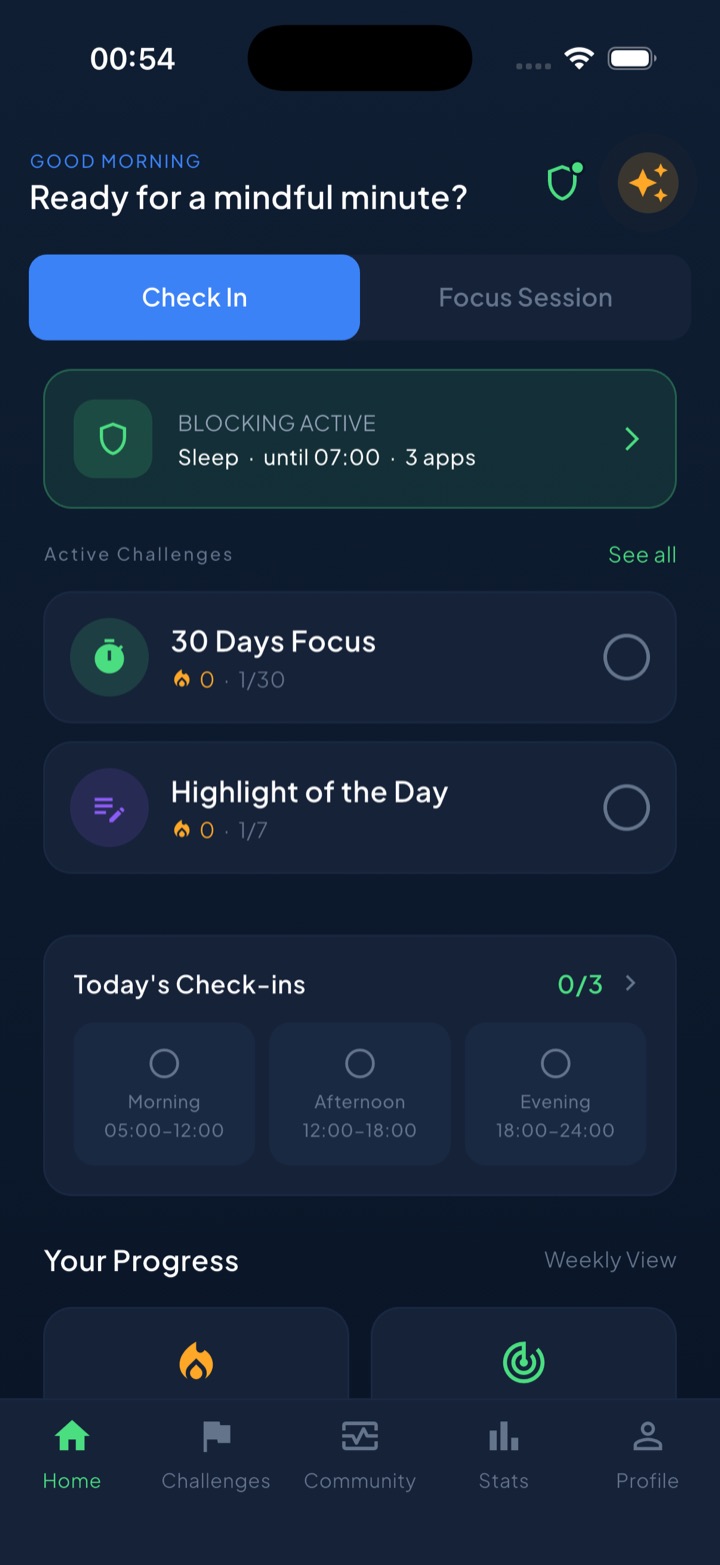
Unscrol is an iPhone and Apple Watch app aimed at that gap, which is the gap the phantom lives in. You set a daily total (45 minutes by default) and a per-session maximum (5 minutes by default), and iOS enforces both through the Screen Time and FamilyControls frameworks rather than a cosmetic overlay. Use a session-sized chunk of the budget and the apps you chose lock for 15 minutes; spend the whole daily budget and they lock until tomorrow. Shield is scheduled blocking by time of day, and switching it off mid-block is deliberately slow, a breathing exercise and a wait rather than a one-tap escape, which matters because the moment you want out is the moment the trained expectation is loudest. A streak counts every day you finish under budget, and home-screen and lock-screen widgets show what is left without you unlocking anything. The connection to the ghost buzzes is direct: your brain lowered its threshold because the phone earned a high priority through constant reward, that priority is maintained by how many times a day you go to it, and fewer sessions are how it comes back down.
Two caveats, plainly. The usage numbers are estimates, because iOS reports usage as crossed thresholds over an interval rather than exact minutes, so treat the budget as approximately right rather than accurate to the second. And iOS hands the app opaque tokens, never app identities: Unscrol cannot see which apps you picked, their names, their icons or your per-app usage. The system draws the app picker and the app only draws the frame around it, while block lists and usage data are processed on-device by iOS and never reach Unscrol’s servers. Free to download, with an optional premium tier adding Streak Saver for a missed day and five concurrent challenge slots instead of one.
Frequently asked questions
What is phantom vibration syndrome?
Phantom vibration syndrome is the sensation of your phone vibrating in your pocket or bag when it did not vibrate at all. The matching version for sound is called phantom ringing, where you hear your ringtone in a noise that was never your phone. Despite the name it is not a recognised medical disorder and it does not appear in any diagnostic manual; researchers use the word syndrome loosely to describe a very common perceptual error. Surveys of students, office workers and hospital staff put the share of people who have felt it somewhere between two thirds and nine out of ten.
Is phantom vibration syndrome a sign of anxiety or a mental illness?
It is not a mental illness, and on its own it is not evidence of an anxiety disorder either. It is a learned perceptual habit: your brain has paired one specific physical sensation with an important reward thousands of times, and now applies that label too readily to ambiguous input like a muscle twitch or fabric moving against your leg. Most people who report phantom vibrations describe them as mildly odd rather than distressing. What it does reliably indicate is how much attention your nervous system is quietly reserving for your phone, which is worth knowing even though the sensation itself is harmless.
How do I stop feeling phantom phone vibrations?
The fastest single change is to turn vibration off entirely rather than turning it down, because your brain cannot keep matching sensations against a signal that no longer exists. After that, cut the number of apps allowed to interrupt you, so the expectation of an alert stops running in the background all day. Moving the phone helps too, whether that means a different pocket, a bag, or the desk instead of your body, since the sensation needs a body surface to appear on. The deepest fix is reducing how often you check at all, because the phantom is a readout of priority and priority falls when the checking falls.
Why do I hear my phone ringing when it is not?
Phantom ringing works the same way as phantom vibration, just in a different sense. Running water, a distant siren, an extractor fan and the hum of a car engine all contain a broad spread of frequencies, and somewhere inside that noise your auditory system finds a pattern close enough to your ringtone to flag it. This is why it happens most in the shower, in the car and near anything with a motor. It fades with the same measures that reduce phantom vibrations, and changing your ringtone to something unlike the background noise you live in often helps immediately.