You are not behind on your group chats, and you were never actually on call. Fourteen chats, three hundred unread and a permanent low hum of guilt is not a personal failure of organisation. It is what happens when a medium built for two people gets used by forty, all day, with no closing time. Group chats hook harder than any feed because they add the one thing TikTok cannot: a real person on the other end who can see that you read it. The fix is not leaving your friends. It is deciding in advance, while calm, which chats may interrupt you and when you show up.

Why do group chats feel more exhausting than a social feed?
Because a feed is optional and a group chat has witnesses.
Three mechanics stack. Social obligation: nobody feels judged for not opening Instagram, but not answering the flat chat about the boiler is a small act of neglect with your name attached. Variable reward: most of what arrives is logistics and noise, and then every so often something is genuinely funny or genuinely important, the same unpredictable payout schedule that makes slot machines work, except now your friends are the machine. Read receipts, which quietly turned a private act into a public one — “Seen 14:12” is surveillance you agreed to install on yourself.
Together they beat any feed on daily opens. A feed gives you FOMO about strangers, uncomfortable but abstract. A group chat gives you FOMO about your own life, the reflex behind why you can’t stop checking your phone and, when the phone is out of reach, behind nomophobia.
Do I have to catch up on 300 unread messages?
No. Read the last twenty and let the other 280 go.
The catching-up instinct treats the badge as a debt you accrued while living your life. It is not a debt, because group messages have a very short half-life. An argument about where to eat on Tuesday is worthless by Thursday, and the people who sent those 280 messages could not tell you what they said either.
So jump to the newest message, read the last screen for context, and start there without apology. The safety net already works: if it actually matters, it becomes a direct message. Escalation is not a flaw in the system, it is the system. Kill the badge while you are here — a red number on an icon is an open loop, and open loops are a documented ingredient in social media and anxiety.
Is muting a group chat a betrayal?
Muting is not leaving. It changes when you find out, not whether. It feels like walking out of a room; it is closer to taking the bell off your neck while staying in it. Nobody can see that you muted, no message is lost, and the history is all there when you arrive. What you are muting is not the people, it is the timing.
The real fear underneath is worth naming: mute it and you miss the joke that becomes next month’s inside reference. That fear is not irrational, and yes, occasionally you will. It also matters far less than it feels, because inside jokes survive by repetition — that is what makes them inside jokes. You will miss the origin and still meet the twelfth iteration, and asking what it means costs two seconds, not an exile.
The mute is not betrayal rule: you owe a group your attention, not your availability. Those are different things, and only one of them is infinite.
How should I set up notifications for fourteen chats?
Sort every chat into three tiers and give each tier different permissions. This single pass does more than any amount of willpower.
| Tier | What gets through | Which chats belong here |
|---|---|---|
| Nothing | No sound, no banner, no badge, muted indefinitely | Dead chats, meme chats, anything over fifteen people, the one nobody leaves |
| Summary | Badge or a quiet grouped digest, seen only when you open the app | The majority: friends, football, the flat, work-social |
| Can wake you | Sound, banner, allowed through Do Not Disturb | Two to four at most, and ideally people rather than groups |
The rule that makes this work is in the last row. The top tier should be people, not chats. Almost no group of fourteen deserves the right to wake you at midnight, but your sister does, and your flatmate does when the boiler is actually on fire. iOS lets you allow specific contacts through a Focus mode, which is exactly this tier and costs nothing. Expect the middle tier to hold ten or eleven of your chats, and expect that to feel drastic for three days. If your settings have never had a clear-out, notification overload is the wider version of the same job.
“I counted mine properly and it was fourteen. Two of them I had not opened since March and still felt bad about. What actually fixed it was turning off read receipts and putting everything except my family chat on badge-only. I check at lunch and again around nine. Nobody has noticed, and one friend told me I had got better at replying, which is the funniest possible outcome.” — Jess, events assistant, 26
What is a reply window, and why is it better than replying instantly?
A reply window is a time you show up rather than a speed you reply at. Pick two, roughly ten minutes each, at the same times most days. After lunch and after dinner works for most people.
It works because of expectation setting. Instant replies teach people to expect instant replies, and the service level agreement you are now failing to meet is one you wrote yourself, unilaterally, by being available at 11pm once. Two windows a day and you quietly become someone who replies in the evening, which is a completely normal thing for an adult to be.
Reply windows also dissolve the left-on-read problem from the other end. That anxiety comes from opening a chat you have no energy to answer, marking it seen, and then owing a reply you never agreed to owe. Open chats only inside a window and you only ever open them when you can answer. And the highest-leverage setting on the list: turn off read receipts. It removes the surveillance layer for you and everyone you talk to. Same batching logic as how to stop checking email constantly, applied to friends instead of colleagues.
How do I leave a dead group chat without it becoming a thing?
Most dead chats do not need a leaving speech. They need archiving, which nobody can see. Sort your exits by the drama they actually require: archive (silent, reversible, right for chats that are merely dormant), mute indefinitely (right for the one nobody leaves), leave with one warm line, or leave without a word. Scale the ceremony to the size of the group: under about six people a friendly sentence is worth writing, and over twenty the system message scrolls past unnoticed.
If you write the line, keep it short, warm and free of diagnosis — this was a great one, I am cutting my chats down to a handful, message me directly any time. What you never do is explain at length, leave mid-argument, or tell the group what is wrong with it on the way out. The stag-do chat three months after the stag do is archaeology, not a relationship, and everyone in it knows.
Do messaging apps need a screen time limit too?
Yes, and they are the exact apps people exempt. Everyone puts TikTok behind a limit and leaves the messenger wide open, because messaging is communication rather than scrolling. That distinction holds much less now that the “just checking” spiral starts in the messenger: you open it to answer one person, see six other chats wearing badges, take the tour, and twenty minutes later you still have not answered the person. Add the feeds messengers have bolted on — statuses, channels, updates — and the exemption does far less work than it used to.
The right instrument is not a hard block, because you genuinely need the app. It is a cap on how long one visit lasts, plus a scheduled window at each end of the day: the same idea as an after-work shutdown ritual, applied to the one app you will never delete.
How does Unscrol help?
The honest starting point: a lot of this is free and already on your phone. iOS gives you App Limits per app or category, Downtime for scheduled windows, Scheduled Summary to collect non-urgent notifications into a digest, and Focus modes that let named contacts through while everything else waits. That last one is your top tier, at no cost. If a notification clear-out and two reply windows fix your week, you are done. Where the built-in tools run out is the per-visit half: iOS has no native cap on a single sitting, and App Limits ship with a one-tap dismissal.
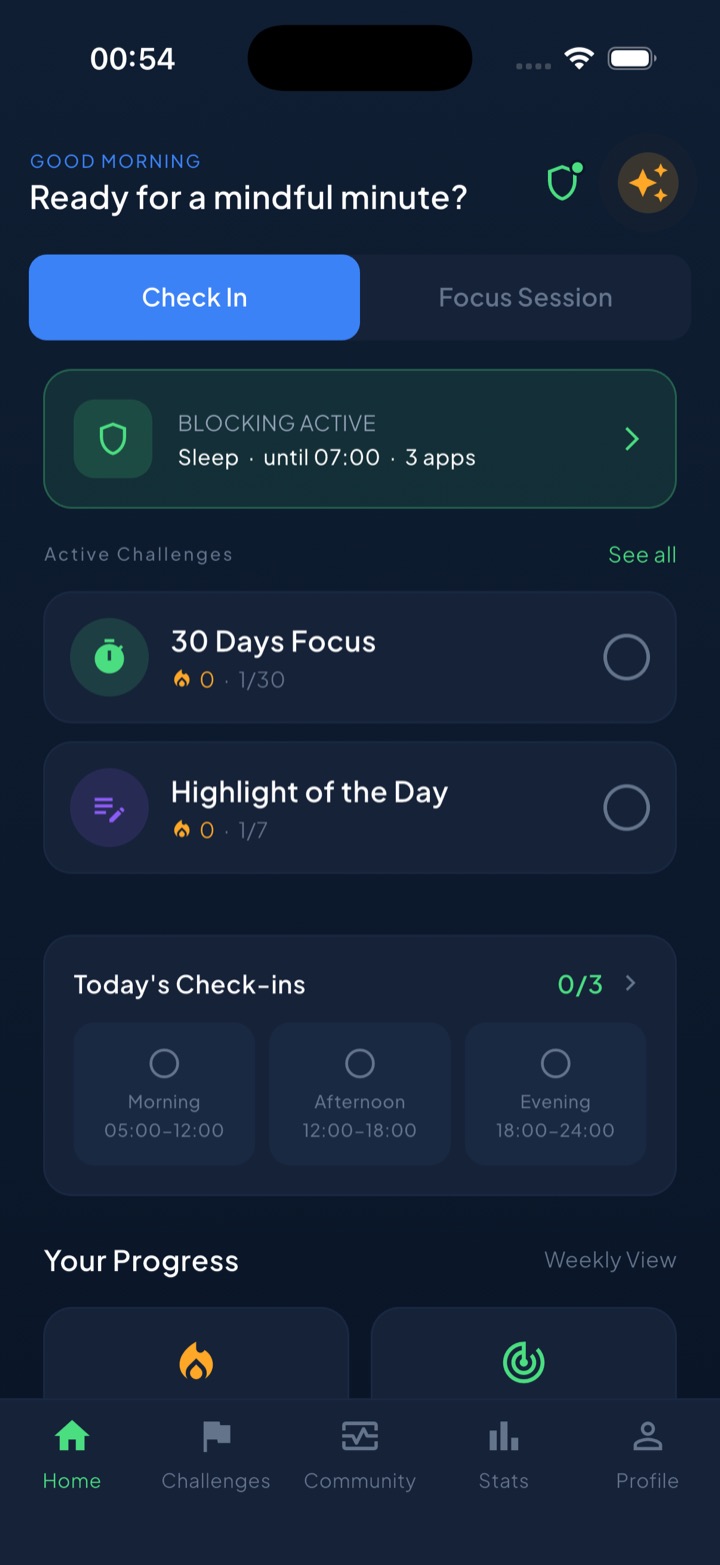
Unscrol is an iPhone and Apple Watch app built around two numbers: a daily total (45 minutes by default) and a per-session maximum (5 minutes by default), both enforced by iOS through the Screen Time and FamilyControls frameworks rather than a cosmetic overlay. Spend a session-sized chunk of the budget and the chosen apps lock for 15 minutes; spend the whole daily budget and they lock until tomorrow. Shield is scheduled blocking by time of day, and switching it off mid-block is deliberately slow: a breathing exercise and a wait, not a one-tap escape. A streak counts every day you finish under budget, and home-screen and lock-screen widgets show what is left without you unlocking anything.
Being straight about the fit: hard-blocking your main messenger all day is not realistic for most people. What suits a group chat problem is the session cap — a five-minute check that ends before the badge tour starts — plus Shield windows over your deep-work hours and your last hour before sleep. Two caveats: the usage numbers are estimates, because iOS reports crossed thresholds across an interval rather than exact minutes, and iOS hands the app opaque tokens instead of app identities, so Unscrol cannot see which apps you picked, their names or your per-app usage, with block lists and usage staying on-device. Free to download, with an optional premium tier adding Streak Saver for a missed day and five concurrent challenge slots instead of one.
Frequently asked questions
Is it rude to mute a group chat?
No, and nobody can tell. Muting is invisible to the other people in the chat, it does not remove you from the group, and it does not stop you receiving anything. All it changes is when you find out, not whether you find out. The version of you that replies at eight in the evening because you chose to is a better group member than the version that half-reads a message during a meeting and forgets to answer, so muting usually improves your presence in a chat rather than reducing it.
Do I need to catch up on hundreds of unread messages?
No. Group messages have a short half-life, so a debate about where to eat on Tuesday is worthless by Thursday and nobody in the chat remembers sending it either. Jump to the newest message, read the last screen or two for context, and let the rest go unread forever. If something genuinely needed you, it will have been repeated, or the person who needed it will have messaged you directly, which is the escalation system working exactly as intended.
How many group chats is too many?
The number that matters is not how many chats you are in but how many are allowed to interrupt you. Most people can sit in twenty chats quite comfortably if only three of them make a sound. The problem starts when every chat has the same permissions as every other chat, because then the flat group about a broken boiler pulls exactly as hard as your closest friends. Sort by permission rather than by membership and the count stops mattering.
Can I put a time limit on WhatsApp without missing important messages?
Yes, if you use a per-session cap rather than an all-day block. A five-minute session limit lets you open the app, answer what needs answering and get out, then closes it before the badge tour begins, which is where most messenger time actually goes. Reserve full blocking for scheduled windows such as deep work and sleep, when you would not have answered anyway. Anyone with a genuine emergency will call, and a phone call cuts through a limit that a chat message never should.