Dating app burnout is real, it has a recognisable shape, and it is now closer to the majority experience than the exception. You are not uniquely cynical or uniquely bad at this. Something in the machine is producing this outcome at scale: people start hopeful, swipe more over time, enjoy it less each month, and end up with a worse opinion of dating in general than when they began. The apps can see it in their own numbers, which is why they keep relaunching themselves around intention, slowness and “meeting in real life”. But the honest diagnosis is not that swiping is evil. It is that the way most people swipe — an hour a night, half-attentive, horizontal — is the part doing the damage.

Why do dating apps burn you out so fast?
Because a dating app is a slot machine wearing a romance costume.
The mechanism is a variable-ratio reward: most swipes give you nothing, a few give you a match, and you can never predict which. That schedule is the most habit-forming one psychologists know of, which is exactly why it runs casinos. If every tenth swipe produced a match, you would get bored. Because it is unpredictable, you keep going, and the going itself becomes the activity. How apps are designed to be addictive walks through the same machinery in feeds, and what dopamine actually does explains why the anticipation, not the match, is the part that hooks.
Then there is the uncomfortable structural fact: the swipe is the product, not the date. This is not a conspiracy, just incentives. An app that put you into a happy relationship on day three would lose a user on day four. Nobody in the building is scheming against your love life, but the metric on the dashboard is sessions, retention and time in app, and every product decision that gets shipped is one that moved those numbers.
The third ingredient is the one people underestimate. You are performing rejection at industrial scale, in both directions. Two hundred micro-judgements a night, most of them negative, most of them received back. No previous generation’s nervous system was asked to do that, and doing it while tired, on a sofa, after work, is not a neutral activity.
Is doomswiping just doomscrolling with hope attached?
Essentially yes, and the hope is what makes it harder to stop.
You already know that an hour of doomscrolling was a waste. That knowledge is a brake. But an hour of swiping comes with a story: you are being proactive, you are putting yourself out there, you are working on your life. It is the only feed on your phone that feels like a responsibility, so the guilt that eventually ends other sessions never arrives.
Meanwhile the apps have quietly adopted the entire feed toolkit. An infinite stack with no bottom. Notifications timed for the evening. Blurred “someone likes you” counters that resolve only if you open the app or pay. Streak-adjacent mechanics that punish absence. It looks like dating; underneath, it is the same architecture as the apps that keep you scrolling in bed.
Why does more swiping lead to fewer real dates?
This is the paradox at the centre of burnout, and there are three mechanisms behind it.
Decision fatigue flattens you. For the first ten profiles you read the bio, notice the third photo, form an actual impression. By profile fifty you are pattern-matching on a single image in under a second. People experience this as “getting pickier”. It is the opposite: your judgements are getting shallower and more arbitrary, and the person you would have liked at profile eight goes past unread at profile sixty.
Abundance makes the current option feel disposable. When the stack is infinite, every profile is implicitly compared to the ones you have not seen yet, and the research on choice overload is consistent — more options, less satisfaction with whatever you pick. The feeling that someone better is two swipes away is manufactured by the interface, not by the dating pool.
Conversation debt piles up. A long swipe session ends with a pile of matches you owe replies to. Replying is effortful; swiping costs nothing. So the cheap behaviour crowds out the expensive one, twenty half-dead chats sit there generating low-grade guilt, and the thing that actually produces a date — proposing a specific plan to one person — never happens.
Try the only metric that matters: hours swiped per date that actually took place. Most people who describe themselves as burnt out are running at something like fifteen or twenty hours per date. That ratio, not the app, is what is exhausting you.
Tired swiping vs intentional swiping
| Tired swiping | Intentional swiping | |
|---|---|---|
| When | After 10pm, sofa or bed | A chosen window, sitting upright |
| How long | Until you get bored or fall asleep | 10 to 15 minutes, on a timer |
| First action | Swipe | Reply to open conversations |
| What you are optimising | Matches | One concrete plan to meet |
| It ends when | The phone dies, or you do | The timer does |
| How it feels | Grazing | Running an errand |
| Weekly cost | Five to ten hours | Under an hour |
The row that decides everything is the first action. Open the app to swipe and you will swipe until something stops you. Open it to answer two messages and you leave with the thing you came for.
How long should a dating app session actually be?
Treat the app as a task, not a feed. Tasks have a definition of done; feeds do not, which is why feeds expand to fill whatever time exists.
Ten to fifteen minutes, two or three times a week, is enough for almost anybody. Inside that window, reply before you swipe. Cap your open conversations at around six, because past that you are running an inbox rather than a love life. And move toward meeting much faster than feels natural: if a conversation is going anywhere, propose something specific within about a week. Messaging is the queue, not the event, and long text rapport is one of the most reliable ways to build a stranger in your head who then does not show up.
Two structural helpers do more than willpower. First, make the session end on a timer rather than on your own boredom — a per-session cap is a different tool from a daily budget, and the difference is covered in session limits versus daily limits. Second, get the app out of your bed: late-night swiping is where the cynicism is manufactured, and it is also where the worst decisions get made. When the urge hits outside your window, a sixty-second reset is usually enough to let it pass.
When is deleting the apps the right call?
Sometimes the middle path is not the answer and you should just go. The clear signals: you open the app mainly when you feel low; months of swiping have produced no in-person meetings; you have started making bitter generalisations about an entire gender; you refer to people as options; or you do not actually want to date right now — a bereavement, a breakup, a brutal work year — but keep swiping so it feels like you are trying.
Be realistic about what deletion does on its own, though. Most people reinstall within a fortnight, usually on a quiet Sunday night, and the reinstall arrives with none of the rules that made the break useful. If you take a break, make it a defined one — thirty days, on the calendar — and decide now what the rules will be when you come back. A break with no return plan is just a longer pause between the same two behaviours. And if constant anxiety about how you are perceived is doing most of the damage, that follows you across apps, so it is worth addressing directly rather than app by app.
“I was on three apps for two years and I could not tell you the name of anyone I actually met. I would swipe from about eleven until my eyes gave out, wake up with sixteen conversations I did not want to have, and feel like dating had become a second job I was failing at. Now the apps unlock for fifteen minutes on Tuesday and Sunday, and they lock again whether or not I am finished. Fewer matches, obviously. Four actual dates in two months, which is four more than the whole of last year.” — Daniel, structural engineer, 32
How does Unscrol help?
The honest starting point: you can get part of the way there for free. Apple’s Screen Time will give you a daily App Limit on the dating apps, Downtime to cover your nights, and a real weekly average so you can see what a year of swiping actually costs. If a daily number plus a sleep schedule is enough to make you stop, use it and buy nothing. Where the built-in tools run out is the session half: iOS has no native per-sitting cap, so a 45-minute daily budget can still be spent in one 45-minute lie-down, which is precisely the session that produces the burnout.
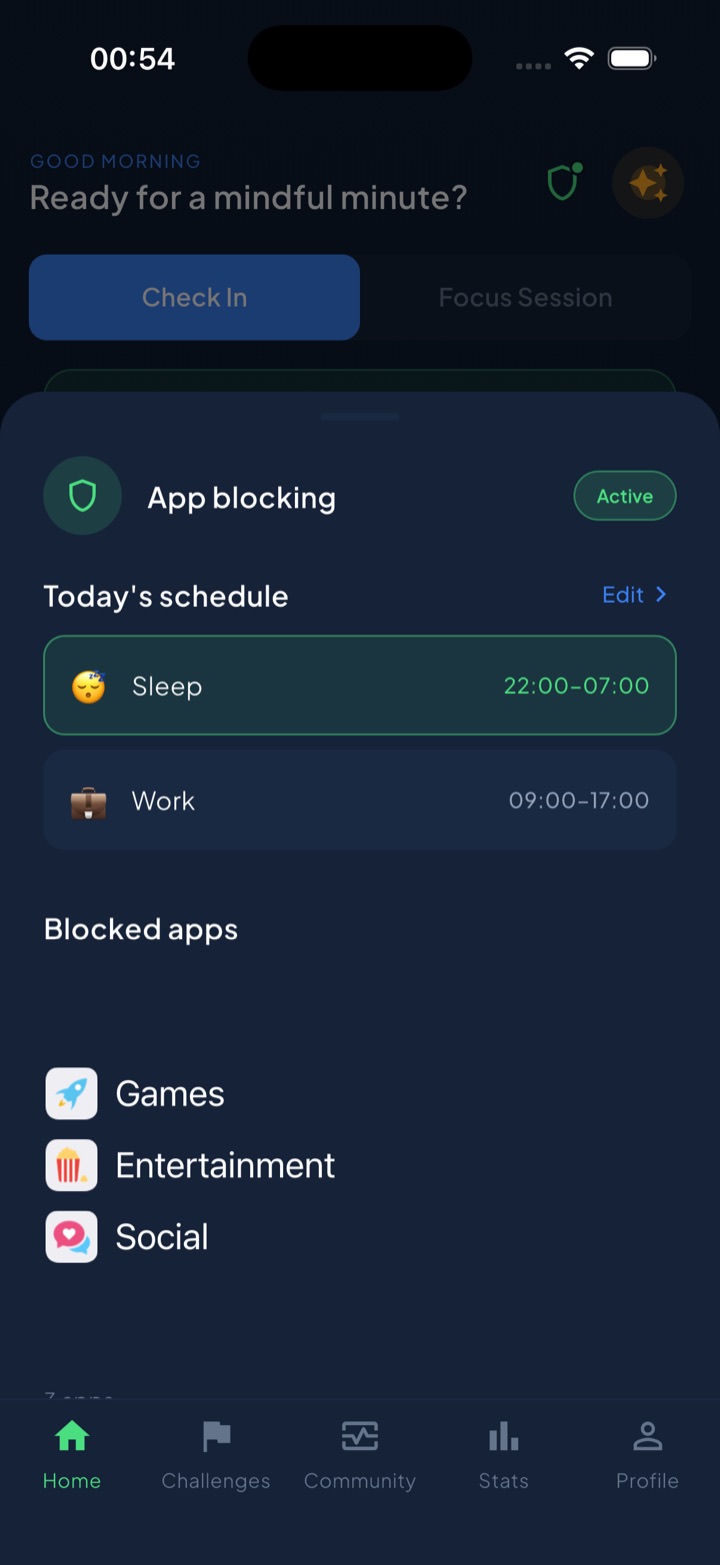
Unscrol is an iPhone and Apple Watch app built around the two numbers this problem needs. You set a daily total (45 minutes by default) and a per-session maximum (5 minutes by default), and iOS enforces both through the Screen Time and FamilyControls frameworks rather than a cosmetic overlay. Spend a session-sized chunk of the budget and the chosen apps lock for 15 minutes; spend the whole daily budget and they lock until tomorrow — which is exactly the “the timer ends the session, not my eyelids” mechanism. For the placement problem, Shield is scheduled blocking by time of day, so you can make the apps simply unavailable after ten at night, and switching it off mid-block is deliberately slow: a breathing exercise and a wait, not a one-tap dismissal. A streak counts every day you stay under budget, and home-screen and lock-screen widgets show what is left without you opening anything.
Two things worth stating plainly, and one of them matters more here than anywhere else. The usage numbers are estimates, because iOS reports crossed thresholds across an interval rather than exact minutes, so treat the budget as approximately right. And iOS hands the app opaque tokens, never app identities: Unscrol cannot see which apps you picked, their names or their icons, and your block list and usage stay on-device rather than reaching any server. For dating apps specifically that is the difference between a private arrangement with yourself and a list of your romantic habits sitting in someone’s database. Free to download, with an optional premium tier adding Streak Saver for a missed day and five concurrent challenge slots instead of one.
Frequently asked questions
Is dating app burnout a real thing or am I just being negative?
It is real, it has a shape, and it is now closer to the majority experience than the exception. The pattern is consistent: you start hopeful, you swipe more over time, the swiping gets less enjoyable, and your opinion of dating in general gets worse. Burnout in any domain comes from sustained effort with unpredictable reward, and a dating app is almost a laboratory version of that. Feeling cynical after a year of swiping is not a personality flaw, it is what that particular loop does to most people who run it long enough.
Why do I get fewer dates the more time I spend swiping?
Because tired swiping is low-quality swiping, and volume is not the input that produces dates. After forty or fifty profiles your brain stops reading bios and starts pattern-matching on the first photo, which makes your choices shallower rather than pickier. At the same time, a long swipe session leaves you with a pile of open conversations you owe replies to, and replying is the expensive part while swiping is the cheap part. So the hours go up, the matches go up, and the number of people you actually sit across from goes down.
Should I delete dating apps completely?
Full deletion is the right call in a few specific situations: if you open the app mainly when you feel low, if months of swiping have produced no in-person meetings, if you have started thinking about an entire gender in bitter generalisations, or if you do not actually want to date right now but keep swiping to feel like you are trying. Otherwise, deletion on its own tends to fail, because most people reinstall within a fortnight during a quiet evening. A time-boxed relationship with the app usually survives contact with real life better than a dramatic delete does.
How long should a dating app session be?
Ten to fifteen minutes is enough for almost everyone, and the session should end on a timer rather than on boredom. Inside that window, answer your open conversations first and swipe second, because messages are what turn into dates and swipes are what turn into more swiping. Two or three sessions a week beats a nightly hour, and no session should happen in bed. Treating the app as a task with a definition of done is the single change that separates people who date from people who swipe.