For most people, no — and in this category a leaderboard is closer to an active harm than a neutral feature. Ranking helps a small group already near the top; for everyone else it produces weekly evidence that they are losing at something they already feel bad about. Worse, social comparison is usually the exact mechanism the user downloaded the app to escape. We know this from the inside: Unscrol shipped a leaderboard and then removed it. This article is the argument for that decision, including the part where competition genuinely does work.

What does a leaderboard actually do to your motivation?
It moves the goal from the inside to the outside.
You installed a screen time app for a private reason. You want your evenings back. You want to read a book without checking something twice a page. You want to be in the room with your kids. Those are internal goals, and they are durable precisely because nobody else has to know about them.
A rank replaces that with a different goal: be above other people. And once the external goal is in place, it tends to crowd out the one underneath it. This is the oldest finding in motivation research — introduce a salient external reward or score for something someone was doing for its own sake, and the original motive weakens. The reward becomes the reason. When the reward disappears, so does the behaviour.
The practical symptom is easy to recognise. You stop asking did I have a good evening and start asking what is my position. Those two questions have different answers surprisingly often.
Why is comparison the wrong mechanism for this specific problem?
Because comparison is the disease, not the treatment.
Social comparison against other people’s curated numbers is one of the better-evidenced pathways from social media to anxiety and low mood — it is one of the four mechanisms in social media and anxiety. Somebody arrives at a digital wellbeing app precisely because that loop has worn them down.
Then the app opens with a table of names and numbers, sorted.
A leaderboard in a wellbeing app is a feed with a scoreboard. It reproduces the mechanism the user is trying to escape, with the app’s own logo on it. That is a strange thing to do to someone on day one.
There is also a measurement problem that no design can fix. A nurse on twelve-hour shifts, a freelancer whose entire client relationship lives in Instagram DMs, a student on summer holiday, and a parent of a newborn will never produce comparable numbers. Ranking them together measures whose life is currently calmer, not who is trying harder.
What happens to people at the bottom of the board?
This is the part most product teams underweight, because they look at their own dashboards and see the engagement of the people at the top.
Ranking is motivating near a boundary. If you are fourth and third place is within reach, the board is genuinely energising. If you are 94th out of 300, the board tells you something you did not need to hear, in public, every week. Most users are not near a boundary. Most users are in the middle or the bottom, and for them the rank is a recurring reminder of failure.
That has a predictable consequence, and it is the same one covered in why shaming yourself doesn’t work: shame produces avoidance, and the first thing avoided is the app itself. A leaderboard does not convert a struggling user into a motivated one. It converts them into a churned one.
“I lasted about three weeks. There was a guy at the top with 42 minutes a day and I was averaging four hours because half my job is coordinating a team over WhatsApp. I knew that was not a fair comparison and it still made me feel like a failure every single Monday. I stopped opening the app rather than fix anything.” — Daniel, 38, site foreman
So when does competition actually work?
It genuinely does work, and pretending otherwise would be dishonest. Step challenges, sales boards, classroom contests and fitness-app group challenges all produce real behaviour change under specific conditions. Those conditions are narrow and worth naming precisely.
| Competition that works | Competition that backfires | |
|---|---|---|
| Who you are ranked against | People you know, in comparable circumstances | Strangers with different jobs, phones and lives |
| Duration | A bounded challenge with an end date | A permanent, always-visible rank |
| The metric | Something everyone measures identically | Screen time estimates that are not comparable |
| The activity | A side quest you opted into | The thing you were already anxious about |
| What losing costs | Nothing; the fun was the point | Confirmation of the story you already tell yourself |
| Emotional loading | Low. Steps, pages read, pull-ups | High. Self-control, discipline, identity |
Read the left column and you can see the shape of a good competitive feature: short, chosen, mutual, and about something you would happily discuss out loud. A two-week step challenge with four colleagues works because it ends, because everyone counts steps the same way, and because nobody believes their step count is a moral verdict on them.
Screen time fails every one of those tests. It is permanent, it is not comparable, it is loaded with self-judgement, and it is measured in estimates. The gap between the two columns is exactly why a feature that works beautifully in a fitness app becomes corrosive in a wellbeing one.
Why did we remove ours?
Four reasons, in the order they became obvious.
The numbers were never comparable. Screen time is derived from crossed thresholds, not stopwatch minutes, and two people’s totals mean different things even when the digits match.
It rewarded the wrong behaviour. A board rewards a low number. It cannot tell the difference between someone who genuinely reclaimed their evenings and someone who moved their scrolling to a laptop to protect a rank. Any metric that becomes a target stops being a good measure, an effect covered in the habit tracker guide.
It undermined the mechanic that was working. A private streak against a budget you chose is an agreement with yourself. A rank is an argument with strangers. The first survives a bad week; the second does not.
It conflicted with the architecture. Unscrol never sees which apps you chose or how you spend time in them; iOS keeps all of that on-device. Building a competitive layer on top of deliberately blurry, deliberately private data meant either weakening the privacy model or shipping a ranking we knew was crude. Neither was acceptable.
What should you use instead?
If you want the motivational pull without the comparison damage, the useful substitutes are all versions of the same idea: compare yourself to your own last week.
- A budget you set yourself. A number you chose is a commitment. A number ranking you against others is a verdict.
- A private streak. Streaks work through consistency and loss aversion, not through beating anyone — see why streaks build habits. Keep it visible only to you.
- One accountability partner, not three hundred. A person who knows your circumstances can tell the difference between a lapse and a busy week. A board cannot.
- Bounded group challenges. If you want competition, run it for two weeks, with friends, on something specific, and then let it end.
- A visible remaining allowance. Knowing you have nine minutes left today changes tonight. Knowing you are 94th changes nothing.
How does Unscrol help?
The honest starting point: Apple’s built-in Screen Time has no leaderboard, no feed and no social layer at all, and that is one of the best things about it. It is free, private, already on your iPhone, and it will never compare you to a stranger. If you can set an App Limit and respect it, that is genuinely the whole solution. Its one real weakness is enforcement — the Ignore Limit button hands the decision back to you at the precise moment you are least able to make it.
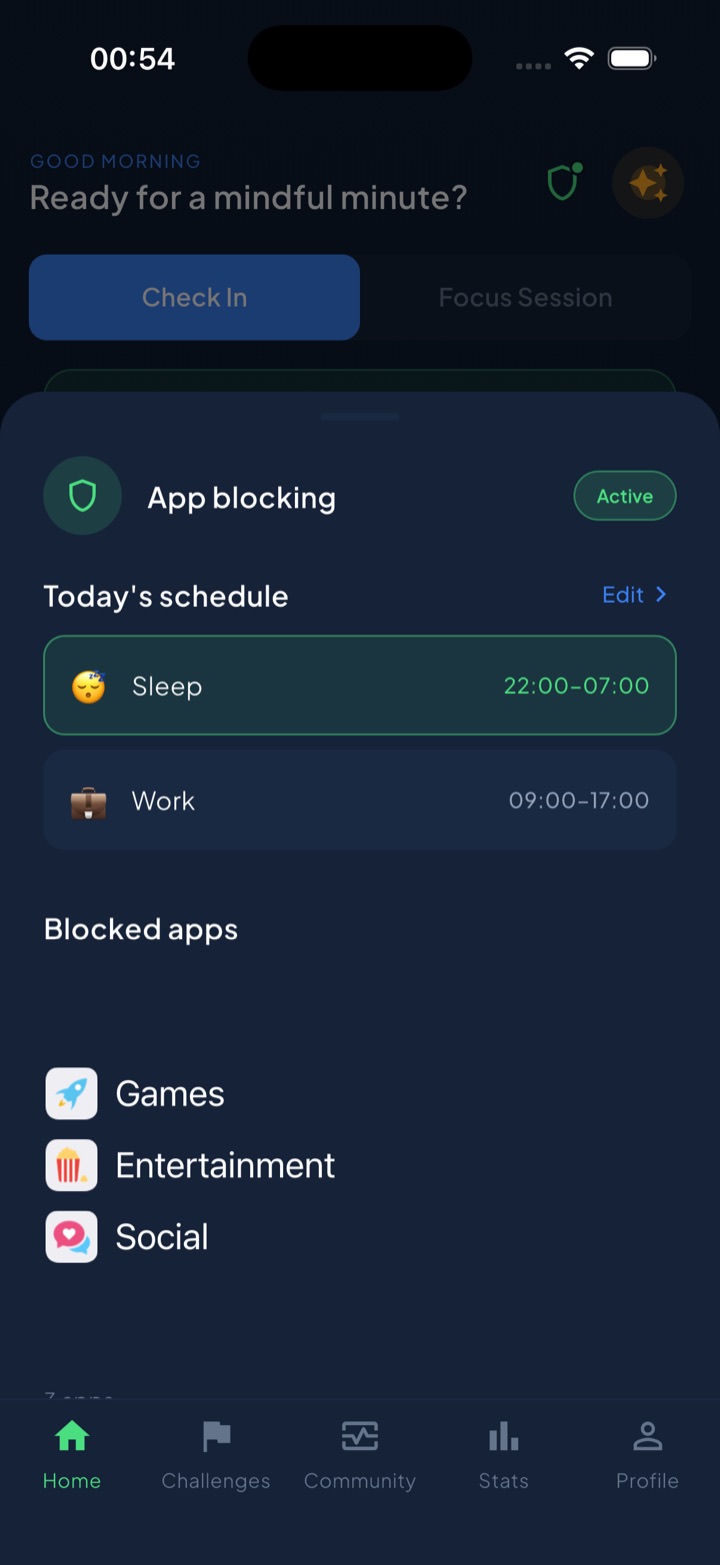
Unscrol is an iPhone and Apple Watch app built on the same Apple frameworks, and it now has no leaderboard either. The core is two numbers you pick: a daily total and a per-session maximum. Use a session-sized chunk of the budget and your chosen apps lock for 15 minutes. Spend the whole daily budget and they lock until tomorrow. A streak counts every day you stay under budget, and it is yours alone.
Around that, Shield blocks by schedule and is deliberately slow to turn off mid-session, Mind Break is a one-minute reflection, Streak Saver on the premium tier rescues a missed day, and 28 home-screen and lock-screen widgets can show the budget you have left. Around 117 challenges across eight categories give you something to do with the reclaimed time — the free plan tracks one at a time, premium five. Unscrol never learns which apps you chose: iOS hands it opaque tokens rather than app identities, and block lists and usage data are processed on-device and never reach Unscrol’s servers. Which is also, conveniently, the reason there is nobody to rank you against.
Frequently asked questions
Do leaderboards actually help people reduce their screen time?
For most users, no. A ranking helps a small group who are already close to the top and can realistically move up; for everyone else it supplies weekly evidence that they are losing, which drives disengagement rather than effort. There is also a specific irony in this category: the person installing a screen time app is usually trying to escape exactly the comparison dynamic that a leaderboard reinstalls. The behaviour is private, the circumstances are wildly different between users, and the numbers are estimates, so the ranking mostly measures whose life is calmer.
Why did Unscrol remove its leaderboard?
Because it optimised the wrong thing. A rank turns a private decision about your own evenings into a public score against strangers whose jobs, commutes and phones have nothing in common with yours. Screen time figures are estimates rather than exact minutes, so the comparison was never sound to begin with. And a board rewards the number rather than the life behind it, which is how people start gaming their own tool. Unscrol now compares you only against your own budget and your own previous days.
When does competition actually work for building a habit?
Competition works best when it is short, bounded, and among people you actually know. A two-week step challenge with five colleagues, a month-long reading contest between friends, a bounded team push with a clear end date. The conditions that make it work are consistent: an activity everyone measures the same way, roughly comparable circumstances, an opt-in that people chose, and a finish line. Permanent public rankings of a private, emotionally loaded behaviour fail all four of those conditions at once.
What should a wellbeing app use instead of a leaderboard?
Compare the user to their own past rather than to other people. In practice that means a budget the user sets themselves, a streak that only they can see, a visible remaining allowance for today, and a gentle recovery mechanic for a missed day. If social motivation is genuinely wanted, keep it small and chosen: one accountability partner, or a bounded group challenge with an end date. The general rule is that comparison should be opt-in, private by default, and never permanent.