Almost none of it means anything, and that is genuinely the reassuring part. Skibidi is not code for something you should know about. Gyatt is mostly a noise. The words your nine-year-old has now said forty times before lunch are, in the main, playground nonsense of exactly the kind every generation has produced, and half of them will be as dead as “on fleek” by Christmas. What is worth your attention is not the vocabulary at all. It is where the vocabulary came from, and how many hours of watching it took to arrive.

What do skibidi, gyatt and rizz actually mean?
Here is the decoder, written honestly. Treat it as a snapshot rather than a dictionary, because a good third of it will be out of date by the time your kid reads it over your shoulder, and they will very much enjoy telling you so.
| Term | Roughly means | Worry level |
|---|---|---|
| skibidi | Nothing fixed. A filler and intensifier from the Skibidi Toilet video series | None |
| rizz | Charisma, specifically romantic charm. Short for charisma | None |
| Ohio | Adjective for weird, cursed or bad. “This is so Ohio” | None |
| aura | Invisible social points, gained or lost. “Minus a thousand aura” | None |
| fanum tax | Taking a bite of someone else’s food, from a streamer’s bit | None |
| 6-7 | A chant with a hand gesture, from a song clip. Means nothing whatsoever | None, and short-lived |
| delulu | Delusional, usually said about oneself and affectionately | None |
| NPC | Someone on autopilot, from background video game characters | Low, can be used to dismiss people |
| gyatt | An exclamation about a large backside | Worth a conversation |
| sigma | A lone-wolf compliment, drifted out of manosphere vocabulary | Worth knowing the origin |
| mewing | Pressing the tongue to the roof of the mouth to sharpen the jawline | The gateway to the one below |
| looksmaxxing | The umbrella term for optimising your appearance by any means | The one actually worth watching |
Two things about reading that table. First, the meanings are soft on purpose. A word like skibidi has no stable sense; it works as an intensifier, a filler and a punchline depending entirely on delivery. When a child cannot define it, they are not hiding anything from you. There is nothing there to hide.
Second, notice how empty the worry column is. That is not me being relaxed for effect. Ten of those twelve are noise, and treating them as evidence of decline is how a parent spends their credibility on the wrong argument.
Why does the slang change so fast?
Because the feed does, and that is the actual finding buried in all of this.
Playground slang used to travel at the speed of a playground. A word appeared, spread through a year group over a few weeks, held for a season or two, then faded. The bottleneck was human contact, and it kept vocabulary alive long enough for you to notice it, learn it, and be embarrassing with it.
Now a phrase can be born in a fifteen-second clip, reach several million children in a weekend, saturate, and be uncool by the following weekend because using it marks you as late. The half-life has collapsed from a school year to roughly a month.
That collapse is the useful signal. The churn rate of your child’s vocabulary is a direct readout of how fast their feed cycles. Nobody learns twelve disposable words a term from three friends at break. You learn them from a very large number of very short videos, watched in stretches long enough to catch the same joke from forty different accounts, which is the mechanism the what is brain rot explainer covers on the science side. The words are the exhaust. The consumption is the engine.
Is any of it actually harmful?
Mostly no, and it helps to say why rather than just reassuring you.
In-group language is developmental work. It marks who is inside and who is outside, it is cheap to produce, and fluency in it is genuine social competence at nine. A child who can deploy the current word correctly is doing something skilful, and a child locked out of it is often the one having a harder week. Nonsense words are also just funny, and being nine is one of the last periods in life when a word can be funny purely because of how it sounds.
There are two places I would not wave it away. The first is anything about other people’s bodies, which is where gyatt sits. The issue is not the syllable, it is the habit of narrating strangers’ bodies out loud as a joke, and that is worth one calm conversation rather than a ban.
The second is the sigma and looksmaxxing corner. Most kids using sigma have no idea it drifted out of a specific online subculture, and mewing is genuinely just a jaw thing they saw in a clip. But that vocabulary sits at the edge of a much less playful world of appearance optimisation and ranking, and it is the one branch of the current lexicon where I would want to know which videos are arriving. If you want to change what arrives rather than argue about it, resetting the algorithm does more than any conversation will.
So what should I actually be watching?
Not the words. Three other things, none of which show up in the slang.
Session length rather than daily total. Twenty minutes of short video followed by going outside is a completely different event from ninety uninterrupted minutes ending in a blank stare. The total can be identical. The experience is not, and the long unbroken stretch is where the damage lives. This is the same distinction underneath popcorn brain and the reason short-form video is treated differently from television.
Sleep, from both ends. Screen time that eats the front of the night or wakes them early is the single clearest predictor of a bad week, and it is far more measurable than mood. If bedtime is drifting later by fifteen minutes a month, that is a real signal in a way that saying skibidi at dinner is not.
Whether they can still be bored. This is the one I would rank above everything. A child who cannot sit in a car for twenty minutes without a screen, who gets genuinely distressed by an unfilled gap, is telling you something about their baseline that no vocabulary audit will. Boredom tolerance is the skill being spent here, and it is the one worth defending.
If your child is a teenager rather than nine, the dynamics shift considerably and teenagers who will not get off the phone is the more useful piece. For the rough numbers by age, screen time recommendations by age is a reasonable starting frame, with the honest caveat that the shape of the time matters more than the total.
“I spent about four months correcting my son every time he said skibidi, and all I achieved was becoming the person he says it around less. What actually worked was asking him to explain a video to me. He talked for eleven minutes. I understood maybe a third of it. But I found out he watches most of it between half nine and eleven at night, which is the thing I could actually do something about.” — Dan, project manager and dad of a ten-year-old, 43
How do I talk about it without becoming the cringe parent?
Ask them to explain a meme to you, and mean it.
This sounds like nothing and it is the highest-yield thing on this page. Children are delighted to be the expert, an explanation takes several minutes, and in those minutes you learn which accounts they watch, which friends sent what, what they find funny and what they are pretending to find funny. A ban gives you none of that. Curiosity is not a soft option here, it is simply better intelligence.
Two things not to do. Do not use the words yourself as a joke, because the joke is that you are old and it converts a shared thing into a private one. And do not perform disgust at the vocabulary, because you will need that credibility later for something that actually matters, and you cannot spend it twice.
Should I ban the words at home?
No, with one narrow exception.
Banning a word makes it valuable. It converts a piece of throwaway nonsense into contraband and moves it out of your hearing, which is the opposite of what you want. The exception is words that carry an idea rather than a sound, where the conversation is about the idea and not about the syllable.
Keep your authority for the hours and the bedtime. Those are the two levers that change anything, and they are the two that survive the vocabulary turning over again in November.
How does Unscrol help?
The honest starting point: the slang is free, the hours are what cost. Apple’s Screen Time already gives you a lot for nothing. You get a real weekly average per app, daily App Limits by app or category, Downtime for scheduled windows, and Family Sharing so you can see a child’s usage from your own phone. If a daily cap plus a sleep schedule is enough in your house, you do not need anything else and should not buy anything. Where the built-in tools run out is the shape of the time: iOS has no per-sitting cap, so a 45-minute daily budget is spent perfectly legally in one uninterrupted 45-minute descent, which is exactly the session this article says to watch.
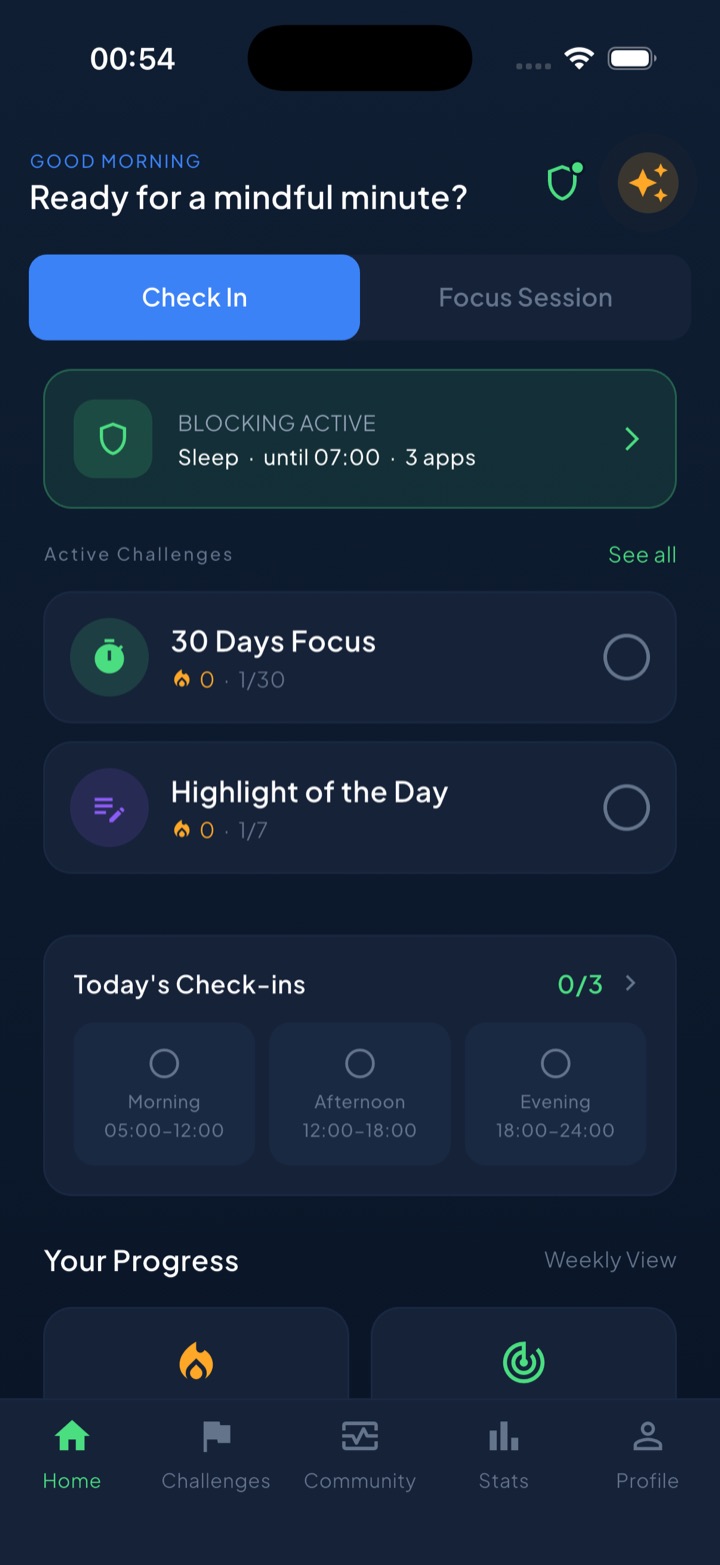
Unscrol is an iPhone and Apple Watch app built around exactly that gap, and it is worth saying plainly that it is a tool for structuring your own phone rather than a parental monitoring product. You set a daily total (45 minutes by default) and a per-session maximum (5 minutes by default), and iOS enforces both through the Screen Time and FamilyControls frameworks rather than a cosmetic overlay. Spend a session-sized chunk of the budget and the chosen apps lock for 15 minutes; spend the whole daily budget and they lock until tomorrow. Shield handles placement: blocking you schedule by time of day, for homework hours or the hour before sleep, and switching it off mid-block is deliberately slow, a breathing exercise and a wait rather than one tap. A streak counts every day you stay under budget, and home-screen and lock-screen widgets show what is left without opening anything.
The family angle is the unglamorous one. A child who watches a parent scroll through dinner learns more from that than from any rule, and the most useful version of this app in a household is usually the one running on the adult’s phone. Two caveats, plainly. The usage numbers are estimates, because iOS reports through crossed thresholds across an interval rather than exact minutes. And iOS hands the app opaque tokens, never app identities: Unscrol cannot see which apps you picked, their names or your per-app usage. The system draws the app picker, the app only draws the frame around it, and block lists and usage stay on-device. Free to download, with an optional premium tier adding Streak Saver for a missed day and five concurrent challenge slots instead of one.
Frequently asked questions
What does skibidi actually mean?
Functionally, nothing. It comes from Skibidi Toilet, a YouTube animated series built out of surreal short clips, and it escaped into general use as a filler word with no fixed meaning. Depending entirely on tone and context it can mean good, bad, weird, or absolutely nothing at all, which is why asking a child to define it usually produces a genuine shrug rather than evasion. It works more like a sound effect than a word, and that is the normal life cycle of playground nonsense rather than a sign of anything worrying.
Is brain rot slang bad for my child?
The slang itself is close to harmless. Every generation has produced in-group nonsense words, from groovy to gnarly to on fleek, and being fluent in the current set is a form of social competence rather than a symptom of decline. What deserves attention is the delivery mechanism underneath the vocabulary, which is usually hours of hyper-cut short video. The words are a visible trace of an invisible consumption pattern, so the useful question is not how much slang your child uses but how many uninterrupted hours of feed it took to learn it.
Should I ban words like skibidi and gyatt at home?
Banning a specific word almost never works and usually backfires, because forbidding a term is the fastest way to make it valuable currency among friends. The exception is words that are about other people's bodies or that carry ideas you would not want repeated, where the useful move is a conversation about what the word implies rather than a rule about the syllables. In practice a parent who asks what a word means and listens to the answer gets far more insight than one who issues a ban. Save your authority for the hours and the bedtime, which are the things that actually change outcomes.
How much short-form video is too much for a nine-year-old?
There is no single correct number, and the more useful measure is the shape of the time rather than the total. A child who watches twenty minutes of short video and then goes and does something else is in a very different position from a child who does ninety uninterrupted minutes and cannot describe a single thing they saw. Watch for three specific signals instead of a stopwatch reading: sessions that run far longer than intended, sleep that is being eaten from the front or the back, and a growing inability to tolerate ordinary boredom. If those three are fine, the raw number matters much less than parenting advice usually suggests.