AI slop is mass-produced, machine-generated content made to win the engagement lottery rather than to be true, useful or good. It is the surreal image of a soldier carving a wooden dog. It is the animal rescue that never happened, the synthetic voice reading invented history over someone else’s drone footage. It exists because producing it costs almost nothing and the feed pays out exactly the same for a fake as for the real thing. The word went from niche jargon to dictionary word-of-the-year shortlists in about eighteen months, which tells you how fast the flood arrived. It is still arriving while you read this.

What exactly counts as AI slop?
Not everything made with AI is slop. A filmmaker using a generative tool as one step inside a piece of work they actually thought about is not producing slop. Slop is defined by a ratio: almost no effort in, enormous volume out.
The genres are recognisable by now.
Sympathy bait. Impossibly sad scenes engineered for the comment section: soaked kittens, an elderly baker with no customers on his birthday, a cake nobody came to eat. The emotion people feel is real. The event never happened.
Fake rescues. A dog pulled from a flood, a bird cut free from netting, generated frame by frame and posted by an account that rescues something new every ninety minutes.
Invented history. Sepia photographs of things that were never photographed, captioned with a confident date and a story that sounds like it came from somewhere.
Narrated theft. A synthetic voice reading a scraped script over footage someone else shot, uploaded a hundred times a day across a hundred channels.
Pure engagement bait. Anything built to make you stop and say wait, what, because stopping is the metric.
The thread running through all of it is that nobody is claiming authorship, because there is nobody there. Slop is not a person’s bad work. It is output.
Why is my feed suddenly full of AI-generated content?
Two facts collided.
The first is that content became effectively free to produce. What used to need a camera, a location, a person and an afternoon now needs a sentence. If a channel can post four hundred videos a month instead of four, it will.
The second is that your feed does not rank truth. It ranks whether you stopped. The only signal the algorithm reliably receives from you is the pause — how long you hovered, whether you watched it twice, whether you tapped into the comments. Every one of those counts as engagement, which means arguing with slop feeds it. The angry reply saying this is obviously fake is, to the ranking system, indistinguishable from applause.
Put those two together and you get something genuinely new: slop A/B-tests itself into your eyeballs. A thousand variants go out, the ones that make people stop survive, the rest disappear, and the survivors get remixed into the next thousand. It is evolution running at the speed of a render farm, and the fitness function is your attention. How apps are designed to be addictive covers the older half of that machinery. Slop is what happens when you hand the same machinery an infinite content supply.
Why does it matter if I just scroll past it?
Because scrolling past is not free, and because it quietly changed what your scroll time is worth.
Here is the argument nobody was making two years ago. Your forty-five minutes on a feed used to buy you some amount of real human content: friends, people who make things, someone who was actually standing there. The same forty-five minutes now buys less of that, because slop occupies the slots. You did not decide to spend a smaller share of your day on things people actually made. The supply changed underneath you.
That is the strongest case yet that raw scroll time is overpriced. The price is unchanged and the product got worse. If you were paying forty-five minutes a day for a magazine that quietly replaced half its pages with generated filler, you would cancel it without a second thought. Brain rot describes what that low-nutrition diet feels like from the inside, and what short-form video does to attention describes what it does to your appetite for anything longer.
There is a second cost, and it is the one people underrate. Once you have been fooled twice, you start scanning everything, including the genuine photographs. That constant low-grade verification is tiring, and it is the tax slop charges you even on the posts you correctly identify.
How do I tell if a post is AI slop?
Fast checks, roughly ordered by how often they work.
| Where to look | What gives it away |
|---|---|
| The account | Thirty near-identical uploads today, no replies to anyone, no history before last month |
| Hands and teeth | Extra fingers are rarer now; look for fingers that merge or change count mid-motion |
| Physics | Water that does not splash, fur that does not part, crowds where feet slide instead of stepping |
| Text in frame | Signs, logos and printing on shirts dissolving into letter-shaped noise |
| Background faces | The main subject is sharp while everyone behind them melts |
| The caption | Vague, emotional, no place name, no date, no source, no photographer |
| Continuity | An object that changes shape between the start and end of a four-second clip |
The account check is the strongest one and the least used. A human being posts at human speed. Scroll the profile before you believe the post — thirty uploads in a day with no conversation underneath any of them tells you more than any pixel-level tell, and unlike the visual clues it will still work next year, when the renders get better and the hands come out right.
“My grandad sent me a wartime photo of a soldier and a dog with a whole story attached. It took me ten seconds to notice the rifle strap went nowhere. I didn’t say anything. Then I realised he sends me four of these a week and believes every single one, and that his feed is now basically nothing else. That was what made me finally look properly at my own feed.” — Marcus, warehouse supervisor, 34
Why do older relatives believe it, and how do I help?
Because spotting it is a learned skill, not common sense. If you grew up treating image manipulation as a normal background fact, you scan pictures by default and you barely notice you are doing it. If you grew up when a photograph was evidence, you do not. Nothing else about being older makes anyone more gullible.
What actually works, in order. Do not debunk one post, because you will be doing that forever and it teaches nothing transferable. Teach one rule instead: check the account, not the picture. Real people have histories, replies, and a posting rate a human could sustain. Show them a generator once, because watching a convincing fake photo appear out of a sentence they typed themselves does more than twenty corrections ever will. And give them somewhere to ask. Most people do not want to be wrong in public. They want one person they can quietly check with first.
What actually works against a feed full of slop?
Three rungs, in increasing order of effect.
Curate hard. Slop only reaches you through a channel you left open. Use not interested, block the account, and — this is the one people get wrong — stop commenting to call it fake. Every reply is a vote for more. Resetting your algorithm goes through what genuinely moves recommendations versus what only feels like it does.
Follow humans directly. Move the people whose work you actually want out of the recommendation feed and somewhere an algorithm does not mediate: a following-only tab, a newsletter, a group chat, a paid subscription. Anything with a name attached and a person who would be embarrassed to fake it. This is also the only rung that improves your feed rather than just shrinking it.
Shrink the open-ended feed time. This is the rung that survives everything else, because curation is a war of attrition and slop production scales faster than your blocking finger ever will. The one variable slop cannot optimise around is the size of the window you leave open. A session with a hard end puts a ceiling on how much of it can reach you, no matter how good the generators get. How to stop doomscrolling covers the mechanics of ending a session you never consciously started, and if a chatbot has quietly become part of the same loop, AI chatbot dependence is the neighbouring problem.
How does Unscrol help?
The honest starting point: you can get part of the way there for free. Apple’s Screen Time gives you daily App Limits per app or category, Downtime for scheduled windows, and a real weekly average to work from. If a daily number plus a sleep schedule is enough to make you stop, you do not need anything else and you should not buy anything. Where the built-in tools run out is the per-sitting half: iOS has no native cap on a single session, and App Limits ship with a one-tap dismissal, which is exactly the moment a feed full of engineered curiosity is best at beating you.
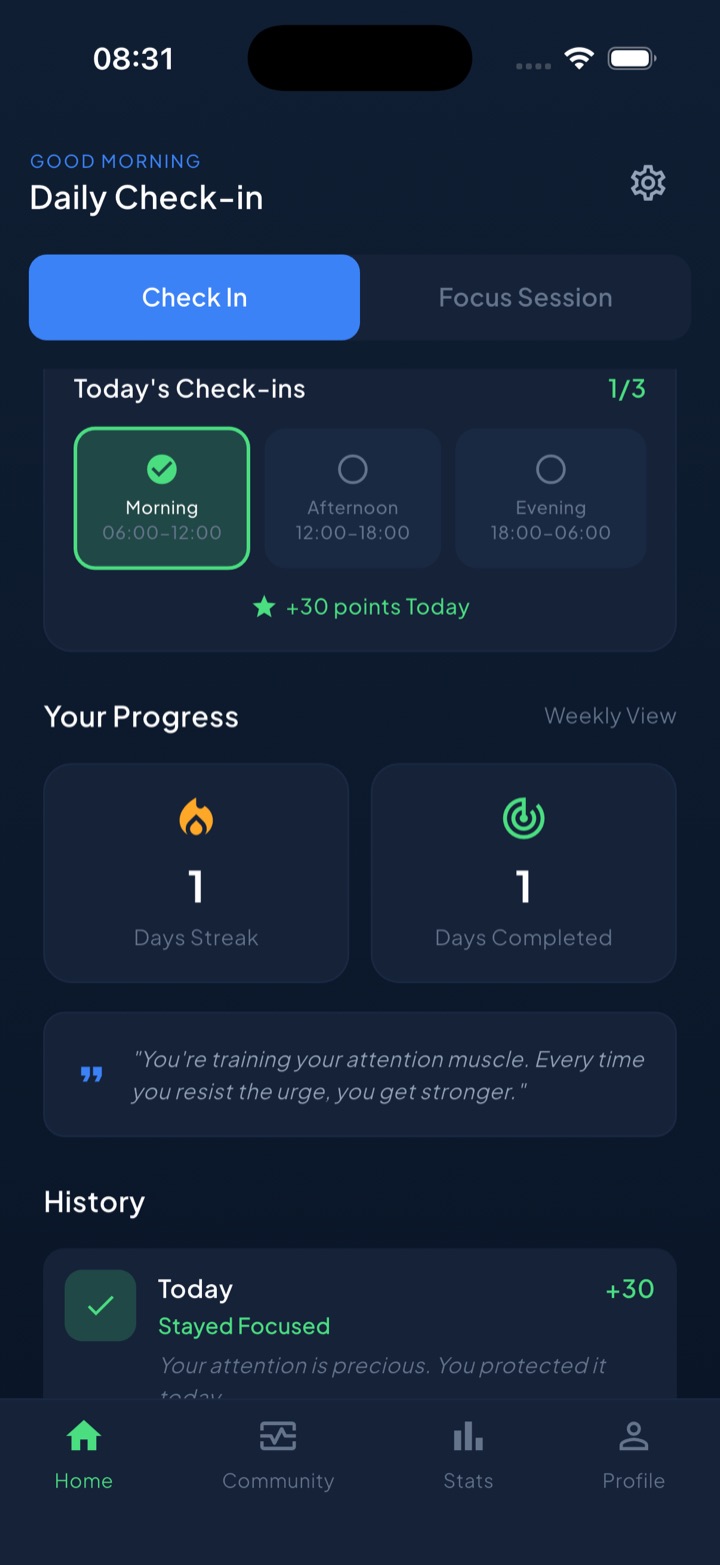
Unscrol is an iPhone and Apple Watch app built around two numbers instead of one. You set a daily total (45 minutes by default) and a per-session maximum (5 minutes by default), and iOS enforces both through the Screen Time and FamilyControls frameworks rather than a cosmetic overlay. Spend a session-sized chunk of the budget and your chosen apps lock for 15 minutes; spend the whole daily budget and they lock until tomorrow. A streak counts every day you stay under budget, and home-screen and lock-screen widgets show what is left without you opening anything. For placement there is Shield, blocking you schedule by time of day, and switching it off mid-block is deliberately slow: a breathing exercise and a wait, not a one-tap dismissal.
Two caveats, plainly. The usage numbers are estimates, because iOS reports crossed thresholds across an interval rather than exact minutes, so treat the budget as approximately right rather than accurate to the second. And iOS hands the app opaque tokens, never app identities: Unscrol cannot see which apps you picked, their names, their icons or your per-app usage. The system draws the app picker and the app only draws the frame around it, so block lists and usage data are processed on-device by iOS and never reach Unscrol’s servers. Free to download, with an optional premium tier adding Streak Saver for a missed day and five concurrent challenge slots instead of one.
Frequently asked questions
What is AI slop?
AI slop is mass-produced, machine-generated content posted at volume to win engagement rather than to be true, useful or well made. It covers surreal images built to farm sympathy comments, fake animal rescues that never happened, synthetic voices narrating stolen footage, and invented historical photographs captioned with confident dates. The defining feature is not that a machine was involved but the ratio between effort and output: nobody is claiming authorship, because there is nobody there. The term moved from niche internet jargon to dictionary word-of-the-year shortlists in roughly eighteen months, which is a decent measure of how fast the flood arrived.
Why is my feed suddenly full of AI content?
Two things collided. Generating a video used to require a camera, a location and a person, and now it requires a sentence, so an account that posted four things a month can post four hundred. At the same time, recommendation feeds do not rank truth, they rank whether you stopped scrolling. That means a thousand generated variants can be posted cheaply, the ones that make people pause survive, and the survivors get remixed into more of the same. Slop effectively A and B tests itself into your feed, and commenting to say something is fake counts as engagement too.
How can I tell if a video or photo is AI generated?
Check the account before you check the pixels. A human posts at human speed, so thirty near-identical uploads in one day with no replies to anyone and no older history is the single most reliable tell, and it keeps working as the renders improve. After that, look at hands and teeth, at physics such as water that does not splash properly or feet that slide, at any text inside the frame, since signs and logos tend to dissolve into letter-shaped noise, and at faces in the background, which often melt while the main subject stays sharp. Vague emotional captions with no place, date or source are another strong signal.
Does AI slop actually matter if I just scroll past it?
Yes, because it changes what your scrolling time is worth. The same forty-five minutes on a feed used to buy you some amount of content that real people made, and slop now occupies a growing share of those slots without you having chosen that. The price stayed the same while the product got worse, which is the strongest argument yet that open-ended scroll time is overpriced. There is also a second cost that people underrate: once you have been fooled twice you start verifying everything, including the real photographs, and that constant low-grade suspicion is tiring in itself.