Executive dysfunction is a breakdown in the brain’s management layer — the set of functions that start, hold, sequence, inhibit and monitor everything you deliberately do — and a phone attacks the two weakest of them: inhibition and task initiation.
It is not a single skill. It is a bundle of eight to eleven of them, depending on whose model you read, and they fail independently. That is why “I have executive dysfunction” tells you almost nothing useful on its own, and why general advice bounces off. The person who cannot start is broken in a different place from the person who starts everything and finishes nothing. This piece names the functions, says which one a feed is actually exploiting, and separates the whole thing from procrastination and from laziness, which it is not.

What is executive function, in plain terms?
Executive function is the set of processes that let you act on a decision instead of on the loudest impulse in the room. Neuropsychologists locate most of it in the prefrontal cortex and its connections. The everyday version is unglamorous: remembering what you walked into the kitchen for, not saying the sharp thing, opening the document, noticing that an hour has passed.
The literature splits along two lines. The lab model, from Akira Miyake and colleagues in a heavily cited 2000 paper in Cognitive Psychology, reduces executive function to three separable components — inhibition of prepotent responses, updating of working memory, and shifting between mental sets. The clinical model, used by Peg Dawson and Richard Guare in their executive-skills work, breaks the same territory into eleven named everyday skills, which are the ones you will recognise from your own bad weeks.
Executive dysfunction is what you call it when one or more of those runs below the level your life requires. That is a description, not a diagnosis. There is no separate diagnostic code for it and no clinician will hand it to you as a standalone label.
What are the executive functions, and what does your phone do to each?
Each one gets a sentence on what it does and a sentence on what an infinite feed does to it.
- Working memory — holding information in mind while you act on it: the address you were just told, the three things you came upstairs for, the sentence you were halfway through. What a feed does: a thirty-second check overwrites the contents, which is why you can put the phone down and genuinely not know what you were doing.
- Inhibition, or response control — the pause between an impulse and an action. What a feed does: it is engineered to turn an impulse into an action in one thumb movement, so there is no gap wide enough for inhibition to fire in.
- Task initiation — starting something without an external forcing function. What a feed does: it parks a zero-initiation task eight inches from the high-initiation one, which is how “I’ll start in five minutes” becomes an hour. This is the failure covered in detail in ADHD task initiation.
- Sustained attention — staying with something through boredom or fatigue. What a feed does: it removes the requirement entirely by re-supplying novelty every few seconds, which is why scrolling can look like enormous focus while being the opposite — the pattern behind ADHD hyperfocus and endless scrolling.
- Emotional regulation — managing a feeling so that it does not choose your next action. What a feed does: it is the fastest available way to not feel something, so it becomes the default regulation strategy, and the feeling is still there when you look up.
- Planning and prioritisation — deciding what matters and in what order. What a feed does: it hands you an endless list with no priority attached to any item, and half an hour of that leaves your own list feeling less ordered than before.
- Time management — estimating how long something takes and how long you have been doing it. What a feed does: it strips out every time cue, with no chapters, no credits and no natural stopping point, which makes it uniquely bad for a brain already dealing with time blindness.
- Self-monitoring, or metacognition — noticing what you are doing while you are doing it. What a feed does: absorption suppresses it, so the question “what am I actually doing” arrives about thirty minutes late.
Two more appear in most clinical lists and are worth naming. Flexibility is revising a plan when it breaks; goal-directed persistence is staying with a goal after it stops being interesting. Neither is attacked as directly by a phone, but both erode quietly in a day chopped into three-minute pieces.
Is executive dysfunction the same thing as ADHD?
No, and the confusion runs in both directions.
ADHD is a diagnosis with criteria. Executive dysfunction is a description of a pattern. They overlap heavily: Russell Barkley’s influential 1997 model in Psychological Bulletin reframed ADHD as fundamentally a disorder of behavioural inhibition and self-regulation, with inhibition as the foundation the other executive abilities rest on. But they are not the same object.
The evidence is also more careful than the internet is. A 2005 meta-analysis by Erik Willcutt and colleagues in Biological Psychiatry pooled 83 studies — 3,734 participants with ADHD and 2,969 without — and found consistent group differences on every executive-function measure, with medium effect sizes between 0.46 and 0.69, strongest on response inhibition, vigilance, working memory and planning. Their own conclusion was that executive-function weaknesses are “neither necessary nor sufficient to cause all cases of ADHD”. The deficits are real at group level and not universal at individual level. You can have ADHD and test normally on these measures. You can also have serious executive dysfunction and not have ADHD.
That second half matters, because executive dysfunction is not exclusive to ADHD. It turns up in depression, in anxiety (worry occupies the same working memory the task needs), after concussion and other head injury, during grief, in chronic pain and illness, and — most commonly and most reversibly — in sleep deprivation. Onset is the useful clue. ADHD-related difficulty is lifelong and shows up in several settings; a sharp decline over the last two months points somewhere else, and sleep, mood and a recent head knock are better first suspects than a lifelong neurodevelopmental condition.
How is executive dysfunction different from procrastination and laziness?
These three get used interchangeably and are not interchangeable at all.
| Executive dysfunction | Procrastination | Laziness | |
|---|---|---|---|
| What the person wants | The task done, often urgently | The task done, but later | Not to do the task |
| What the block is | The starting or holding mechanism does not engage | Avoidance of a specific discomfort: boredom, difficulty, fear of doing it badly | No block; it is simply not worth it to them |
| Does a deadline fix it? | Sometimes not, even mid-panic | Usually, at the last possible moment | Irrelevant, since no attempt is being made |
| What helps | External structure: a smaller first step, another person present, a timer, no easier alternative in reach | Naming the specific discomfort, then shrinking it | Nothing, because there is nothing to fix |
| What makes it worse | Being told to try harder, shame, an unblocked phone within arm’s reach | Vague, oversized, undefined tasks | Not applicable |
The row that decides everything is the first. Laziness is an absence of wanting. Executive dysfunction is wanting at full volume with no transmission attached to it. That is why “just do it” lands so badly: it is advice for a problem the person does not have.
Procrastination sits between the two and genuinely overlaps both. The honest version is that most stalled tasks are a mixture, and the ratio changes from task to task. A tax return you dread is mostly discomfort avoidance. A form you are neutral about and still cannot open at 4 p.m. on a Tuesday is mostly initiation.
Why does a phone find the broken function so fast?
Because the phone is the only object in the room that requires none of the functions you are short of.
Starting it takes no initiation. Staying with it takes no sustained attention, because the novelty is supplied for you. It needs no planning, no prioritisation and no time estimate, and it will regulate an unpleasant feeling faster than anything else within reach. For a brain running low on executive fuel, a feed is less a temptation than the path of least resistance made visible.
It also charges you while sitting there doing nothing. A 2017 study by Adrian Ward and colleagues in the Journal of the Association for Consumer Research found that the mere presence of a participant’s own phone on the desk — face down, silent, untouched — measurably reduced available working memory capacity and fluid intelligence, with the largest costs for the most phone-dependent participants. Treat the size of that effect as unsettled: a 2023 meta-analysis of 22 studies put the pooled effect at a small g = −0.14, with the attention component not statistically significant. The direction is consistent, the magnitude is argued over. The broader interaction between these brains and these devices is covered in ADHD and phone addiction.
Which function is actually broken for you?
Work out which one before you pick a fix. A rough mapping, starting from the sentence you would actually say out loud:
- “I know exactly what to do and I am sitting here not doing it.” Task initiation.
- “I start ten things a day and finish none of them.” Goal-directed persistence, sometimes flexibility.
- “I looked up and it was one in the morning.” Time management and self-monitoring.
- “I keep losing the thread halfway through.” Working memory.
- “I have the phone in my hand before I have decided to pick it up.” Inhibition.
- “I cannot work when I am upset, and I reach for the phone instead.” Emotional regulation.
- “I can list everything that needs doing and cannot put it in an order.” Planning and prioritisation.
Most people recognise two or three of these rather than one. That is normal, and it still narrows the problem usefully: a working-memory problem wants written checklists, an inhibition problem wants the phone out of reach, and those are different interventions.
“I assumed the problem was attention, because that is the word in the name. It is not. I can read a technical manual for two hours. What I cannot do is put the manual down at the point I planned to, or start the report I have been thinking about since Monday. Once I stopped trying to fix ‘focus’ and started fixing ‘start’ and ‘stop’ separately, things moved.” — Tom, insurance claims adjuster, 36
What helps when the broken function is inhibition?
The general principle is short: when an internal function is offline, put that function outside your head. You are not trying to strengthen the prefrontal cortex through effort — that is the thing that is currently not working. You are trying to make the environment do part of its job, which is the argument laid out in environment design beats willpower.
Concretely, and in rough order of yield:
- Move the phone, not your attitude. Another room during a launch window beats face-down on the desk, and both beat a promise to yourself.
- Write the first physical action down the night before. “Open the claims file and type the date” is executable. “Do the claims” is a fog with an activation cost attached.
- Borrow someone else’s executive function. Working alongside another person, in a room or on a call, supplies external initiation your own system is not generating.
- Use Apple’s built-in tools first. On iPhone,
Settings > Screen Time > App Limitssets a daily cap per app or category, and Downtime blocks by time of day. It is free and it is enough for some people.
The honest limitation of the built-in route is that a limit you set in a good moment is dismissed in one tap in a bad one, which is precisely the moment inhibition is offline. Unscrol is an iPhone app built on the same Apple Screen Time frameworks, so its blocks are system-enforced shields rather than reminders you can swipe away: a daily budget for your chosen apps, a per-session cap, and a 15-minute lock when you burn a session. Turning a block off deliberately requires a breathing exercise and a wait rather than a single tap. Because iOS hands the app opaque tokens rather than app identities, it cannot see which apps you picked or how long you spent in them; that stays on your device.
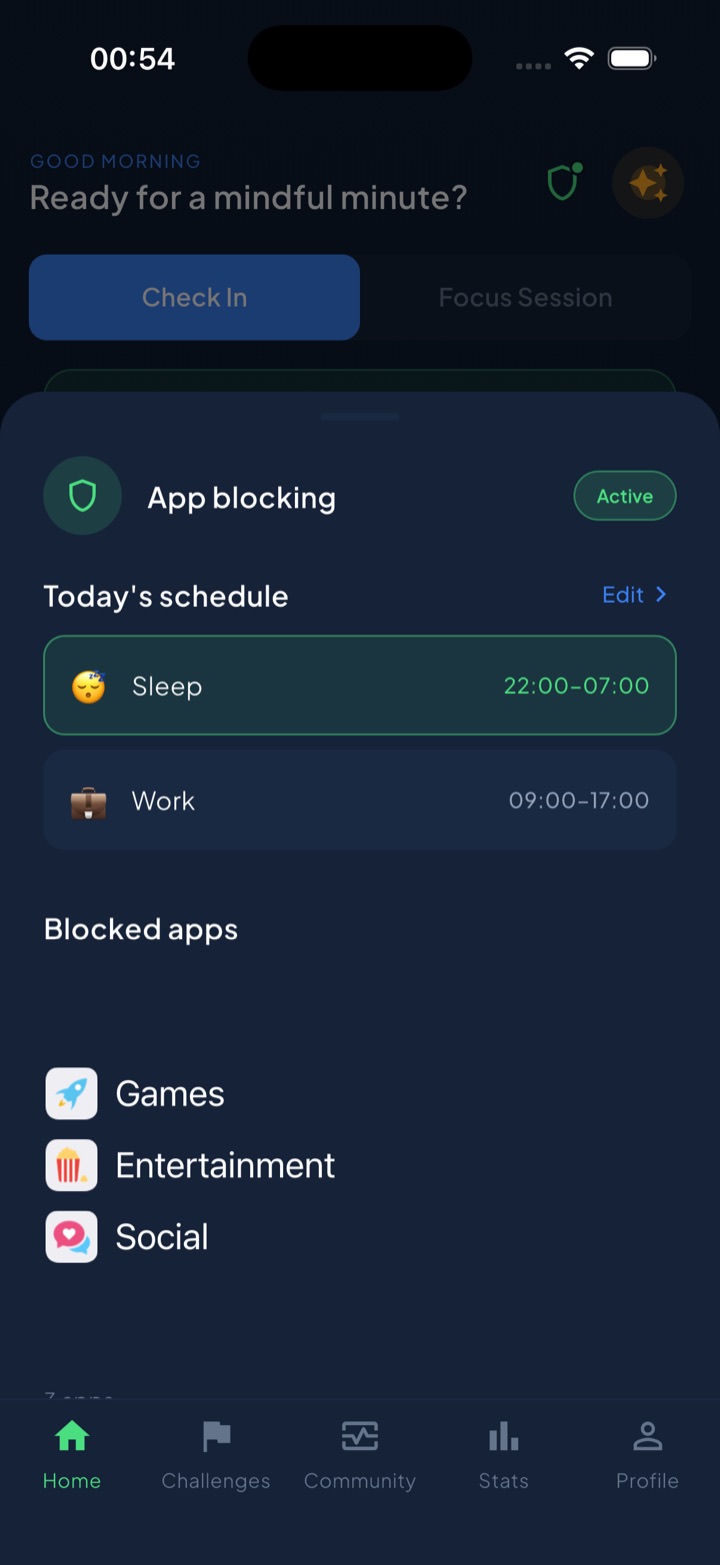
That is the whole mechanism, and it is deliberately unexciting: it does not make you want the task more. It removes the thing that was winning.
When is this a clinician’s question rather than a productivity question?
If this is materially affecting your work, your studies or your relationships, an assessment from a clinician is the right next step. That is worth saying once, plainly. Strategies and blockers are scaffolding, and scaffolding works best on a foundation that has been looked at properly — particularly since several of the conditions that produce executive dysfunction are treatable, and some of them are not ADHD.
Nothing here is medical advice, and no article can tell you which of the possible causes applies to you.
What this framework does not fix
Naming the broken function is useful, and it is not a cure. Three limits worth being straight about.
It does not change the underlying capacity. Knowing that your weak link is initiation rather than attention makes you better at choosing interventions; it does not give you more initiation. On a bad day the correct diagnosis and the correct tool both still lose.
It does not survive sleep debt. Every function on the list degrades sharply without sleep, and no external system compensates for a run of five-hour nights. If that is the situation, the blocker is not the intervention that will help most.
And external structure has a ceiling. A system-enforced block genuinely does the inhibition your prefrontal cortex is not doing right now, which is the point. But it does not touch emotional regulation, it will not make a dreaded task less dreaded, and if the phone is being used to avoid something specific, removing the phone leaves you sitting with the thing you were avoiding. Sometimes that is exactly what needs to happen. Sometimes what needs attention is the thing itself.
Frequently asked questions
What is executive dysfunction in ADHD?
Executive dysfunction is when the brain's management functions run below the level your life requires. Those functions include working memory, response inhibition, task initiation, sustained attention, emotional regulation, planning, time management and self-monitoring. In ADHD they tend to be weaker as a group, which is why the same person can be brilliant at the work itself and unable to begin it, or lose an evening without noticing. It is a description of a pattern rather than a diagnosis in its own right: there is no separate diagnostic code for it, and a clinician assesses the underlying condition, not the label.
Is executive dysfunction the same as being lazy?
No, and the difference is what the person wants. Laziness means the task is not worth doing to you, so you do not try. Executive dysfunction means you want the task done, sometimes desperately, and the mechanism that converts that intention into a first physical action does not engage. People who have felt both describe them as nothing alike. It is also why advice like 'just get started' fails: it is aimed at a motivation problem, and this is an activation problem. What tends to work instead is external structure — a smaller first step, another person nearby, a timer, and no easier alternative within reach.
What are the main executive functions?
Research models differ. Akira Miyake and colleagues, in a widely cited 2000 study, reduced executive function to three separable components: inhibition of automatic responses, updating of working memory, and shifting between mental sets. Clinical and coaching practice usually uses a longer, more practical list — the version from Peg Dawson and Richard Guare names eleven skills, including response inhibition, working memory, emotional control, task initiation, sustained attention, planning and prioritisation, organisation, time management, flexibility, goal-directed persistence and metacognition. The important point is that they fail independently. Knowing which one is weak tells you far more than the umbrella term does.
Can you have executive dysfunction without ADHD?
Yes, and it is common. Executive dysfunction appears in depression, in anxiety, after a concussion or other head injury, during grief, in chronic pain and illness, and most reversibly of all in sleep deprivation. Certain medications and heavy alcohol use affect it too. The pattern of onset is a useful clue: ADHD-related executive difficulty is lifelong and shows up across many settings, while a sharp decline over recent weeks or months points somewhere else. If executive function has fallen off a cliff and used to be fine, sleep, mood and a recent injury are more likely first suspects than a neurodevelopmental condition.