Social media does not make people lonely on average, but the kind of use matters enormously: passively consuming other people’s lives tracks with more loneliness, while directly talking to people you already know tracks with less. The honest summary of two decades of research is that the average effect is small, contested, and runs in both directions. Lonely people reach for their phones more, which makes any correlation between the two almost impossible to read as a one-way story. What the evidence does support fairly consistently is the distinction most headlines skip: the same app leaves you emptier or steadier depending on whether you consumed it or used it to reach somebody.
Loneliness is worth separating from the anxiety question, which is noisier and less well measured. Loneliness has decades of instrumentation behind it, a clear definition, and an unusually interesting answer.
Does social media actually cause loneliness?
Not in the way the headlines imply. The strongest correlational finding is real: in a 2017 study in the American Journal of Preventive Medicine, Brian Primack and colleagues surveyed 1,787 US adults aged 19 to 32 and found that people in the heaviest quartile of social media use had roughly twice the odds of reporting high perceived social isolation, and those who checked most frequently had more than three times the odds. That is a large-sounding association. It is also a photograph: everyone was measured once, so nothing in it establishes what caused what.
When researchers follow people over time instead, the picture shrinks considerably. A 2025 meta-analysis in the Journal of Medical Internet Research by Jia Yuin Fam and Niko Männikkö pooled 26 longitudinal studies covering 24,798 people and found the relationship between loneliness and problematic media use runs in both directions, with effect sizes of about r = 0.10 and r = 0.09 once each study’s own statistical model was used rather than raw correlations. The authors described the effects as weaker than anticipated.
So an association exists, it is bidirectional, and it is small. Everything interesting is in the detail underneath.
Which came first, the loneliness or the scrolling?
This is the single most misreported thing in this literature, and it deserves a blunt statement: lonely people use more social media, so a correlation between the two tells you nothing about direction on its own.
A 2014 meta-analysis in Computers in Human Behavior led by Hayeon Song pooled 18 research effects covering 8,798 people and concluded that the relationship runs mostly from loneliness to Facebook use rather than the other way. Lonely people went to the platform; the platform was not making them lonely. That finding is a decade old and has been argued over since, but the mechanism is obvious once stated. If your Friday evening is empty, the phone is the thing within reach. Any study that photographs a single moment will find heavy users lonelier and will be unable to say why.
Rebecca Nowland, Elizabeth Necka and John Cacioppo made the same point in a 2018 review in Perspectives on Psychological Science, and added a useful refinement: internet use appears to reduce loneliness when it strengthens existing relationships or builds new ones, and to increase it when it is used to withdraw from the discomfort of face-to-face contact. Same hours, opposite outcome, depending on what the hours were for.

Why does passive scrolling track badly and messaging doesn’t?
Because they are different activities that happen to share an icon.
The experimental evidence here is better than most of this field’s. In 2015, Philippe Verduyn and colleagues published a paper in the Journal of Experimental Psychology: General that did two things: cued people in a lab to use Facebook passively or actively, and separately tracked people in daily life using experience sampling. Both methods pointed the same way. Passive use predicted declines in affective well-being over the following hours, and envy was the mechanism carrying the effect.
The other direction has experimental support too. Fenne große Deters and Matthias Mehl ran a one-week experiment, published in Social Psychological and Personality Science in 2013, in which one group was simply asked to post more status updates than usual. That group reported less loneliness by the end of the week, and the effect was explained by feeling more connected to their friends. Their friend counts did not change. Their hours did not change. The direction of the activity did.
Moira Burke and Robert Kraut went further in a 2016 paper in the Journal of Computer-Mediated Communication, linking well-being surveys to actual server logs for 1,910 Facebook users, so the behaviour was measured rather than self-reported. Receiving targeted, composed messages from close friends improved well-being. Reading friends’ broadcasts to everyone did not. Receiving one-click likes did not. The benefit lived specifically in messages somebody had written to you.
What does each pattern do to loneliness?
| Pattern | What it looks like | Association with loneliness | Evidence |
|---|---|---|---|
| Passive consumption | Scrolling feeds, watching stories, reading comments, contacting nobody | Worse for some people, with envy and comparison as the mechanism | Two experimental designs support it, but it is genuinely contested |
| Active, directed contact | Messaging one person, replying properly, posting something of your own | Better; the clearest positive finding in the field | Two experiments plus behavioural log data |
| Displacing contact | Hours online that came out of hours you would otherwise have spent with people | Worse, and the case is strongest for adolescents | Good long-run trend data, weak causal proof |
| Arranging contact | Using the same apps to fix a time, a place and a person | Better; the most consistently protective pattern | Coherent with everything else, but rarely studied on its own |
The row that matters most is the last one, and it is the one nobody researches directly.
Is the displacement argument true?
Partly, and mostly for teenagers.
Hours are finite, so an hour on a feed is an hour not spent somewhere else. The question is whether that hour would otherwise have been social. Jean Twenge, Brian Spitzberg and Keith Campbell examined surveys of 8.2 million US adolescents from 1976 to 2017, published in the Journal of Social and Personal Relationships in 2019, and found a real decline: college-bound high school seniors in 2016 spent about an hour less per day on in-person social interaction than their equivalents in the late 1980s, counting parties, hanging out, dating and driving around. The drop was not explained by more homework, more paid work or more extracurriculars.
Two honest caveats. First, that is a trend correlation across four decades, and a great deal besides phones changed in that time. Second, the displacement case is much weaker for adults, whose evenings were already less social than a teenager’s, and who often use the same apps to keep long-distance relationships alive that would otherwise have quietly lapsed.
There is a smaller, better-documented version of displacement that applies to everyone: the phone that comes out during time you are already spending with someone. That is phubbing, and it does not require any hours at all to do damage.
Why does a feed feel like company?
Because it delivers a real signal of other people without the parts of contact that make it restorative.
Ana Levordashka and Sonja Utz documented the mechanism in Computers in Human Behavior in 2016 under the name ambient awareness: knowledge of what people in your network are doing, accumulated from fragments — status updates, photos, small posts — absorbed peripherally while you browse. Their Twitter studies found that browsing alone was enough to build it. Around 80% of participants could recall specifics about at least five people in their network, and roughly three-quarters of those were people they knew only through the platform.
That is not nothing. It is genuine social information and it registers as such. But it is one-way. Nobody noticed you were there, nobody is expecting you tomorrow, nobody’s evening changed because you showed up. The same holds for the parasocial version, the creator whose life you follow closely and who does not know your name. You leave with the sensation of having been among people and none of the obligation, and obligation turns out to be a load-bearing part of why company helps at all.
That gap between the feeling of contact and the fact of it is probably why heavy passive use can sit alongside severe loneliness rather than curing it, and why measuring your life against a feed of edited ones widens the gap instead of closing it.
How big are these effects, honestly?
Small on average, and smaller than either camp in the public argument would like.
Markus Appel, Caroline Marker and Timo Gnambs reviewed the meta-analytic evidence in Review of General Psychology in 2020 and found associations between social networking intensity and outcomes including loneliness, self-esteem and life satisfaction sitting around r = .10 — a real signal, and a weak one. That is the number to hold onto when you read that social media is destroying a generation, and equally when you read that concern about it is a moral panic.
Averages also hide people. The best demonstration is a 2022 study by Patti Valkenburg and colleagues in the Journal of Computer-Mediated Communication, which tracked 353 adolescents aged 13 to 15 six times a day for three weeks, producing nearly 33,000 individual measurements. Browsing predicted lower well-being for 20% of them, higher well-being for 17%, and nothing measurable for the remaining 63%. The authors’ conclusion was that the passive use hypothesis was confirmed for 20% of adolescents and rejected for 80%.
Read that carefully, because it cuts both ways. The population average is small partly because it mixes people it genuinely harms with people it genuinely helps. The only question that matters for you is which group you are in, and that is answerable — not by reading meta-analyses, but by watching your own weeks.
What does the research suggest actually helps?
The interventions with the most support are unglamorous and specific.
- Reduce the volume without quitting. In a 2018 experiment in the Journal of Social and Clinical Psychology, Melissa Hunt and colleagues asked 143 University of Pennsylvania undergraduates to cap Facebook, Instagram and Snapchat at ten minutes per platform per day for three weeks. That group reported lower loneliness and lower depression than the control group. Thirty minutes a day, not zero.
- Convert a scroll into a message. When you notice you have been consuming for a while, send one person one specific thing. Directed contact is the strongest positive finding in this literature, and it costs about forty seconds.
- Use the same apps to make a plan with a time in it. “We should catch up” is not contact. A day, an hour and a place is.
- Mute the accounts that trigger comparison and keep the people. Muting is not a relationship decision, and treating it as one is why most feeds never get cleaned.
- Protect the hours when contact is actually possible. Feeds are available at 1 a.m. Friends mostly are not. Spending 7 p.m. on a feed and 1 a.m. wishing you had company is a scheduling problem as much as a psychological one.
None of this is treatment. If loneliness has been persistent and is affecting your sleep, your appetite or your ability to get through an ordinary day, that is worth raising with a doctor or a therapist rather than solving with an app setting.
“I moved cities for work at 34 and told myself I was still in touch with everyone, because I saw their photos every day. It took about eight months to notice I had not had an actual conversation with any of them since I left. Nothing about my feed changed when I fixed it. I just started sending three messages on Sunday nights, each with a date in it.” — Daniel, logistics planner, 34
Where is the evidence thin?
In more places than a confident version of this article would admit.
The passive-versus-active distinction, which is the spine of most advice on this subject including some of the above, is under real challenge. Valkenburg’s group argued in a 2022 critical review that the evidence for the passive use hypothesis is much weaker than its popularity suggests, that the available meta-analyses conflict with each other, and that individual differences swamp the average effect. Treat “passive use is bad” as a useful heuristic with mixed support, not a law.
Arranging contact — using social platforms to organise real meetings — is the pattern the evidence points at most encouragingly and studies least directly. It is mostly inferred from other findings rather than measured as its own variable.
And nearly everything above measures self-reported loneliness among students and adolescents in wealthy countries over a horizon of weeks. Nobody has run the study you actually want, which would follow ordinary adults for years.
What a screen-time app can and cannot do here
The limit first: a daily budget does not manufacture friendships. No app setting has ever introduced anybody to anybody. What a budget does is narrower and more literal — it returns the evening in which something might happen.
That is the whole mechanism and it is worth stating without embellishment. Unscrol gives distracting apps a daily budget, 45 minutes by default, plus a per-session cap of 5 minutes, both built on Apple’s official Screen Time frameworks so the block is a system-enforced shield rather than a notification you can swipe past. Burn a session and those apps lock for 15 minutes. Spend the day’s budget and they lock until tomorrow. You can also schedule blocks by time of day, which is the setting that matters most here: the hours when other people are awake and reachable are a narrow window, and they are exactly the hours a feed is best at absorbing.
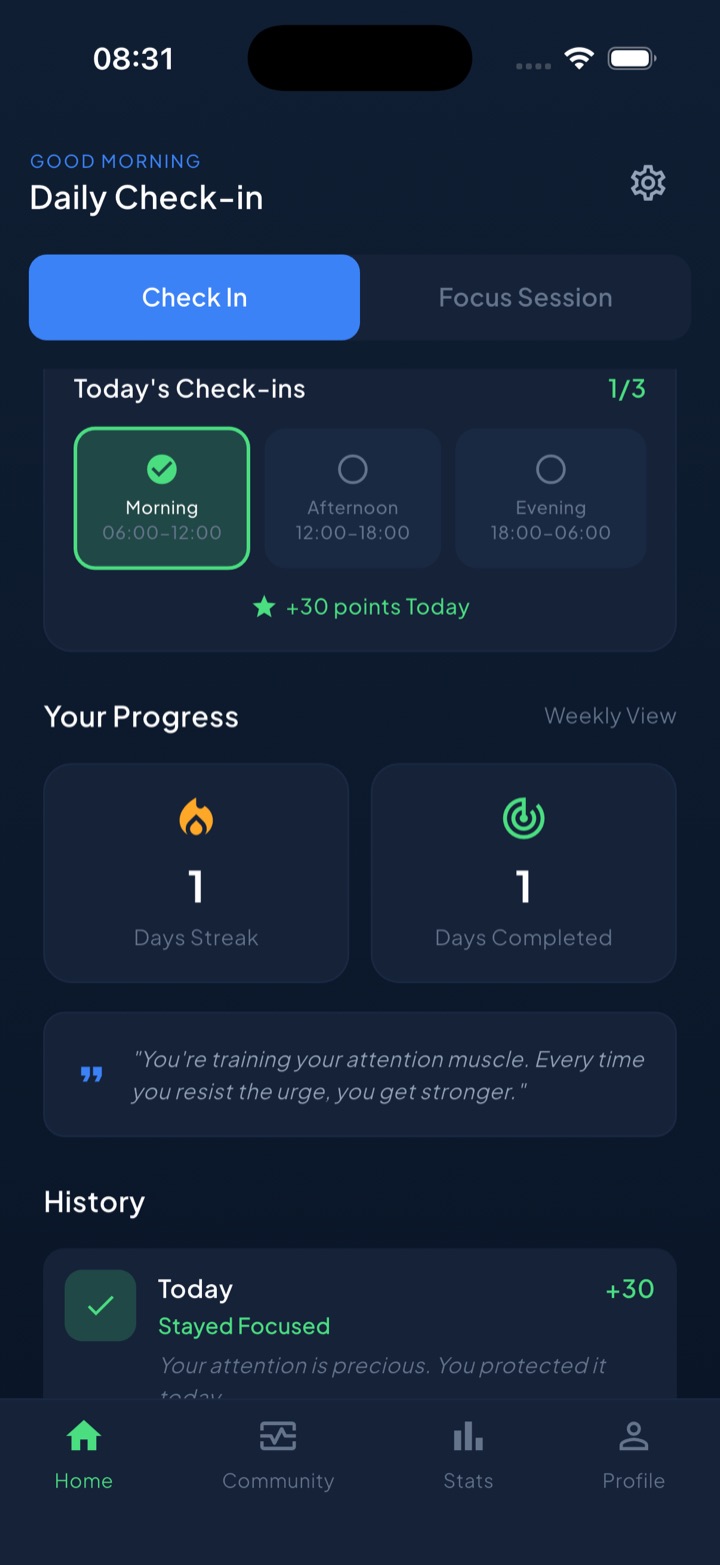
What happens in the returned hour is entirely up to you, and the app has no opinion about it. If you want the evening to be more social, the thing that changes the outcome is the message with a date in it, not the streak and not the block. If you want the evening to be quieter on purpose, that is a legitimate choice too, and a list of things worth doing with a freed hour is easier to act on than an empty one. Unscrol is free to download; the subscription adds a Streak Saver for a missed day and raises concurrent challenge slots from one to five. It cannot see which apps you picked — iOS hands it opaque tokens rather than app names — so none of this depends on anyone knowing anything about your feed.
And the real limit: if your loneliness is structural — a new city, a bereavement, a job with no colleagues, a life stage where everyone’s evenings disappeared into small children — reducing screen time will not touch the cause. It will make the empty evening more obvious. For some people that is the useful part. For others it is simply harder, and it is worth knowing which you are before you start.
Frequently asked questions
Does social media cause loneliness?
Not in a simple one-way sense, and the average effect is small. Heavy users do report more loneliness in survey after survey, but a 2025 meta-analysis of 26 longitudinal studies covering nearly 25,000 people found the relationship runs in both directions with effect sizes around r = 0.10 in each. Lonely people reach for their phones more, which alone would produce most of the correlation you read about in headlines. What the evidence supports more clearly is that the type of use matters: consuming other people's posts without contacting anyone tracks with worse loneliness, while messaging people you actually know tracks with better.
Why do I feel lonelier after scrolling?
The most likely reason is that a feed delivers the signal of other people without the parts of contact that actually help. Researchers call the effect ambient awareness: you accumulate real knowledge of what people are doing, absorbed peripherally while browsing, but nobody noticed you were there and nobody's evening changed because you showed up. A 2015 experiment by Philippe Verduyn and colleagues found that passive Facebook use predicted declines in mood over the following hours, with envy carrying the effect. Comparison against edited lives adds to it. The sensation is of having been among people; the fact is that you were not.
Does using social media less make you less lonely?
Sometimes, modestly. The clearest evidence comes from a 2018 experiment at the University of Pennsylvania in which 143 undergraduates capped Facebook, Instagram and Snapchat at ten minutes per platform per day for three weeks and reported lower loneliness and lower depression than a control group. That is thirty minutes a day, not zero. Cutting time alone does not create company, though. The pattern with the strongest positive evidence is not less use but different use: sending one person a message, or using the same apps to arrange a meeting with a time and a place in it.
Is online friendship as good as in-person friendship?
It depends on the format rather than the medium. Moira Burke and Robert Kraut analysed server logs and well-being surveys for 1,910 Facebook users in 2016 and found that receiving composed, targeted messages from close friends improved well-being, while reading broadcasts to everyone and receiving one-click likes did not. So online contact can be genuinely restorative when someone wrote it to you specifically. Where it falls short is when it replaces rather than arranges meeting: online relationships that never turn into a time and a place tend to leave the underlying loneliness where it was. Use the apps to schedule contact, not to substitute for it.