Almost everyone does it, and the cost is not the one you would guess. Surveys of adults across several countries keep landing in the same place: roughly three quarters take a phone to the toilet, and the number climbs well past that for people under thirty. The hygiene angle gets all the jokes, but it is the least interesting part. What actually happens is that a four-minute errand becomes a twenty-five-minute one, your body spends that time in a position it was never meant to hold, and the last room in the house where your mind used to wander quietly stops being that room. Nobody talks about this, which is exactly why it never gets fixed.

How many people actually scroll on the toilet?
Enough that you are the strange one if you do not. Consumer surveys in the US and UK have put the figure somewhere between two thirds and nine in ten depending on how the question is asked, with the highest numbers among Gen Z, where taking the phone in is not a habit so much as an assumption. Parents of small children report it at close to universal.
The interesting part is the gap between how common it is and how rarely anyone mentions it. This is a behaviour practised by most of the population and discussed by almost none of it, which means nobody gets the ordinary social feedback that reshapes other habits. Your friend will tell you that you are on your phone at dinner. Nobody knows what you are doing behind a locked door, including, after about minute six, you.
Why does two minutes turn into twenty-five?
Because the toilet scroll is not about the toilet. It is a micro-escape, and it is the only one left that nobody is allowed to challenge.
Think about what happens if you sit on the sofa and scroll for twenty minutes in a house with other people in it. Someone comments, or you feel the need to justify it, or you at least register that you are visibly doing nothing. Now do the same twenty minutes behind a locked bathroom door. There is no observer, no clock, no social cost, and a built-in excuse that no one on earth will interrogate. It is the most legitimate hiding place an adult has access to.
That is why the sessions stretch, and it is also why the standard advice fails. If you take the phone away without replacing what it was doing, you have not removed an indulgence, you have removed somebody’s only unobserved five minutes of the day. The same pull that makes you check your phone when you are bored is amplified in there, because the pull is met with zero friction and zero witnesses.
Then the feed does what feeds do. There is no last page, no end of the reel, no credits, nothing that says this is the natural point to stand up. Combine an environment with no stopping cue and a medium designed to have none, and twenty-five minutes is not a failure of discipline. It is the predictable output.
What do colorectal doctors say about phones and toilets?
They have started saying it loudly, and the argument is more boring and more convincing than the headlines suggest.
A toilet seat is a ring. When you sit on it, the tissue around the anus is unsupported, hanging over a hole, with gravity doing the rest. Blood pools in the veins there and nothing pushes it back out. For the three or four minutes the fixture was designed around, this is fine. For twenty minutes a day, every day, for a few years, it is a slow mechanical insult, and the result is the swollen tissue that turns into hemorrhoids. Colorectal surgeons now routinely report seeing this in patients in their twenties and thirties who have none of the classic risk factors, and the one variable that changed is the phone.
There is a second mechanism worth knowing. When you are absorbed in something, you strain without registering that you are straining, in the same way people clench their jaw while reading email. You lose the feedback loop that would normally tell you to stop pushing and come back later.
The honest caveat: this is clinical observation plus a well-understood mechanism, not a randomized trial, and phones sit alongside low fiber intake, dehydration and pregnancy on the list of contributors. But the practical advice doctors give has converged on something very simple. Under five minutes. If nothing is happening, stand up and come back.
Is my phone really dirtier than the toilet seat?
Yes, and it has been for years, but the framing is slightly off. Toilet seats get cleaned. Phones essentially never do. Your phone visits the bathroom, then the kitchen counter, then your pillow, then the dinner table, then your face, and at no point does anything interrupt that circuit.
What matters is not that the phone was in the bathroom. It is that the bathroom is one of the few rooms where you touch a surface, then immediately touch the phone, then leave. The flush handle and the door lock are the transfer points, not the air. This is not a reason to panic, and it is not the main argument in this article. It is a reason to wipe the thing down occasionally and to notice that a device you press against your cheek has never once been cleaned.
What did you actually lose when you took the phone in there?
This is the part that gets no attention and matters most.
Ask people where they get their best ideas and a startling share of them say the shower. That is not a coincidence or a joke. The shower is warm, low-stimulus, requires just enough physical attention to occupy the body and none to occupy the mind, and crucially, contains no screen. Under those conditions the brain slips into a wandering mode where it stops processing incoming information and starts connecting things it already knows. That mode is where solutions to yesterday’s problem arrive unannounced.
The bathroom used to be the other room like that. It was three or four minutes of enforced nothing, several times a day, and it did quiet work you never noticed because you never noticed it happening. Fill those minutes with a feed and you do not get a neutral swap. You get input where there used to be processing. Boredom is not the absence of activity, it is a specific and productive state, and you have deleted one of the last places it was guaranteed to happen.
| Phone in hand | Phone left outside | |
|---|---|---|
| Typical length | 15 to 25 minutes | 3 to 5 minutes |
| What your mind does | Receives | Wanders |
| How it ends | When something interrupts you | When you are finished |
| How you feel after | Vaguely behind | Neutral |
| Physical cost | Prolonged unsupported sitting | None worth mentioning |
| What you remember of it | Nothing | Nothing, but there was nothing to remember |
“I am a teacher. Between the bell and the next bell there is genuinely nowhere I can be alone, so the staff toilet became my office. Twenty minutes, three times a day, on a plastic seat, reading arguments between strangers. What broke it for me was not guilt, it was working out that I was not going in there because I needed the toilet. I was going in there because it was the only door in the building I was allowed to lock.” — Tom, secondary school teacher, 36
How do I actually stop taking my phone in there?
Three fixes, in the order that they work.
Give the phone a spot, and make the spot boring. The decision to grab it happens in under a second at the doorway, and you will not win that decision by resolving harder. Win it earlier by making the default position of the phone somewhere else: the charging pad, a shelf in the hall, a bowl by the door. Leaving it behind should require no decision at all. Picking it up should require a small one.
Give yourself a real break, so the bathroom stops being the only one. This is the fix people skip and it is the one that determines whether the other two hold. If the bathroom is your only unobserved time, taking the phone out of it just makes the hiding place worse without removing the need to hide. Put two genuinely unreachable breaks into the day where you are allowed to be doing nothing in public. Ten minutes outside counts. Things to do instead of scrolling is mostly a list of ways to spend a break that leaves you feeling like you had one.
Put a real time cue on the feed. If the phone does come in, the room gives you nothing: no clock, no window, no person waiting. So the cue has to come from the phone itself, and it has to be an actual stop rather than a notification you swipe away. A cap on how long one sitting can last is the only intervention that fires inside the bathroom rather than at the end of the day. This is the same reason a per-session limit outperforms a daily one everywhere else, and the bathroom is the purest example of the problem it solves.
One thing not to do: swap the feed for the news. Reading headlines in there is not a fix, it is doomscrolling in a smaller room, and it holds you longer because bad news has even fewer natural exits than entertainment does.
How does Unscrol help?
The honest starting point: you can get part of the way there for free. Apple’s Screen Time gives you daily App Limits per app or category, Downtime for scheduled windows, and a real weekly average to work from. If a daily number is enough to change your behaviour, use it and buy nothing. Where it runs out is precisely this problem: a daily total tells you at 9pm that you used 47 minutes, which is no help at all to the person who sat down at 8:12 intending to be up by 8:15. iOS has no per-sitting cap, and App Limits ship with a one-tap dismissal.
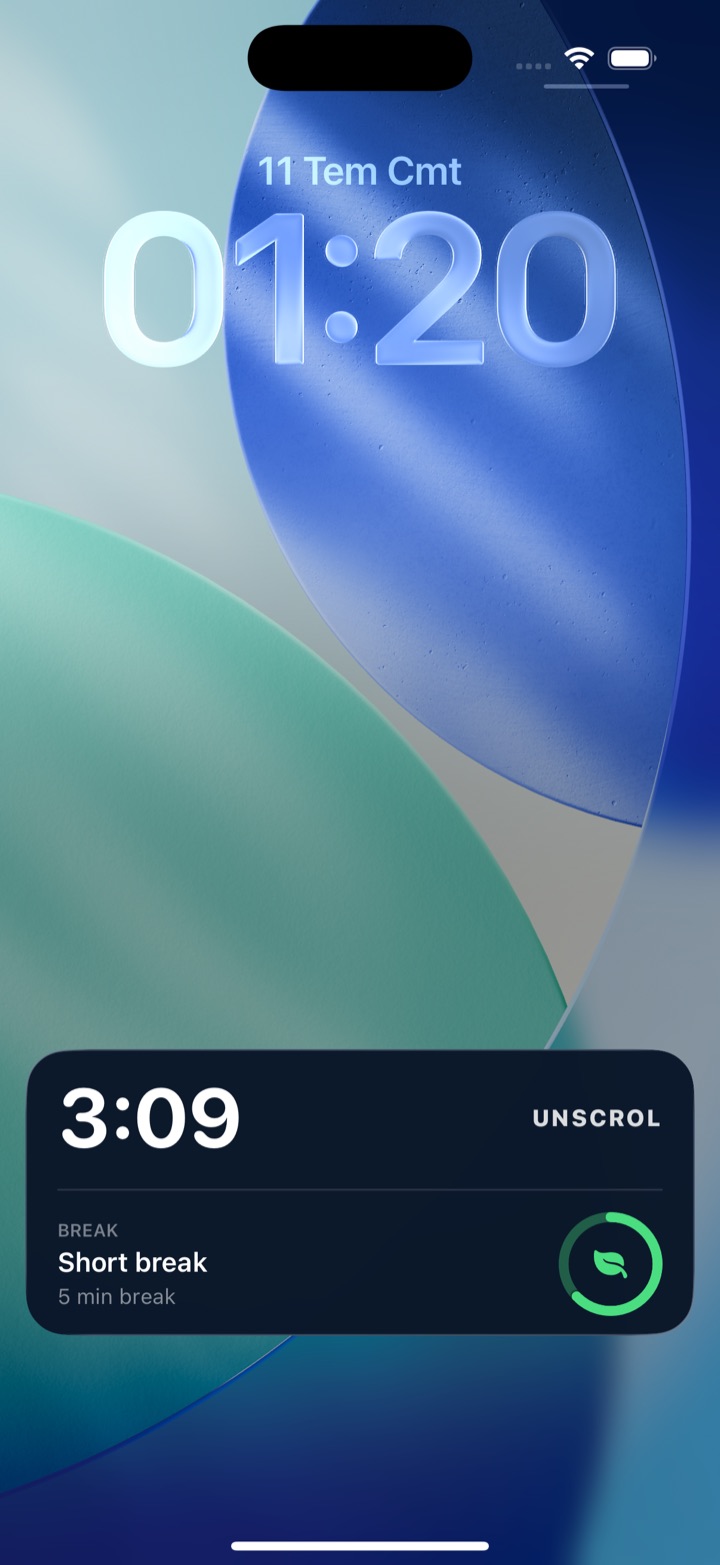
Unscrol is an iPhone and Apple Watch app built around two numbers instead of one. You set a daily total (45 minutes by default) and a per-session maximum (5 minutes by default), and iOS enforces both through the Screen Time and FamilyControls frameworks rather than a cosmetic overlay. Spend a session-sized chunk of the budget and the apps you chose lock for 15 minutes; spend the whole daily budget and they lock until tomorrow. That five-minute cap is the one that reaches into the bathroom, because it ends the sitting while you still remember why you sat down. A streak counts every day you stay under budget, and home-screen and lock-screen widgets show what is left without you opening anything. For placement, Shield blocks by time of day on a schedule you set, and turning it off mid-block is deliberately slow: a breathing exercise and a wait, not a one-tap dismissal.
Two caveats, plainly. The usage numbers are estimates, because iOS reports crossed thresholds across an interval rather than exact minutes, so treat the budget as approximately right rather than precise to the second. And iOS hands the app opaque tokens, never app identities: Unscrol cannot see which apps you picked, their names, their icons or your per-app usage. The system draws the app picker; the app only draws the frame around it, and block lists and usage data stay on-device. Free to download, with an optional premium tier adding Streak Saver for a missed day and five concurrent challenge slots instead of one.
Frequently asked questions
Is it bad to use your phone on the toilet?
It is worse than most people assume, for two reasons that have nothing to do with squeamishness. The first is time: a trip that should take three or four minutes routinely stretches to fifteen or twenty-five, because a feed has no natural ending and nobody is going to knock. The second is position, since sitting on an open ring for that long leaves the tissue around the anus unsupported and pooling with blood, which is the mechanism colorectal doctors point to when they talk about hemorrhoids in otherwise healthy young adults. The hygiene issue is real but ranks third, and it is mostly about where the phone goes afterwards rather than the bathroom itself.
How long is too long to sit on the toilet?
Most colorectal specialists give the same rough guidance: finish in under five minutes, and if nothing is happening, get up and come back later rather than waiting it out. The concern is not the toilet, it is prolonged sitting on a seat with a hole in it, which removes the support your body would normally have and lets pressure build in the veins around the anus. Straining while distracted makes it worse, because you are pushing without noticing that you are pushing. A phone is the single most reliable way to turn a four-minute visit into a twenty-minute one, which is why the advice has quietly shifted from how you sit to what you bring.
Can scrolling on the toilet actually cause hemorrhoids?
Colorectal doctors increasingly warn that it contributes, and the reasoning is mechanical rather than mysterious. Prolonged sitting on a toilet seat leaves the perineum unsupported, gravity pulls blood into the veins around the anus, and there is no counter-pressure to push it back, so the cushions of tissue there swell and eventually stay swollen. Do that for twenty minutes a day for years and you get a slow, cumulative version of an injury that used to take a very different lifestyle to produce. It is worth being precise, though: this is clinical observation and a well-understood mechanism, not a randomized trial, and phones are one contributor alongside low fiber, dehydration and straining.
How do I stop taking my phone into the bathroom?
Do not rely on willpower at the door, because the decision is made in about half a second and you will lose it. Give the phone a physical home outside the bathroom, ideally its charging spot, so leaving it behind is the default rather than a choice you have to keep making. Then fix the reason you are going in there, which is usually that the bathroom is the only break nobody questions, so build in two or three legitimate breaks where you can be unreachable without hiding. Finally, put a real time cue on the feed itself, because the underlying problem is that a feed does not end and you have nothing in the room telling you nine minutes have passed.