Livestreams take more hours out of a week than anything else on your phone, and almost nobody counts them. A short-form feed asks for twenty minutes. A show asks for forty-five. A stream asks for six hours, gets them, and never once announces itself as a session. It feels social rather than sticky, ambient rather than absorbing, and it plays through dinner and chores and bedtime like a radio you happen to love. The problem is not that you enjoy it. The problem is structural: a stream has no ending, so the leaving is always on you.

Why does a stream take hours when a video takes minutes?
Because there is nothing in the format that ends.
Every other thing you watch has a shape. A video has a progress bar you can see filling. An episode rolls credits, which is the most effective off-switch television ever invented: a stopping cue that arrives on its own, without you deciding anything. Even an infinite feed eventually numbs you out. Boredom does the work there, and you close the app without ever calling it a decision.
A stream has none of that. No runtime, no last page, no credits, and no reliable dull stretch to push you out, because the quiet stretches are exactly when the streamer starts talking properly and chat gets funny. The only external stopping cue is the streamer going offline, which happens on their schedule, usually late, and usually after you have already told yourself three times that you were about to go.
So every exit has to be a decision you make yourself, at the moment you least want to make it. That is the whole mechanism, and it is why the same person who can close TikTok after twenty minutes will sit through eight hours of someone else playing a game. How to stop watching YouTube deals with the autoplay version of this problem; live is the harder version, because there is no next video to decline. There is only the one thing, still going.
Where does an episode let you out, and where does a stream?
| An episode | A live stream | |
|---|---|---|
| Length known in advance | Yes, around 42 minutes | No, and it can run long |
| Stopping cue | Credits, automatic | Streamer goes offline, usually late |
| Cost of leaving | Nothing, you resume later | You miss the part that only happens once |
| While you are away | Nothing happens | Everything happens, and chat reacts to it |
| Who ends the session | The format does | You do, alone, over and over |
| Typical single sitting | 45 minutes | 3 to 8 hours |
The row that explains the six hours is the second-to-last one. With every other format, the medium eventually takes responsibility for stopping you. With a stream, that job was quietly handed to you and never handed back, and you are being asked to do it while tired, comfortable and mid-conversation.
Is it strange that I feel like I know them?
No. And treating that feeling as embarrassing tends to make it harder to change anything, so it is worth naming honestly.
Researchers described this in the 1950s, watching people form one-sided bonds with television hosts. Streaming took that and removed almost every asymmetry that used to keep it obviously one-sided. This person talks for six hours a day, unscripted, about ordinary things. They react in real time. They answer chat. Sometimes they read your name out loud and say something back to you specifically. Your brain files that under company, because from the inside it looks exactly like company.
And the fit is real. If your week is short on people who talk to you without wanting anything, a stream is a room that is always warm, always on, and never asks you to perform. That is not a character flaw. That is a reasonable response to a gap. The same shape shows up in AI chatbot addiction, where the pull is also less about content than about being reliably attended to.
The question worth sitting with is not whether the feeling is legitimate. It is whether the stream has become the only place you get it. If it is currently the most attentive voice in your week, that is information about the shape of your days, not a verdict on you.
Why does missing a stream feel like actually missing something?
Because on a live platform it genuinely is, and this is where live pulls harder than any recorded format.
A raid, a drop, a meltdown, a bit that becomes a running joke for two months: those happen once, in front of whoever showed up. The VOD keeps the footage and loses the thing you were there for, which was being one of the people it happened to. Miss enough of them and chat starts speaking a language you have to catch up on. Nobody excludes you on purpose. You just were not there.
That is a much sharper version of ordinary online FOMO, and it explains the behaviour that looks irrational from outside: keeping a stream open during a work call, during dinner, during a film you chose. You are not watching. You are staying present so you do not become someone who missed it.
What are six ambient hours actually costing?
Two things, and only one of them is obvious.
Sleep, first and by design. Streams run late because that is when the audience is free and the streamer is warmed up. The best hours of most streams are hours you should be asleep for, and the specific trap is that leaving at 1am costs you the ending, which does not exist, so there is no natural place to stop. This is the same machinery behind revenge bedtime procrastination, except a friendly voice is holding the door open.
Displacement, second and much quieter. This is the real cost. Six hours of ambient stream do not feel like a choice, so they never get weighed against anything. The gym, the phone call, the thing you said you would start this month: none of them ever lose an argument, because no argument is held. They simply do not come up, for the eleventh evening in a row. Compare that to gaming or scrolling, which at least feel like activities you decided on. Ambient watching gets to take the same hours without ever going on the record.
“The stream was just on. All day, every day, while I worked, while I ate, while I fell asleep. I never once thought of it as watching something. Then I checked Screen Time in April and it was forty-one hours in a week, and I genuinely thought the phone was broken. I still watch him. I watch two evenings a week now, on purpose, and I remember those two evenings, which I could not say about the forty-one hours.” — Marcus, warehouse supervisor, 24
Should I be worried about subs and donations?
Not automatically, but be honest with yourself about what the money is doing.
Sub, resub, gifted subs, donations with your message read out: these are designed as reciprocity, and reciprocity is the correct instinct in a friendship. Someone gave you six hours of company this week and asking for nothing feels wrong. That instinct is not a defect. It is just being run through a system where the friendship is one-directional and the transaction is not.
The practical test is the one you would use anywhere else money and feelings mix, as in doom spending: does the amount survive being said out loud, and would you rather have spent it on your own week? If you are gifting subs on a night you were already low, or the total for the month would surprise someone who knows you, that is the signal. Not the existence of the spending.
How do I watch less without quitting?
Nobody needs to quit. The goal is to convert an ambient habit into a chosen one.
Pick appointment streams over ambient ones. Choose two or three people you actually want and decide roughly when and how long. Watch those segments like a show, with a start and a finish you set. Everything else stays off, including the tab you keep open “in case”.
Decide: second screen or first screen. If it is genuinely background while you cook and fold laundry, fine, but then it is background and you do not sit down for it. If you would sit down for it, it is a first screen and it gets a start and an end time. The failure mode is the blurry middle, which is where the hours live. Same logic as using your phone while watching TV, where the half-attention is what costs you.
Protect two windows completely. No stream during meals, no stream after your sleep hour. These need no willpower once they are just what happens, and between them they remove most of the damage.
Mute chat for one full stream. This is the most useful experiment in the list. For a lot of people the pull turns out to be the room rather than the content, and finding that out changes what you do next, because a room is much easier to replace than a person you like.
Give the hours a budget, like any app. Not zero. A real number you would defend out loud, checked weekly. If you want a method for choosing it from your actual average rather than your aspiration, how to set a screen time budget does exactly that.
How does Unscrol help?
The honest starting point: you can get a decent distance for free. Apple’s Screen Time gives you daily App Limits per app or category, Downtime for scheduled windows, and a real weekly average that will probably surprise you. If seeing the number is enough to change what you do, use that and buy nothing. Where the built-in tools run out is specific to this habit. A daily limit dialog appearing at hour four of a stream is one tap from dismissed, and by default Screen Time limits can be ignored once reached. There is also no native per-sitting cap, so one eight-hour session and forty short check-ins look identical to iOS.
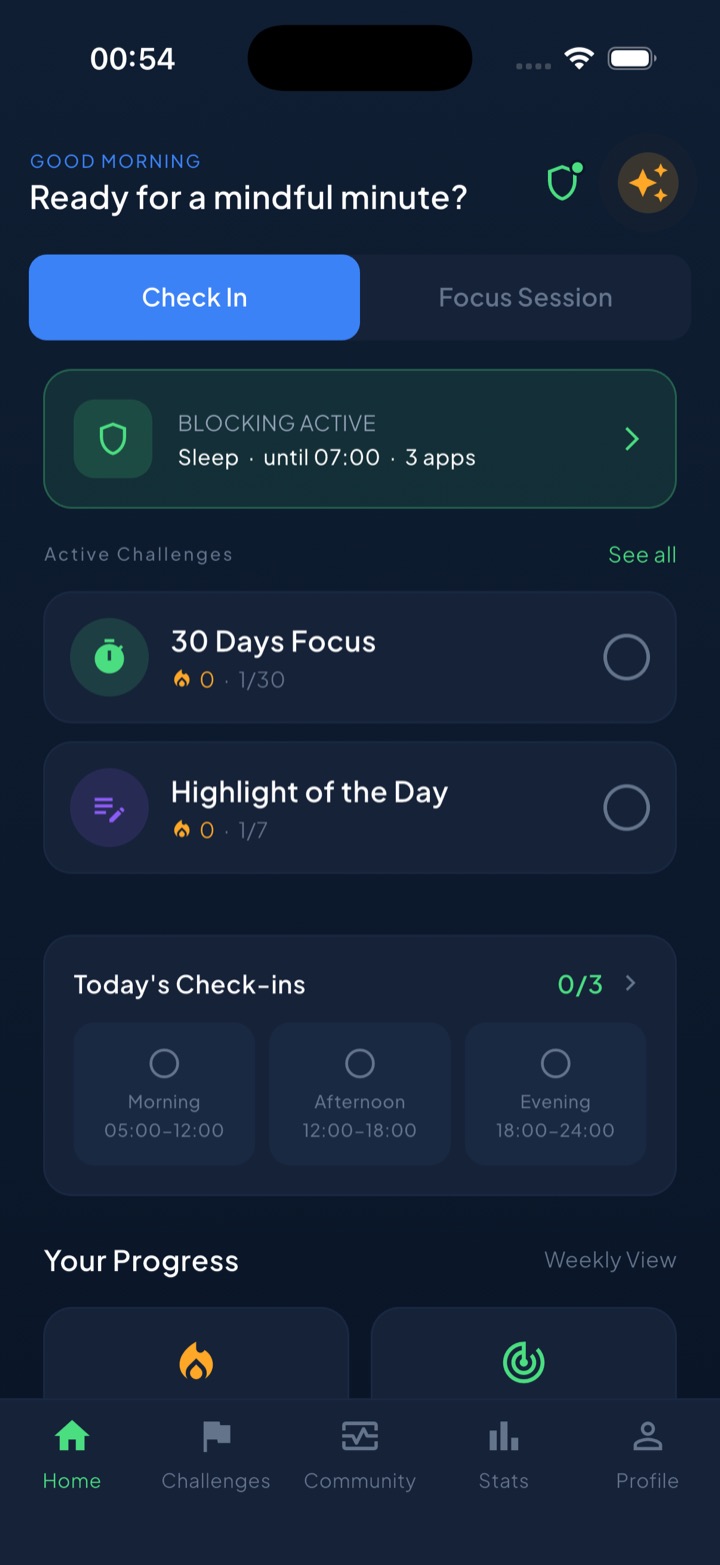
Unscrol is an iPhone and Apple Watch app built on Apple’s Screen Time and FamilyControls frameworks, so what you set is enforced by iOS rather than drawn as an overlay you can swipe away. You choose a daily total (45 minutes by default) and a per-session maximum (5 minutes by default) for the apps you pick. Spend a session-sized chunk of the budget and those apps lock for 15 minutes; spend the whole daily budget and they lock until tomorrow. That per-session number is the part that matters here, because it gives a stream the ending it refuses to give itself. For the hours rather than the volume there is Shield, scheduled blocking by time of day, and switching it off mid-block is deliberately slow: a breathing exercise and a wait, not a one-tap dismissal. An overnight Shield window protects exactly the hours streams are engineered to take. A streak counts every day you finish under budget, and home-screen and lock-screen widgets show what is left without you opening anything.
Two caveats, plainly. The usage numbers are threshold-based estimates, because iOS reports crossed thresholds across an interval rather than exact minutes, so treat the budget as approximately right rather than precise to the second. And iOS hands the app opaque tokens rather than app identities: Unscrol cannot see which apps you picked, whether a streaming app is among them, or what you do there. The system draws the picker; the app only draws the frame around it, and block lists and usage data stay on-device. Free to download, with an optional premium tier adding Streak Saver for a missed day and five concurrent challenge slots instead of one.
Frequently asked questions
Is watching livestreams for hours actually a problem?
It depends entirely on what those hours are displacing, not on the number itself. Six hours of stream while you cook, fold laundry and text friends is a different thing from six hours in which you meant to study, meant to call someone back and meant to sleep at midnight. The reason livestreaming deserves a closer look than most habits is the session length: a single sitting routinely runs three to eight hours, which is longer than anything else on your phone asks for. Judge it by the week you actually had, not by the total. If nothing you cared about got pushed out, you are fine.
Why is a livestream so much harder to stop watching than a TV show?
Because an episode has an ending built into it and a stream does not. Credits are the most effective off-switch television ever invented: a stopping cue that arrives on its own, without you deciding anything. A stream has no runtime bar, no last page and no credits, so every single exit has to be a decision you make yourself, in the exact moment you least want to make it. On top of that, leaving costs you something real, because whatever happens next only happens once and the chat will be talking about it tomorrow.
Is it unhealthy to feel like you know a streamer personally?
It is not unhealthy, and treating it as embarrassing usually makes it harder to change. What you are feeling is a real response to a real signal: someone is speaking in your direction for hours a day, reacting in real time, sometimes reading your name out loud. Your brain files that under company because that is what it looks like. The question worth asking is not whether the feeling is legitimate, it is whether the stream has become the only place you get that feeling. If it is currently the most attentive voice in your week, that is information about the shape of your days rather than a verdict on your character.
How do I watch fewer streams without quitting entirely?
Stop watching ambiently and start watching on purpose. Pick two or three streamers you genuinely want, decide roughly when and for how long you will watch them, and treat that like an appointment rather than leaving something running all day as background noise. Add two hard edges that need no willpower: no stream during meals and no stream after your chosen sleep hour. Then run one experiment, which is to mute chat for a full stream, because for a lot of people most of the pull turns out to be the room rather than the content.