The trip you scroll through is a trip you will partly not remember, and that is a memory problem before it is a willpower problem. You paid real money to be somewhere with different light, different food and a different sound outside the window at seven in the morning. Then you spent the first pool morning inside the same feed you read on your own sofa on a wet Tuesday. The phone is the one object in your bag whose entire function is to make your surroundings stop mattering, and you carried it to a place you chose specifically for its surroundings. Fixing this does not require a retreat in the woods. It requires about six rules, decided at home.

Why does scrolling on vacation feel worse than scrolling at home?
Because you paid for novelty, and the feed is the anti-novelty machine.
Travel works on you through unfamiliarity. Streets you cannot predict, a language you have to concentrate on, a breakfast you have to ask about. That effort is not a side effect of the holiday, it is the mechanism: unfamiliar days lay down more distinct memories, which is why one week somewhere new feels longer in retrospect than a month of identical commutes.
Now open Instagram in that hotel room. It is byte for byte what it was in your kitchen. Same accounts, same format, same algorithm trained on the person who never left. Being identical everywhere is not a bug in the product, it is the product. So the feed does not just take up holiday time, it actively cancels the thing you flew for.
There is a second reason, less flattering. Holidays are unstructured, and unstructured time is where the habit lives. At home the scrolling hides in the gaps between obligations. On a beach it is all gaps, so the habit expands to fill the whole thing, which is why people who are fine at work fall apart on day two of a trip.
Will I remember less of a trip I spend on my phone?
Yes, and the mechanism is boring rather than mystical. What you attend to during an experience is what gets encoded.
Memory is not a recording of what stood in front of you. It is assembled from what your attention was actually doing at the time, and dividing that attention while something is being encoded is one of the most replicated ways to weaken how well you recall it later. Standing in front of a harbour at dusk while your thumb is elsewhere writes down a thin, low-resolution harbour. The moment is not saved somewhere and lost, it was never fully written. If you want the longer version of how this plays out day to day, smartphones and memory covers the offloading habit underneath it.
This is also why the trip can feel long while you are inside it and then compress into four images by November. The parts that survive are the parts you were fully in.
Can I take photos, or is the camera the problem?
Take the photos. The camera is not the leak.
Taking a picture is a short interaction with an obvious ending, and framing a shot can genuinely sharpen what you notice about a place. What follows it is the problem. Sharing the photo means opening an app, the app opens on the feed rather than on your upload, and forty minutes later you are reading about a stranger’s kitchen renovation while a coastline waits behind your screen. Then the replies start, and you have just given yourself a reason to check the phone every twenty minutes for the remaining nine days.
The rule that works is simple: shoot all day, post at home. Nobody’s holiday photos are less good for arriving five days late, and the version you assemble on your own sofa is better than the one you panic-crop at dinner. The one carve-out is the group chat with the people you are travelling with, because that is logistics rather than feed. Everything else can wait.
How do I stop checking work email on holiday?
Start by naming the fear honestly. It is almost never a specific email. It is the ambient dread of the pile, and the suspicion that the pile is growing teeth while you are not looking.
Make the autoresponder mean it. “Limited access to email” is a sentence everyone including you knows is a lie, and it invites people to write anyway. Give the exact dates, name a colleague who can actually decide things rather than one who can only take a message, and state plainly that mail arriving in this window will not be read and should be resent afterwards. That last clause is what does the work, because it moves the pile off your return day.
Then allow yourself one designated check per day. Twenty minutes, a fixed time, a fixed place, and ideally the flat hour after lunch rather than the best light of the morning. The pattern that destroys holidays is “I will just glance”, because a glance has no ending and no ceiling on how often it repeats. A scheduled check has both. If it turns out the business cannot survive nine days without you personally, that is a staffing problem wearing a phone problem’s clothes, and it will still be there in the same shape when you get home, alongside the after-work shutdown ritual you have also never had, and the phone habits at work that made the holiday feel like an escape in the first place.
What is the actual kit for a phone-free trip?
Most vacation phone use does not start as scrolling. It starts as a task: maps, the ticket, the translation, the restaurant. Each one is a legitimate reason to unlock the phone, and every unlock is a door the feed walks through. So remove the tasks in advance.
| Set up before you fly | What it stops |
|---|---|
| Offline maps downloaded for the whole region | Unlocking to navigate, then still holding the phone twenty minutes later |
| Boarding passes and tickets in the wallet app or printed | Opening the airline app, which lives one swipe from Instagram |
| A few restaurants and one museum saved as a list | Evening research sessions that become evening feed sessions |
| Cash in the local currency for day one | The bank app being the first thing you open on arrival |
| A paper book, actually in the bag | Reaching for the phone because your hands are empty |
| Feed apps behind a block for morning and evening windows | Making the same decision forty times a day while tired |
On top of the kit, three rules do the rest. Airplane-mode mornings until you have finished breakfast, because the first unlock sets the tone for the whole day and mornings are when the light is best anyway. The phone lives in the hotel safe after dinner, which is the single highest-yield rule on this list and the one people resist most. And one paper book, because the honest reason you reach for the phone at the airport, on the bus and by the pool is that you need something to do with your hands.
“I flew to Lisbon and answered Slack from a rooftop for two hours on the first morning. Nobody had asked me to. On the next trip I put my work email off my phone entirely and checked it once a day at four in the afternoon from the hotel lobby. I came back with actual memories instead of a camera roll and a vague sense that I had been somewhere warm.” — Tom, agency account director, 36
Do I need a phone-free retreat?
Digital detox travel is a real industry now. Phone-free retreats, hotels handing you a lockbox at check-in, dumbphone vacations, silent weeks in the mountains. They work, in the narrow sense that any environment which makes a behaviour impossible works.
But look closely at what is being sold. It is not a technique. It is the removal of the decision, enforced by someone else’s box. You can remove the decision yourself, once, at home, in about ten minutes of packing. The retreat is genuinely worth it if you have tried the rules and cannot hold them, or if you want the company of thirty other people going through the same withdrawal. It is not worth it as a substitute for having any rules the other fifty-one weeks of the year.
The cheaper version is a weekly day without your phone at home. If one Sunday a month is survivable, a week abroad will be easy. If one Sunday is unthinkable, that is useful information to have before you have spent money on flights.
How do I get home without a re-entry binge?
Do not open the backlog on the flight home.
That flight is the worst possible place to do it. You are tired, you cannot act on a single thing you read, and the trip is still warm enough that the inbox will paint over it. You land having swapped the last honest hours of the holiday for anticipatory dread about Monday, and the emails have not moved.
Do this instead. On the flight, write down three things from the trip you want to keep: a meal, a conversation, a street at a particular hour. It takes four minutes and it converts a fading experience into something you can actually retrieve. Then open work when work opens, not before. Give yourself one slow first evening at home with no catch-up scrolling at all, because the backlog of other people’s weeks is not urgent and never was. A walk without your phone on that first evening does more for the re-entry than any amount of triage.
How does Unscrol help?
The honest starting point: Apple gives you most of this for free. Screen Time has daily App Limits per app or category, and Downtime for scheduled windows, so you can set a holiday schedule from the phone you are already holding without buying anything. If a bedtime schedule and a daily cap are enough to keep you off the feed for a week, you are done and should stop reading. Where the built-in tools run out is enforcement and shape: App Limits ship with a one-tap dismissal, and there is no per-sitting cap, so the mid-holiday version of you who is bored on a train can undo the whole thing without noticing.
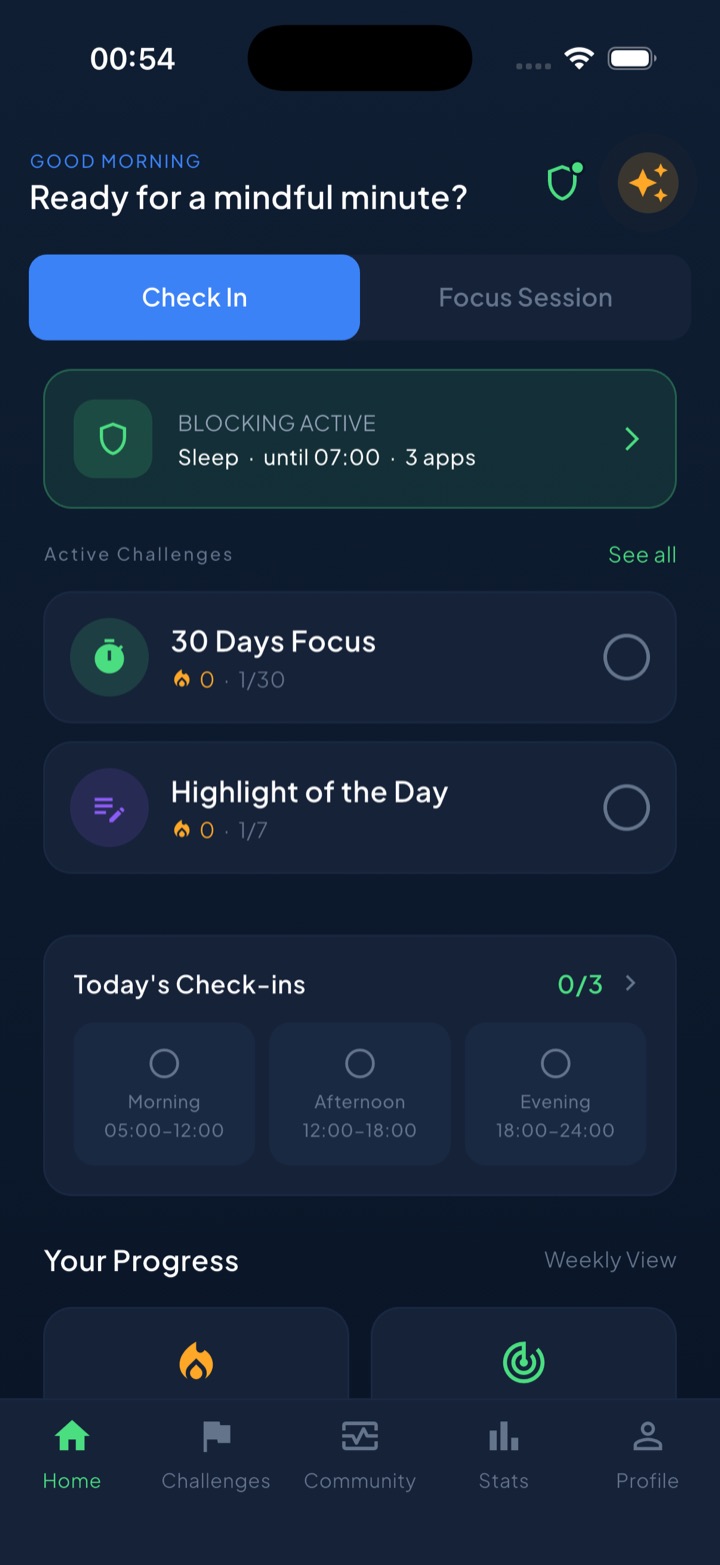
Unscrol is an iPhone and Apple Watch app built on Apple’s Screen Time and FamilyControls frameworks. For a trip, the piece that matters is Shield: scheduled blocking by time of day, so you can put a window over the morning and one over the evening. Maps, camera, wallet and messages stay exactly where they are while the feeds stay shut, which is the actual shape of the problem on holiday, since you do need the phone and only need certain apps to be unavailable. Switching a Shield window off mid-block is deliberately slow, a breathing exercise and a wait rather than a dismissal, which is the difference between a rule and a suggestion at ten at night on a hotel balcony.
The rest works the same way abroad as at home. You set a daily total (45 minutes by default) and a per-session maximum (5 minutes by default). Spend a session-sized chunk of the budget and the chosen apps lock for 15 minutes; spend the whole daily budget and they lock until tomorrow. A streak counts each day you stay under, and home-screen and lock-screen widgets show what is left without you unlocking anything.
Two caveats, plainly. The usage numbers are threshold-based estimates, because iOS reports crossed thresholds across an interval rather than exact minutes, so treat the budget as approximately right. And iOS hands the app opaque tokens rather than app identities: Unscrol cannot see which apps you picked, their names or your per-app usage, and block lists and usage data are processed on-device and never reach any server. Free to download, with an optional premium tier adding Streak Saver for a missed day and five concurrent challenge slots instead of one.
Frequently asked questions
How do I stop scrolling on vacation?
Decide the rules before you fly, because the version of you holding a cold drink by a pool will not invent policy. The three that carry most of the weight are airplane-mode mornings until you have eaten breakfast, the phone living in the hotel safe after dinner, and photos taken freely but posted only once you are home. Remove the functional reasons to unlock the phone in advance by downloading offline maps and putting boarding passes in your wallet app, because most vacation phone use starts as a legitimate task and turns into a feed. A paper book in your bag does more work than any app, because the real problem is that you have nothing else to hold.
Will I really remember less of a holiday if I spend it on my phone?
Probably, yes. Memory is not a recording of what happened in front of you, it is built from what you actually attended to, and divided attention at the moment of encoding is one of the most reliably documented ways to weaken later recall. Physically standing in front of a view while your thumb is somewhere else lays down a thin version of that view. This is also why the trip that felt long while you were living it can compress into three images by November, and why the parts you were fully present for are the ones that survive.
Should I stop taking photos on vacation?
No. Taking a photo is a short interaction with a clear ending, and framing a shot can even sharpen what you notice about a scene. The leak is the posting loop that follows, because sharing the photo means opening an app that opens on a feed, and the replies then give you a reason to check your phone every twenty minutes for the rest of the day. Shoot as much as you want and upload when you get home. Nobody's holiday photos are worse for arriving five days late.
How do I stop checking work email on vacation?
The fear is rarely a specific email, it is the ambient dread of what the unread pile will be when you land, so treat it as dread management rather than inbox management. Set an autoresponder that actually means it: give the dates, name a colleague who can genuinely decide things, and say that mail sent during this window will not be read and should be resent afterwards. Then allow yourself one designated twenty-minute check per day at a fixed time and a fixed place, ideally the flattest hour of the afternoon rather than the best light of the morning. A scheduled check has an end, whereas a quick glance has neither an end nor a limit on how often it happens.