You are not weak-willed. You have built the strongest habit loop you own, and you rebuild it three times a day. Meals are the most reliable idle minutes in your life: your hands are busy, your eyes are free, and the whole thing arrives on a schedule. Something was always going to fill that gap, and short-form video is very good at filling gaps. After a few years of pairing, the fork genuinely does not want to move until something is playing. That is a conditioned response, not a character defect, and conditioned responses can be undone in steps, without you ever having to eat a meal staring at a blank wall.

Why did eating and watching get welded together so tightly?
Because you practise this pairing more than any other habit you have.
Count it honestly. Breakfast, lunch, dinner: twenty-one repetitions a week, every week, for years. Nothing else in your life gets that kind of rehearsal. The gym gets three. Reading gets whatever is left. If you had trained any skill twenty-one times a week since you were a teenager you would be exceptional at it, and you are in fact exceptional at this one.
Meals also have a structural feature almost nothing else has: they occupy your hands and mouth while leaving your eyes and ears completely idle. That idle channel is the whole opportunity. It is the same reason scrolling during a film or a series is so common, except a meal leaves even more of you free.
Then there is the reward schedule. Food is already pleasurable, and you have layered a second, faster, more variable reward directly on top of it. Two hits arriving together train much harder than either one alone, which is the ordinary mechanism behind how social feeds shape your dopamine system. The pairing does not need willpower to maintain itself; it maintains itself.
The result is that the cue is no longer boredom. The cue is the plate. You did not decide to watch something. You sat down with food, and by the time you noticed, the video was already playing and you had already taken three bites you cannot remember.
Does watching something while you eat actually make you eat more?
Yes, and this is the part of the topic with the clearest evidence behind it.
Studies of attentive eating repeatedly find that people who are distracted during a meal eat somewhat more in that sitting. That result is real but modest. The striking one comes later: distracted eaters go on to eat noticeably more at the next snack or meal, hours after the screen is gone.
The mechanism is memory, which is the genuinely surprising part. Fullness is not purely a stomach signal. Feeling satisfied later in the day depends partly on remembering having eaten, and a meal consumed behind a screen leaves a very thin memory trace. Your stomach knows lunch happened. The part of you that decides whether you deserve a snack at four o’clock does not have a clear record of it.
You can test this on yourself without any equipment. Try to describe your last three lunches in detail. If most of them are a blur with a rough label attached, that blur is exactly the missing record.
Why does the food taste like less?
Because taste is built from attention, and you spent yours somewhere else.
Flavour is not delivered whole by the tongue. It is assembled from taste, smell, texture, temperature and expectation, and that assembly needs processing capacity. Give most of the capacity to a screen and the assembly is done cheaply. The meal still registers as food. It does not register as this food.
This is why people who cook for themselves and then eat behind a video often describe a specific, quiet disappointment: they did the work of making something good and received almost none of it. The calories arrive. The meal does not.
What does the habit cost once it hardens?
The solo version costs you a break. A meal is one of the few natural pauses left in a day, and a pause where your attention is fully occupied is not a pause. You stand up from lunch having rested nothing.
The social version costs more. It usually begins with one person answering a message at the table and ends with two people eating across from each other, each watching a separate screen, in a silence that both would describe as comfortable. That habit removes the most reliable shared half hour of the day without either person deciding to remove it, which is why a phone-free family dinner is worth defending even when everyone insists they do not mind.
Is “I can’t eat alone in silence” really about the video?
Mostly, no. It is about the silence.
A meal alone is one of the last situations where you have nothing to do with your eyes, nowhere to be, and no task to hide inside. That is untrained boredom tolerance at its most exposed, which is why the discomfort feels so much larger than the situation deserves. Ten minutes of quiet chewing should not feel like anything, and yet for a lot of people it feels unbearable in a way they find slightly embarrassing.
The good news is that boredom tolerance is trainable, and meals are a forgiving place to train it because they are short, they end on their own, and there is something pleasant happening the whole time. Why boredom is good for your brain covers what actually happens in those empty minutes, which is more than nothing.
How do I stop without hating every meal?
Do not go cold turkey. Silence at the table is the final rung, not the first one, and starting there is why most attempts collapse within two days.
Downgrade the stimulus instead. Move one rung at a time and stay there until it feels ordinary.
| Rung | What is playing | What it takes | Move down when |
|---|---|---|---|
| 1 | Video you actively watch | Eyes, ears, most of your attention | You can name the meal you just ate |
| 2 | Video playing face-down, audio only | Ears, some attention | You stop turning the phone back over |
| 3 | Podcast or audiobook | Ears, on your terms | You notice you have missed a paragraph |
| 4 | Music, radio, ambient sound | Almost nothing | The room feels less loud than the playlist |
| 5 | Nothing | Nothing | This is the destination, not the deadline |
Three more things make the ladder work.
The first-five-bites rule. The screen stays off until bite six. Five bites is short enough that you will actually do it and long enough to cover the part of the meal that tastes best. Most people find that some meals never get to bite six with a screen on, because the food turned out to be enough.
One screen-free meal a day, not three. Pick the smallest, least stressful one, usually breakfast. A single meal is a beachhead you can hold; three is a resolution you will abandon by Thursday.
Add friction with a plate. Eating out of the container while standing at the counter is a meal with no beginning, no end and no reason to put the phone down. Plating the food and sitting at a table gives the meal edges, and edges are what make the phone feel like an interruption rather than a natural part of it. If evenings are where this bites hardest, what to watch out for with short-form video explains why the format in particular is so hard to put down mid-meal.
“I lived alone for four years and I do not think I ate a single meal without something playing. Silence was the part I could not do, not the phone. I started with podcasts, then music, and now most lunches are just lunch. The strange thing is that I have started noticing when the food is actually good, which I had assumed was something I had always been doing.” — Daniel, junior developer, 26
How does Unscrol help?
The honest starting point: you can get some of this for free. Apple’s Screen Time gives you daily App Limits per app or category, Downtime for scheduled quiet windows, and a real weekly average to work from. If setting a daily number is enough to change how you eat, use it and buy nothing. Where the built-in tools run out is that meals are not a daily-total problem. They are a specific forty minutes, twice a day, where the phone needs to be the hard option rather than the default one, and a cumulative budget cannot express that.
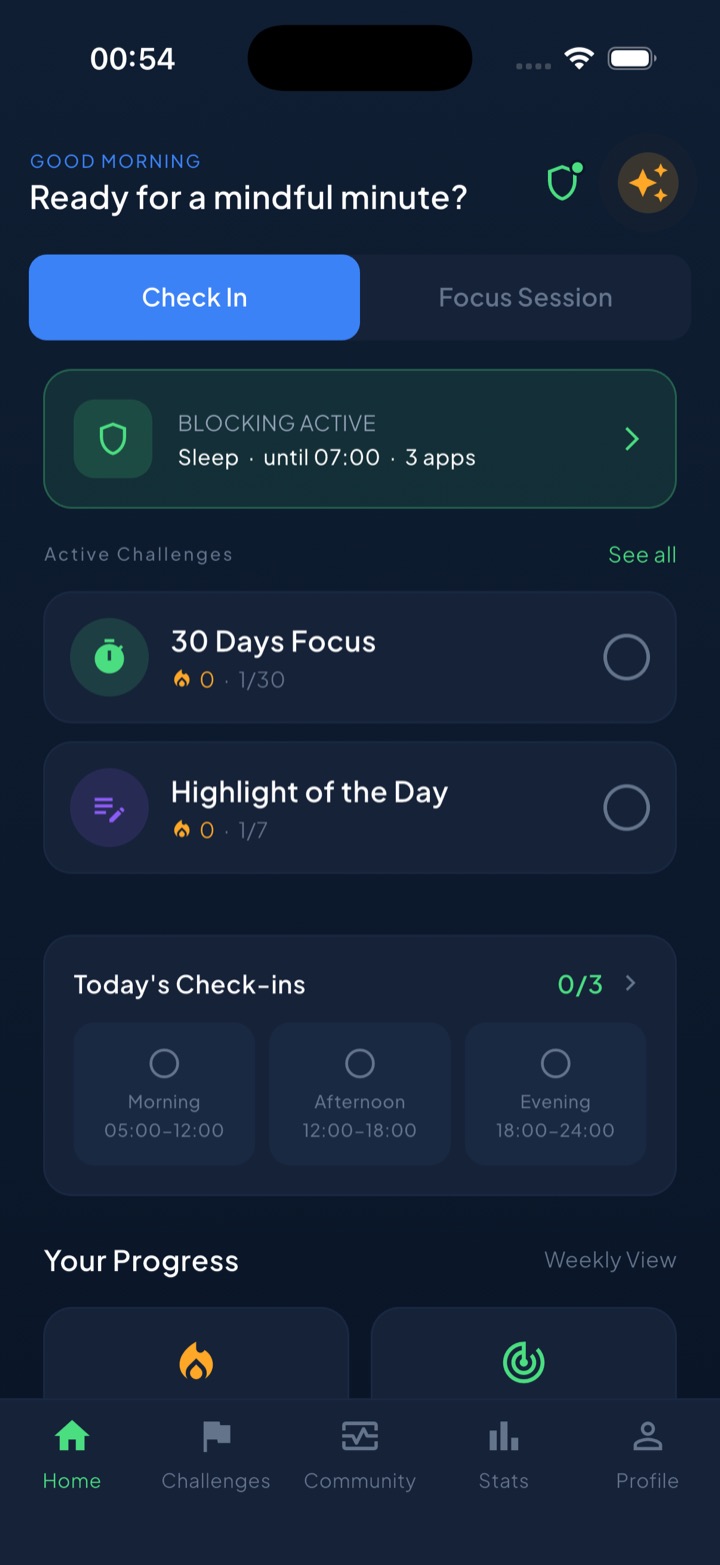
Unscrol is an iPhone and Apple Watch app that handles both halves. Shield is scheduled blocking by time of day: set a window over your usual lunch and dinner and the chosen apps are simply unavailable for those forty minutes, and switching it off mid-block is deliberately slow, a breathing exercise and a wait rather than a one-tap dismissal. For the rest of the day you set a daily total (45 minutes by default) and a per-session maximum (5 minutes by default), which is the number that ends the one-video-with-lunch that quietly became forty. Spend a session-sized chunk of the budget and the chosen apps lock for 15 minutes; spend the whole daily budget and they lock until tomorrow. A streak counts every day you stay under budget, and home-screen and lock-screen widgets show what is left without you opening anything. Enforcement runs through Apple’s Screen Time and FamilyControls frameworks, not a cosmetic overlay.
Two caveats, plainly. The usage numbers are estimates, because iOS reports crossed thresholds across an interval rather than exact minutes, so treat the budget as approximately right rather than precise to the second. And iOS hands the app opaque tokens rather than app identities: Unscrol cannot see which apps you picked, their names or their icons, and your block lists and usage data are processed on-device by iOS and never reach Unscrol’s servers. Free to download, with an optional premium tier adding Streak Saver for a missed day and five concurrent challenge slots instead of one.
Frequently asked questions
Why can't I eat without watching something?
Because meals are the most reliable idle minutes in your life and you have paired them with video roughly twenty-one times a week for years. Your hands and mouth are busy while your eyes and ears sit completely free, which is exactly the gap short-form video is built to fill. After enough repetitions the cue stops being boredom and becomes the plate itself, so the video starts playing before you have consciously decided anything. That frequency is why the habit feels so much stronger than habits you actually care more about, and it is also the reason it responds well to being downgraded in steps rather than quit outright.
Does watching videos while eating make you eat more?
Yes, and the effect shows up twice. Research on attentive eating consistently finds that people distracted during a meal eat somewhat more during that meal, and the larger finding is what happens afterwards: they eat noticeably more at the next snack or meal. The mechanism is memory. Feeling satisfied a few hours later depends partly on remembering what you ate, and a meal consumed behind a screen leaves a much thinner memory trace, so your body arrives at the next eating occasion without a clear record that lunch happened.
How do I stop watching something while I eat?
Do not go cold turkey, because silence at the table is the hardest version and most people bounce off it in two days. Downgrade the stimulus instead: move from video you watch to a podcast, from a podcast to music, from music to nothing, staying on each rung until it feels normal. Add the first-five-bites rule, where the screen stays off until bite six, so you always taste the beginning of the meal. One screen-free meal a day, usually the smallest and least stressful one, is a more realistic target than all three.
Is it bad to eat in front of a screen every single day?
It is not a moral failing and one distracted meal costs you very little. The problem is that a daily pattern quietly changes three things at once: you eat somewhat more without registering it, you taste less of what you paid for, and the meal stops working as a break because your attention never actually rested. The social version costs more than the solo version, since two people eating across from each other while watching separate videos slowly removes the only reliably shared half hour of the day.