Phone rules between partners hold when they name a place and a window rather than a behaviour, apply identically to both of you, and come with an agreed exception written in from the start. Most couples’ phone rules have none of those three properties, because most of them are written in the middle of an argument, by the person who is annoyed, about the person who is not. That version lasts about nine days.
This is about the other version: the boring, symmetrical, faintly bureaucratic kind that is still working in March. If you are still at the stage of naming what the behaviour does to a relationship, phubbing is the diagnosis. What follows is the prescription, written for two adults who have already had this argument at least twice.
Why does “put your phone away” fail as a rule?
Because it is not a rule. It is a request, aimed at one person, with no start time, no end time, and no way to tell afterwards whether it was followed.
Three things break it at once:
- It is unmeasurable. “Be more present” has no observable state. Neither of you can say at 9 pm whether today counted. A rule you cannot score is a rule you will argue about instead of keep.
- It points one way. It was written by the partner who minds more, about the partner who minds less. That makes it a standard one person is held to and the other administers, which is a management arrangement, not an agreement.
- It is enforced by nagging. The only enforcement mechanism available is the annoyed partner saying it again. So every use of the rule is a small conflict, and the rule ends up generating the friction it was written to prevent.
That last point matters more than it looks. In a 2016 study in Psychology of Popular Media Culture, Brandon McDaniel and Sarah Coyne surveyed 143 married or cohabiting women about “technoference” — everyday interruptions of couple time by phones, computers and TV. Those who reported more of it also reported lower relationship satisfaction, but in the model the path ran through conflict over technology use: more interruption, more arguing about devices, and it was the arguing that tracked with the drop in satisfaction. The study is correlational and surveyed only one partner by design, so it settles nothing about direction. It still points somewhere useful. If your rule produces a nightly argument about phones, the rule is not neutral. It is part of the cost.
The goal, then, is not a rule that stops phone use. It is a rule that stops the argument about phone use.
How do you write a rule about a place and a window instead of a person?
Swap every noun. Take the person out; put a room and a clock in.
“Be present at dinner” becomes “no phones on the table, from when food lands to when the plates go in the sink.” “Stop scrolling in bed” becomes “both phones charge in the kitchen from 11 pm.” “Don’t be on your phone the second you walk in” becomes “the first twenty minutes after either of us gets home, phones stay in the hall.”
Notice what changed. Nobody’s intentions are on trial. There is a room, a clock, and a physical place for the object. Either the phone is on the table or it is not. There is nothing to interpret, and so nothing to be defensive about.
This is not a relationship trick, it is a general finding about plans. Peter Gollwitzer and Paschal Sheeran’s 2006 meta-analysis in Advances in Experimental Social Psychology pooled 94 independent studies and found that intentions specified as concrete if-then plans — naming the situation, the place and the time in advance — produced a medium-to-large improvement in follow-through over intentions stated as general aims, with a mean effect size of d = 0.65. “I’ll be better about my phone” is a general aim. “When we sit down to eat, the phone goes on the shelf by the door” is the other kind.
Three windows do most of the work, roughly in this order:
- The table. Any meal you eat together, not only dinner. This is the one that changes the emotional temperature fastest, which is why phone-free meals are the most-recommended single rule in this whole category.
- The first twenty minutes after someone gets home. The reunion is a small ritual and phones flatten it entirely. Twenty minutes is short enough that nobody feels imprisoned and long enough to actually say something. If it is work following you through the door, a proper shutdown ritual does more here than any rule about the phone itself.
- The bedroom. More on that below. It has the largest payoff and attracts the most resistance.
Two windows nobody should attempt in month one: the whole evening, and all of Saturday. Both are too big to keep, and a rule you break is worse than no rule, because breaking it teaches you both that your agreements are decorative.

Why does a phone rule have to apply to both of you?
Because an asymmetric rule is not a rule, it is a ledger, and ledgers get consulted during fights.
The moment one of you is exempt — because you use your phone for work, or use it less, or use it “differently” — the rule stops being a shared standard and becomes a running record of one person’s failures. Every slip is now evidence. The exempt partner has no stake in it, so they enforce it as a favour, and being enforced as a favour is intolerable across months.
Symmetry also fixes a quieter problem. The partner who minds less usually has no idea how often they do it, because nobody notices their own glances. Living under the same rule is the cheapest way to find out. Plenty of people agree to phone-free meals mainly for their partner’s benefit, reach for the phone twice in the first week, and are genuinely surprised.
There is one honest-looking exception to symmetry, and it is not really an exception: if one of you is on call, the rule still applies to both of you and the on-call person uses the exception clause, out loud, in advance. That is a different thing from standing permanently outside the rule.
Here is the pattern in the form it keeps taking:
| The rule that fails | Why it fails | The version that holds |
|---|---|---|
| ”Stop being on your phone so much” | No place, no time, and no way to tell whether it was followed | ”No phones on the table from when food lands to when the plates go in the sink" |
| "Be present when I’m talking to you” | Judges intent, which is unobservable, so it becomes an argument about character | ”First twenty minutes after either of us gets home, phones stay in the hall" |
| "No phones in bed” | Sounds concrete, but has no start time and no plan for the alarm | ”Both phones charge in the kitchen from 11 pm; there is a clock on the nightstand" |
| "Don’t check work messages at dinner” | Points at one person, and dies the first time they legitimately have to | ”Neither of us answers work between 7 and 9, unless one of us is on call and says so at the start of the week" |
| "Put it away when I ask” | Enforcement is nagging, so every use of the rule costs a small fight | ”Either of us can say ‘table rule’ once, and the other puts it down without discussion” |
The right-hand column reads like a lease. That is the point. Boring, checkable, mutual.
What counts as a legitimate exception, and why agree on it first?
The exception clause is what makes the rest of the rule enforceable, and almost nobody writes one, which is why almost every phone rule dies the same way: something real happens, the rule is broken for a good reason, and it never comes back.
Real reasons exist. On-call shifts. A parent in hospital. A kid at a sleepover with a phone. A job where a 7 pm call genuinely cannot go unanswered. A rule that pretends otherwise gets broken inside a fortnight, and the first legitimate break provides cover for every illegitimate one after it.
So write the exceptions alongside the rule, while nobody is annoyed:
- Name the cases. Not “emergencies” — that word does no work at all. “My mother is in hospital.” “I’m on call Tuesday and Thursday.” “The kids are away overnight.”
- Name the shape. The phone stays face-up on the table for that one meal, or in a pocket on silent with a single contact allowed through, or gets checked once between courses. A specified exception is small. An unspecified one swallows the evening.
- Announce it in advance. “I’m keeping my phone on tonight, the ward might call.” One sentence, before the meal, not a defence produced afterwards. The announcement is what makes it an exception rather than a breach.
- Give it an end. “Until Thursday.” An exception with no end date quietly becomes the new rule.
The counterintuitive result is that couples who write generous exception clauses break the rule less often than couples who write strict ones. A rule with no legitimate escape hatch gets broken illegitimately, and a rule that has been broken illegitimately is one neither of you trusts any more.
What if one of you cares far more than the other?
This is the common, real version of the problem, and it is the version most advice quietly skips.
Start by not treating the gap as a defect. Two people can genuinely have different tolerances for divided attention. The partner who is untroubled by a phone on the table is not lying about it, and the partner who finds it corrosive is not being dramatic. What you are negotiating is not who is right about phones. It is whose comfort sets the default in shared time.
A few things help:
- Ask for less than you want. Ask for the whole evening and you get an argument and no rule. Ask for one meal and you will probably get it. A small rule that is kept is worth more than a large one that is resented, and you can widen it in a month.
- Trade, explicitly. Shared time is negotiable in both directions. “Phones off the table at dinner” is much easier to agree to when it arrives with “and I stop commenting on your phone at every other hour of the day.” That second half is a genuine concession, and it is usually the thing the other person actually wants.
- Give up the surveillance. If you have asked for a rule, you have to stop keeping score outside it. You cannot have the rule and the running commentary; asking for both is how you end up with neither.
- Say what it costs you once, without the word “always.” “When you check your phone while I’m mid-sentence, I stop bothering to finish the sentence” is information. “You’re always on your phone” is a charge, and charges get defended rather than answered.
If a small, symmetrical, one-meal request still gets a flat no, that is worth noticing — but it is then a conversation about the relationship, not about the phone.
What do you say the third time it slips?
You say the rule’s name, once, and then you drop it. The third slip is a maintenance event, not a trial.
Agree on the wording before you need it. Two words, neutral, decided in advance: “table rule.” “Hall rule.” Anything works as long as it is short, contains no adjective, and is available to both of you. The agreed phrase does something a sigh cannot: it separates the reminder from the accusation, so nobody has to work out whether they are in trouble.
Then the harder half — no scoreboard. Do not count slips out loud. Do not bring up last Tuesday. A rule with a tally attached becomes a grievance, and the grievance ends up heavier than the original problem. If the same slip keeps happening in the same place, the rule is wrong rather than the person: move the phone further away, shrink the window, or drop that rule and pick a different one.
John Gottman’s lab is the usual citation at this point. From observations of newlywed couples in the 1990s, Gottman reports that partners still together six years later had turned toward each other’s small bids for attention around 86 percent of the time, against roughly 33 percent among those who had divorced. Handle the exact figures carefully: they come largely from his own lab and his popular books rather than independent replication, they describe a correlation rather than a cause, and some of his affective models have not held up well in other samples. What survives the caveats is the unglamorous part — the unit that matters is the small turn toward, not the big talk. Which is precisely why the response to a slip should be cheap. An expensive response makes you both avoid the topic, and avoidance is how rules quietly lapse.
Why is the bedroom the rule that pays off most?
Because it is the one window where the phone is competing with sleep rather than with conversation, and sleep is upstream of everything else you are trying to fix.
The mechanics are dull and effective. Both phones charge somewhere that is not the bedroom, from a fixed time. Buy a cheap alarm clock, because the alarm is the excuse everybody reaches for and it costs about the price of two coffees to remove. If a phone must be in the room, it goes across the room rather than on the nightstand, since the reach from the pillow is the actual behaviour you are trying to stop.
This is also where symmetry earns its keep. Bedroom phone use is rarely one-sided for long: the partner who stays up scrolling and the partner who wakes at 3 am and checks are the same habit at different hours. And it has the clearest knock-on benefit, since what screens do to your sleep shapes the next day’s patience, which shapes how every other rule goes.
Give it two weeks before you judge it. The first three nights are unpleasant and not representative.
What does a starter agreement look like?
Five rules, written in the neutral form, adoptable tonight. Take three of them, not five.
- No phones on the table for any meal we eat together, from when food lands to when the plates are cleared. Phones go on the shelf by the door, not face-down beside the plate.
- For the first twenty minutes after either of us gets home, phones stay in the hall. Coats off, kettle on, talk. After that, do whatever you like.
- Both phones charge outside the bedroom from 11 pm. There is a clock on the nightstand. Whoever comes to bed later brings both.
- Either of us can say “table rule” once. The other puts the phone down without discussion, and neither of us mentions it again that evening.
- Exceptions are announced in advance and have an end date. On call, a sick relative, a child away overnight. Said before the meal, not after the phone is already out.
Note what is not in there: no daily screen-time targets, no comparing weekly reports, no numbers at all. Rules about each other’s totals are surveillance, and surveillance is the part that eventually gets resented.
“We had the same fight about eleven times before we wrote anything down, and what finally worked was almost insultingly simple. The phones live in a bowl by the door during dinner, and it applies to me exactly as much as to Sam. The first week I reached for mine constantly and had to admit I was worse than I’d assumed. The real change was that we stopped having the argument. The rule takes the position, so neither of us has to.”
— Rowan, 39, pharmacy technician
How do you keep the agreement from depending on being watched?
By making the phone harder to use during the window, instead of making your partner the enforcement mechanism.
Most of this is free. iOS Focus modes silence the apps you name on a schedule, Settings > Screen Time > Downtime greys them out during fixed hours, and the highest-yield move of all — putting the phone in another room — costs nothing. Start there. If a bowl by the door solves it, you do not need software.
Unscrol is for the case where the window keeps getting renegotiated at 8:40 pm. It is an iPhone app built on Apple’s official Screen Time frameworks, so a block is a system-enforced shield rather than a reminder you can swipe past, and switching it off mid-window takes a breathing exercise and a wait rather than one tap.
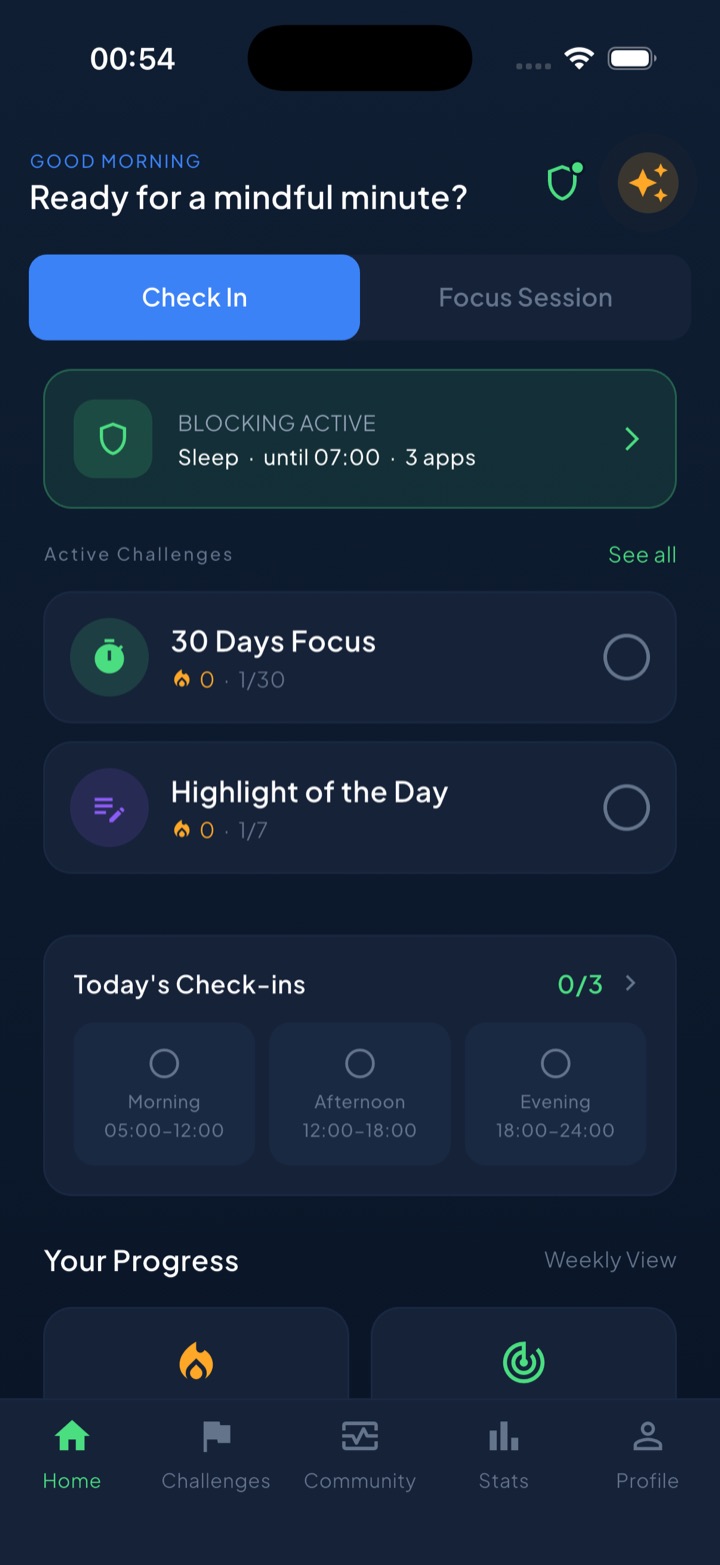
For couples the useful part is the arrangement rather than any single feature: you each run your own budget on your own phone, with your own daily limit on your own chosen apps, and neither of you can see the other’s list. iOS hands the app opaque tokens rather than app names, so it could not report on your partner even if it wanted to. That is the whole point. The rule stops depending on being watched, which is the failure mode this article started with. You both keep the same window; neither of you administers the other.
What phone rules cannot fix
They cannot fix a phone that is a symptom. If one of you is on the phone because home is where the unfinished argument lives, the rule will be kept perfectly and nothing will improve — you will just have two people not looking at phones and still not talking. Worth saying plainly, once: if the phone is a proxy for something larger, the phones are not the thing to fix, and a couples therapist will get further than a bowl by the door.
They also will not survive a life that genuinely does not permit them. Rotating shifts, a newborn, a business with nobody else to answer the phone: sometimes the honest answer is a much smaller rule — one meal a week, not every meal — kept properly, rather than an ambitious one broken daily.
And they will do nothing at all for the person who did not agree. A rule adopted by one partner and announced to the other is a policy, and policies get resisted on principle regardless of their merits. If you cannot reach a genuine yes, write nothing down yet and have the other conversation first.
What they can do is take a recurring argument out of your evenings and put twenty quiet minutes back into a day that had none. That is a smaller claim than most advice in this area makes, and it is roughly what tends to happen.
Frequently asked questions
What are good phone rules for couples?
The rules that survive name a place and a time rather than a state of mind, and apply to both partners identically. Three cover most of the ground: no phones on the table during any shared meal, phones stay in the hall for the first twenty minutes after either partner gets home, and both phones charge outside the bedroom after a fixed hour. Add a short agreed phrase either partner can use as a reminder, and an exception clause naming the situations that legitimately override the rule, such as on-call shifts or a relative in hospital. Adopt two or three, not all of them, and keep the windows small enough that neither of you resents them.
How do I get my partner to stop being on their phone all the time?
Ask for less than you want, and ask for it as a shared rule rather than a restriction on them. A request covering one meal is likely to be agreed to; a request covering every evening will produce an argument and no rule at all. Make it symmetrical, because a rule only one person is held to becomes a record of their failures and gets resented within weeks. Trade something real: agree to stop commenting on their phone use outside the agreed window, which is usually what they want in return. Describe the effect on you once, in specific terms and without the word always, then stop. If a small mutual request still gets a flat refusal, the disagreement is about something other than phones.
Should couples keep phones out of the bedroom?
It is the rule with the largest payoff, because there the phone competes with sleep rather than with conversation, and sleep affects everything the next day. The practical version is that both phones charge in another room from a fixed time, and a cheap alarm clock sits on the nightstand, since the alarm is the reason most people give for keeping a phone within reach. If the phone has to stay in the room, put it across the room rather than beside the bed, because the reach from the pillow is the behaviour worth blocking. Expect the first three nights to feel strange, and do not judge the rule until two weeks in. Like every other rule, it has to apply to both of you.
What should you do when a phone rule keeps getting broken?
Treat repeated slips as evidence about the rule rather than evidence about the person. Agree in advance on a short neutral phrase either partner can say once, with no adjective attached, then let it go without further comment that evening. Do not keep a tally and do not raise previous slips, because a rule with a scoreboard attached turns into a grievance heavier than the original problem. If the same slip keeps happening in the same place, change the setup instead: move the phone further away, shorten the window, or replace the rule with a smaller one you will actually keep. And check whether the rule has a workable exception clause, since most rules break for the first time for a genuinely good reason and are then quietly abandoned.